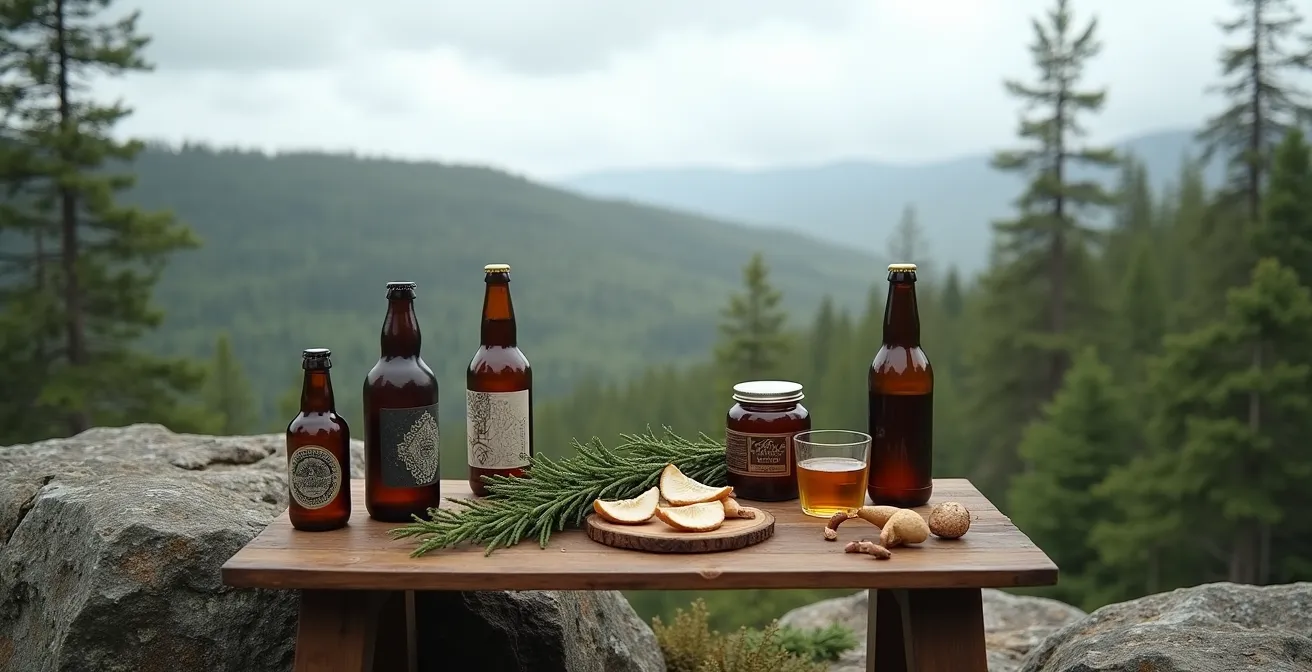
The unique flavour of Quebec craft beer comes from a philosophy of ‘brewing survivance’—transforming the rugged northern landscape itself into distinctive taste profiles.
- Wild-foraged botanicals like spruce tips and Labrador tea introduce resinous, peppery, and floral notes impossible to replicate elsewhere.
- Cold-hardy hop varieties and alternative grains (buckwheat, millet) are embraced for their unique character, not as substitutes.
Recommendation: To truly understand the difference, seek out beers that explicitly mention local, foraged ingredients or spontaneous fermentation—this is the heart of Quebec’s terroir.
Take a sip of a world-class American IPA, and you’ll likely taste a bright, citrusy wave of hops from the Pacific Northwest. It’s a familiar, delicious profile. Now, take a sip of a top-tier Quebecois ale. The experience is different. Alongside the malt and hops, you might find a whisper of pine forest, a subtle peppery spice, or an earthy depth that tastes wild and ancient. Many will say it’s the “local ingredients” or the “French influence,” but this only scratches the surface. The real difference isn’t just a list of additives; it’s a deeply ingrained brewing philosophy shaped by the landscape itself.
This philosophy is a form of brewing survivance: the art of creating something exceptional not in spite of a harsh northern climate, but because of it. It’s about looking at the boreal forest, the windswept coastline, and the short growing season not as limitations, but as a unique pantry of flavours. American craft beer often focuses on perfecting established styles with high-quality, readily available ingredients. In Quebec, the vanguard of brewing is about expressing a sense of place, a “goût du terroir” that is untamed, complex, and utterly distinct. This approach has fueled a vibrant scene, with some analyses suggesting that Quebec beer sales reached 154.6 million Canadian dollars in recent years, reflecting a strong local and growing external demand for these unique flavours.
This guide delves into the core of that difference. We will explore the botanical alchemy that turns forest floor ingredients into nuanced aromas, understand how the cold shapes the very genetics of Quebec hops, and see why an obsession with freshness is more than a trend. Ultimately, you will learn to taste the story of Quebec’s rugged landscape in every glass.
Summary: What Makes Quebec Craft Beer Taste Different From American Beer?
- Spruce Tips and Labrador Tea: What Do They Actually Taste Like in Beer?
- Can Quebec Grow Good Hops Despite the Cold?
- Why You Should Drink That NEIPA Within 3 Weeks?
- Millet or Buckwheat: Are Quebec’s Gluten-Free Beers Actually Good?
- Scotch or Bourbon Barrels: How Wood Affects the Price of Your Bottle?
- The Beer Passport: Is It Worth It for Casual Drinkers?
- Grand Cru vs. Industrial: How to Spot Real Charlevoix Lamb?
- How to Buy Authentic Products on the Flavor Trail Without Tourist Traps?
Spruce Tips and Labrador Tea: What Do They Actually Taste Like in Beer?
The first and most striking distinction in Quebec beer is the masterful use of wild, foraged botanicals. This isn’t about novelty; it’s a practice of botanical alchemy, turning the boreal forest’s offerings into complex layers of flavour. American brewers might use fruit or spices, but the Quebecois approach often involves ingredients that directly evoke the northern wilderness. Two prime examples are spruce tips (épinette) and Labrador tea (thé du Labrador).
Spruce tips, harvested in the spring when they are tender and bright green, don’t make a beer taste like a pine-scented cleaner. Instead, they impart a vibrant, slightly resinous character with surprising notes of citrus, mint, and even tropical fruit. In contrast, Labrador tea, a plant from the rhododendron family, introduces a wonderfully complex profile that is floral, peppery, and slightly tannic, reminiscent of a fine herbal tea with hints of orange peel and spice. When used by a skilled brewer, these ingredients add a dimension of flavour that is both unique and deeply tied to the land.
A brewery that perfectly embodies this philosophy is Brasserie Auval in Gaspésie’s Val-d’Espoir. Founder Benoît Couillard has built a reputation on creating beers that are a pure expression of their local environment, frequently using wild yeast and foraged ingredients. His creations are not just beers with added flavours; they are integrated, complex beverages where the terroir is the star. This is the taste of Quebec: not just malt and hops, but the forest itself.
Can Quebec Grow Good Hops Despite the Cold?
The American craft beer scene is dominated by hops from the Pacific Northwest—varieties like Cascade, Citra, and Mosaic, known for their powerful grapefruit, mango, and pine notes. Quebec’s climate is far too harsh for these popular varieties to thrive. Rather than seeing this as a disadvantage, Quebecois hop growers and brewers have embraced the challenge, cultivating and celebrating varietals that carry the “stamp of the cold.”
The shorter growing season and cold winters stress the hop plants in a way that fundamentally alters their chemical composition, especially their terpene profile—the aromatic compounds that define a hop’s flavour. While they may lack the bombastic tropical fruitiness of their American cousins, Quebec-grown hops often develop a more nuanced and complex character. They tend to exhibit more spicy, floral, earthy, and resinous notes. Varieties that can withstand the cold, like Rakau or a hardy local Chinook, express themselves differently here than they would in Washington or Oregon. This terroir-driven profile gives Quebec IPAs a distinctive backbone that is less about juice and more about aromatic complexity.
This resilience is a testament to the agricultural innovation within the province. Seeing these plants endure the northern climate gives a brewer a deep respect for the ingredient. The resulting beer carries a signature that is uniquely Quebecois.

As the image suggests, the relationship between the hop and its cold environment is one of resilience. This hardiness translates directly into the cup, creating flavours that are sharp, defined, and unmistakably northern. The goal isn’t to imitate the American West Coast, but to create a new benchmark for what a “Northern IPA” can be.
Why You Should Drink That NEIPA Within 3 Weeks?
While many brewing traditions in Quebec lean on history and aging, the province has also fully embraced the modern, ultra-fresh New England IPA (NEIPA). Here, the difference from American interpretations is less about ingredients and more about a fanatical devotion to the beer’s ephemeral nature. A great Quebec NEIPA is a fleeting experience, and the best brewers and bars treat it as such. You are expected to drink it, and drink it now.
The reason is hop oxidation. The hazy, juicy character of a NEIPA comes from massive quantities of hops added late in the brewing process (“dry hopping”). The aromatic oils responsible for the vibrant notes of passionfruit, peach, and orange are incredibly volatile and sensitive to oxygen and time. Within weeks, these bright flavours begin to degrade, replaced by a generic, sometimes unpleasant “hop burn” or a dull, cardboard-like taste. While this is true for all NEIPAs, the Quebec scene has a particularly strong culture of respecting this timeline.
Top breweries like Montreal’s Messorem Bracitorium, crowned Quebec Brewery of the Year in 2023, have built their reputation on this principle. They brew exceptional hop-forward beers and create an environment where they are consumed at their absolute peak. Cans are date-stamped not as a suggestion, but as a firm guideline. This philosophy of peak consumption extends to other styles too, like their heavily fruit-forward smoothie sours served fresh from slushy machines. It’s an understanding that for certain styles, freshness isn’t a feature; it’s the entire point.
Millet or Buckwheat: Are Quebec’s Gluten-Free Beers Actually Good?
In the world of gluten-free (GF) beer, the common approach, particularly in the U.S., has been to find the most seamless substitute for barley, often using sorghum or rice to create a product that mimics traditional beer as closely as possible. In Quebec, however, the philosophy is different. It’s an extension of the “pantry philosophy”—embracing alternative grains for their own intrinsic character rather than viewing them as mere stand-ins.
This has led to a pioneering use of grains like millet and buckwheat (sarrasin). Instead of trying to hide their unique flavours, Quebec brewers celebrate them. Buckwheat, which is not a wheat but a fruit seed related to rhubarb, imparts a distinct nutty, earthy, and slightly rustic flavour. Millet offers a smoother, sweeter profile with notes of corn and honey. The resulting GF beers are not just “good for gluten-free”; they are genuinely interesting beers in their own right, with flavour profiles you won’t find in barley-based ales. This willingness to innovate and redefine a category is a hallmark of the province’s craft scene.
This spirit of innovation is not just anecdotal. Quebec has positioned itself as a leader in the Canadian gluten-free beer space, driven by this creative use of alternative grains. As the following data shows, the province’s approach has set it apart.
| Region | GF Beer Adoption | Alternative Grain Usage | Market Growth |
|---|---|---|---|
| Quebec | Leading innovator | Buckwheat, millet prominent | Strong growth |
| Ontario | Growing market | Traditional alternatives | Moderate growth |
| Rest of Canada | Emerging | Limited options | Slow adoption |
As confirmed by market analysis from sources like a recent Mintel report on Canadian craft beer, Quebec’s role as a leading innovator is evident. This isn’t about removing an ingredient; it’s about building a new identity from the ground up, a principle that resonates deeply within the province’s brewing culture.
Scotch or Bourbon Barrels: How Wood Affects the Price of Your Bottle?
Barrel-aging is a revered practice in both American and Quebecois brewing, but the context and economic realities are quite different. While an American brewer might source bourbon barrels from a nearby Kentucky distillery, a Quebec brewer has a wider, more international palette to draw from, including scotch, cognac, and local icewine barrels. The choice of wood—American oak for bourbon’s vanilla and coconut notes versus French oak for scotch’s spicy, tannic structure—profoundly affects the final beer’s profile.
Furthermore, the “stamp of the cold” plays a crucial role here as well. Many Quebec breweries age their barrels in less-insulated spaces, subjecting the wood to significant temperature fluctuations between the hot, humid summers and frigid winters. This causes the wood to expand and contract more dramatically, accelerating the interaction between the beer and the barrel’s character (and its previous contents). The result can be an aged beer of incredible complexity, developed over a shorter period.
Interestingly, despite the often-higher cost of imported barrels and the intensive process, the price of these premium Quebec beers can be surprisingly competitive. This paradox is largely due to the province’s distribution and retail system. According to an analysis by Le temps d’une bière, Quebec offers the lowest prices for 12- and 24-pack cases, averaging approximately $21.18 and $37.93 respectively. The same publication notes that “Quebec benefits from a broader retail and distribution system, with a greater variety of business models that provide more cost flexibility.” This efficiency allows brewers to invest more in quality ingredients and processes like barrel-aging without passing on exorbitant costs to the consumer. It’s a system that prioritizes access and quality.
The Beer Passport: Is It Worth It for Casual Drinkers?
For any beer geek visiting Quebec, the idea of a “beer passport” or a guided brewery tour is tempting. It promises a curated path through the province’s rich brewing landscape. But is it a valuable tool for discovery or just a gimmick for tourists? For the casual drinker, the value might seem questionable, but for someone looking to understand the terroir we’ve discussed, it can be an indispensable tool.
The primary benefit of a well-designed tour isn’t just the quantity of beer; it’s the context. Guides are often deeply knowledgeable and can connect the dots between a beer’s flavour and the local stories, ingredients, and brewing philosophies behind it. They can take you from a pilsner at one stop to a wild-fermented ale at the next, explaining the vast difference in approach. This is education by immersion.
Take, for instance, the Broue-Tours in Quebec City’s Saint-Roch neighbourhood. For a set price, participants visit several key microbreweries. A tour might include a stop at La Barberie, a pioneering co-operative brewery, to taste their anniversary Pilsner Bohemienne, followed by a visit to Korrigane to try their Mielrose, a beer made with urban honey from Quebec City rooftops. This isn’t just a pub crawl; it’s a narrative. You are tasting the “Je Bois Local” (I Drink Local) movement in action. For a casual drinker, it’s a fun afternoon. For a beer geek, it’s a direct line to the heart of the local scene, providing access and stories you might not find on your own.
Key Takeaways
- The defining characteristic of Quebec craft beer is its use of wild botanicals, creating a “Boreal Terroir” with notes of pine, pepper, and earth.
- The cold climate is not a limitation but a tool, shaping unique hop profiles and intensifying the barrel-aging process.
- The brewing philosophy prioritizes expressing a sense of place, embracing local alternative grains and a culture of peak freshness over simply replicating popular styles.
Grand Cru vs. Industrial: How to Spot Real Charlevoix Lamb?
In the world of gastronomy, certain products become legendary for their connection to a specific place. Charlevoix lamb, for instance, is prized not just for being lamb, but for tasting of the specific salt-sprayed meadows where the sheep graze. It’s a “Grand Cru” product, an ultimate expression of its terroir. Anything else, even if it’s high-quality, is just lamb. This same distinction exists in the Quebec beer world, and learning to spot the difference is key to a true tasting experience.
What is the “Charlevoix lamb” of Quebec beer? It’s a beer produced through spontaneous fermentation. This is the oldest and most terroir-driven brewing method, where the beer is left open to the air to be inoculated by native, wild microorganisms—the local yeast and bacteria floating in the brewery’s environment. The brewer relinquishes control and lets the place itself ferment the beer. This is the polar opposite of “industrial” brewing, which uses a single, pure strain of lab-grown yeast to ensure consistency above all else.
This method is risky, time-consuming, and produces beers that are wildly complex, often with sour, funky, and barnyard notes that evolve over years. They are a direct liquid snapshot of a time and place. As one expert notes on the work of a brewery mastering this method:
Brett & Sauvage produces beers exclusively through spontaneous fermentation using traditional methods, without industrial yeast. Their beers are born from the local terroir, relying on native microorganisms and natural ingredients gathered from the surrounding environment.
– TasteAtlas, Top 19 Quebecois Beers
Seeking out these “spontaneously fermented” or “wild” ales is how you find the true “Grand Cru” of Quebec beer. It is the most profound taste of place you can experience, the liquid equivalent of that hyper-local, world-renowned lamb.
How to Buy Authentic Products on the Flavor Trail Without Tourist Traps?
Armed with this knowledge of terroir, hops, and fermentation, the final step is navigating the “Flavor Trail” and finding these authentic gems. With the boom in craft beer, many places may look the part but offer a generic, tourist-focused experience. The key is to look for the subtle signs of true local passion and craftsmanship, separating the authentic spots from the traps.
An authentic venue is one that lives and breathes the “Je Bois Local” philosophy. It’s not just about having Quebec beers on tap; it’s about curation, knowledge, and integration into the local food culture. A great example is a specialized shop like La Place in Quebec City’s Saint-Roch. It’s more than a store; it’s a hub that offers a vast, expertly curated selection of Quebec craft beers alongside local cheeses and charcuterie. The staff can tell you the story behind each bottle. This is the opposite of a tourist trap, which might have a few big-name craft beers next to souvenir t-shirts.
When visiting breweries directly, look for the signs of a true “brasserie artisanale.” Is the brewing equipment visible? Do they have a rotating tap list with seasonal offerings that use ingredients you won’t see anywhere else, like chicoutai (cloudberry) or pimbina (high-bush cranberry)? Is the menu infused with beer, showing a deep culinary connection? These are the markers of authenticity.
Action Plan: Identifying Authentic Quebec Microbreweries
- Check the language: Look for establishments where French is predominantly spoken by staff and patrons, indicating a deep local rooting.
- Look for the tanks: Check for visible brewing equipment and signs of on-site production, proving it’s a genuine brewery, not just a taproom.
- Scan the seasonal list: Seek breweries with rotating seasonal beers using unique local ingredients like chicoutai, pimbina, or saskatoon berries.
- Prioritize the pioneers: Look for cooperatives or long-standing breweries like La Barberie (operating since 1997) that have deep community roots.
- Examine the menu: Choose venues featuring beer-infused food menus (e.g., beer poutine, beer-based sauces), which shows a true culinary integration of their craft.
Ultimately, tasting the difference in Quebec craft beer is an active process. It requires curiosity and a willingness to look beyond familiar style guidelines. By seeking out the flavours of the boreal forest, embracing the nuances of northern-grown hops, and learning to spot the markers of true local craftsmanship, you can discover a beer culture that is as rich, complex, and untamed as the land it comes from.