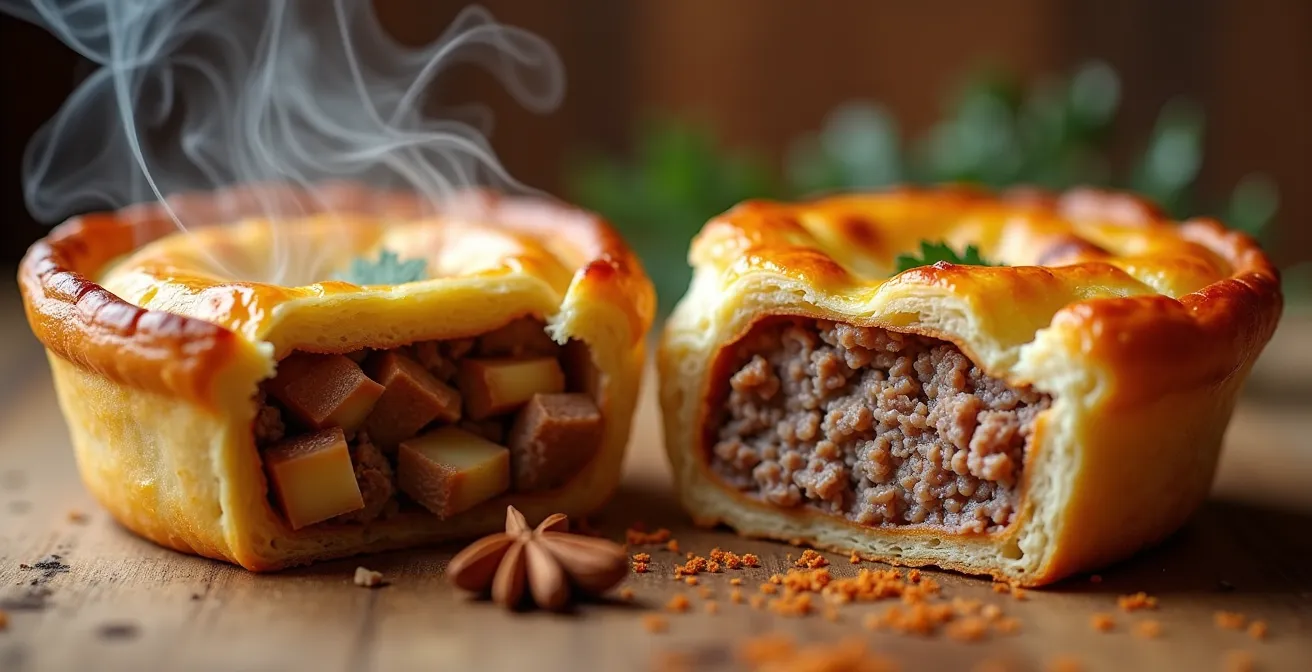
The belief that Tourtière is just a generic “French-Canadian meat pie” is a profound misunderstanding; the real difference lies not just in ingredients, but in a deep-rooted history of regional identity and culinary sovereignty.
- The structure is key: authentic Tourtière du Lac-Saint-Jean uses cubed meat and potatoes in a deep-dish crust, whereas pâté à la viande uses ground meat in a standard pie dish.
- The choice of meat is a map of Quebec’s terroir, with game and pork inland and fish on the coasts, reflecting a history of self-sufficiency.
Recommendation: To truly experience Quebec’s culinary heritage, look beyond the label and learn to identify the structural and regional markers of an authentic tourtière.
For any food-loving visitor to Quebec, the encounter is inevitable. On a menu, at a market, or on a family’s holiday table, you will find a golden-crusted meat pie. But to call it all “tourtière” is to make a fundamental error, one that overlooks the rich, nuanced, and fiercely defended culinary identities of the province. Many believe the distinction is minor, a simple matter of recipe preference. They might have heard it’s a Christmas dish, often served with ketchup, and leave it at that. This surface-level understanding misses the entire point.
The truth is, tourtière is not a single dish. It’s a culinary dialect, a map of Quebec’s history written in pastry and filling. The divide between a true, deep-dish Tourtière du Lac-Saint-Jean and a common *pâté à la viande* (meat pie) is as significant as the geographic and cultural landscapes that created them. This is not merely about food; it’s about gastronomic sovereignty. The ingredients, the structure of the pie, and even the condiments served alongside it are declarations of a region’s story, its self-sufficiency, and its resistance to the homogenization of its most iconic dish.
This guide will not just give you a list of ingredients. It will deconstruct the myth of the monolithic tourtière. We will explore the very essence of what defines these pies, from the choice of meat that speaks of the local terroir to the great condiment schism that can divide a dinner table. We will show you where to find the real thing in an urban centre like Montreal and explain its deep connection to the holiday season, helping you understand not just what you’re eating, but the cultural history it represents.
To navigate this delicious but complex world, this article breaks down the essential distinctions and cultural contexts. Explore the sections below to become a true connoisseur of Quebec’s most cherished culinary tradition.
Summary: Decoding the Identity of Quebec’s Iconic Meat Pie
- Game Meat or Pork: What Makes a Traditional Tourtière?
- Where to Buy Authentic Tourtière in Montreal if You Can’t Cook?
- Ketchup or Fruit Ketchup: The Debate That Divides Families?
- How to Reheat a Frozen Pie in a Hotel Room?
- Why Is It Harder to Find Tourtière in July?
- Vegetarian at the Sugar Shack: Is It Even Possible?
- Grand Cru vs. Industrial: How to Spot Real Charlevoix Lamb?
- How to Survive the “Cabane à Sucre” Meal Without Getting Sick?
Game Meat or Pork: What Makes a Traditional Tourtière?
The most fundamental distinction between an authentic tourtière and a generic meat pie lies in its very structure and substance. The term *pâté à la viande* typically refers to a pie made with ground (minced) meat, usually a mix of pork and beef, in a standard, relatively shallow pie crust. It is delicious and comforting, but it is not a Tourtière du Lac-Saint-Jean. The latter, the iconic dish of the Saguenay region, is an entirely different creation defined by its architectural integrity. It uses cubed meat and potatoes, slow-cooked in a rich broth within a deep, sturdy pastry case. This is more of a casserole with a lid than a simple pie, a dish so substantial it is often related to another Quebecois classic, the *cipaille* (sea-pie).
The choice of meat is a direct reflection of Quebec’s culinary terroir. While pork is common, its prevalence is also tied to market economics, as shown by a 16.7% decline in Quebec pork prices in late 2022 which can influence its use. However, historical authenticity points to a much wider range of proteins. In coastal regions, it’s not uncommon to find tourtière made with fish like salmon. Inland, where hunting was a way of life, the filling was—and in many traditional families, still is—made with wild game like rabbit, hare, or moose. This use of local, available protein speaks to a history of self-sufficiency and a direct connection to the land.
Therefore, a “traditional” tourtière is not defined by one type of meat, but by its regional context and its robust, cubed-meat structure. It is a hearty, slow-cooked meal, born from the need to create a nourishing dish from the resources the land provided. The common ground-meat pie is a more modern, simplified cousin, but lacks the historical and structural depth of the original.
Where to Buy Authentic Tourtière in Montreal if You Can’t Cook?
For the traveler or urban dweller in Montreal without a Quebecois grandmother’s recipe, finding an authentic tourtière can feel like a daunting task. The city is filled with bakeries and grocery stores selling *pâtés à la viande*, but locating a true, artisanal tourtière requires a more discerning eye. The key is to look for establishments that respect the tradition—specialty butchers (*boucheries*) and high-end bakeries or markets known for their prepared foods are your best bet.
These places often pride themselves on using quality meat mixes and, most importantly, on their crust. A proper tourtière crust is an art form in itself, typically made with lard for a flaky, flavourful result that stands up to the hearty filling. While a heat-and-serve pie from a quality brand can be excellent, nothing compares to one from a local artisan who has been perfecting their craft for decades. These are not just pies; they are repositories of culinary heritage.
Here are a few trusted Montreal locations where you can find a high-quality tourtière that honours tradition:
- Maison du Rôti (1969, ave. du Mont-Royal Est): A specialty butcher known for its excellent meat quality, offering a tourtière with a traditional veal, pork, and beef mix.
- Première Moisson (various locations, including Marché Jean-Talon): A reliable high-end bakery chain whose heat-and-serve meat pies are known for a homemade taste and quality ingredients.
- La Binerie Mont-Royal (367, ave. du Mont-Royal Est): A historic diner that serves a classic beef-pork tourtière by the slice, offering a taste of old-school Quebec comfort food.
These establishments represent the bridge between historical tradition and modern urban life, making it possible for anyone to experience an authentic piece of Quebec’s culinary culture.
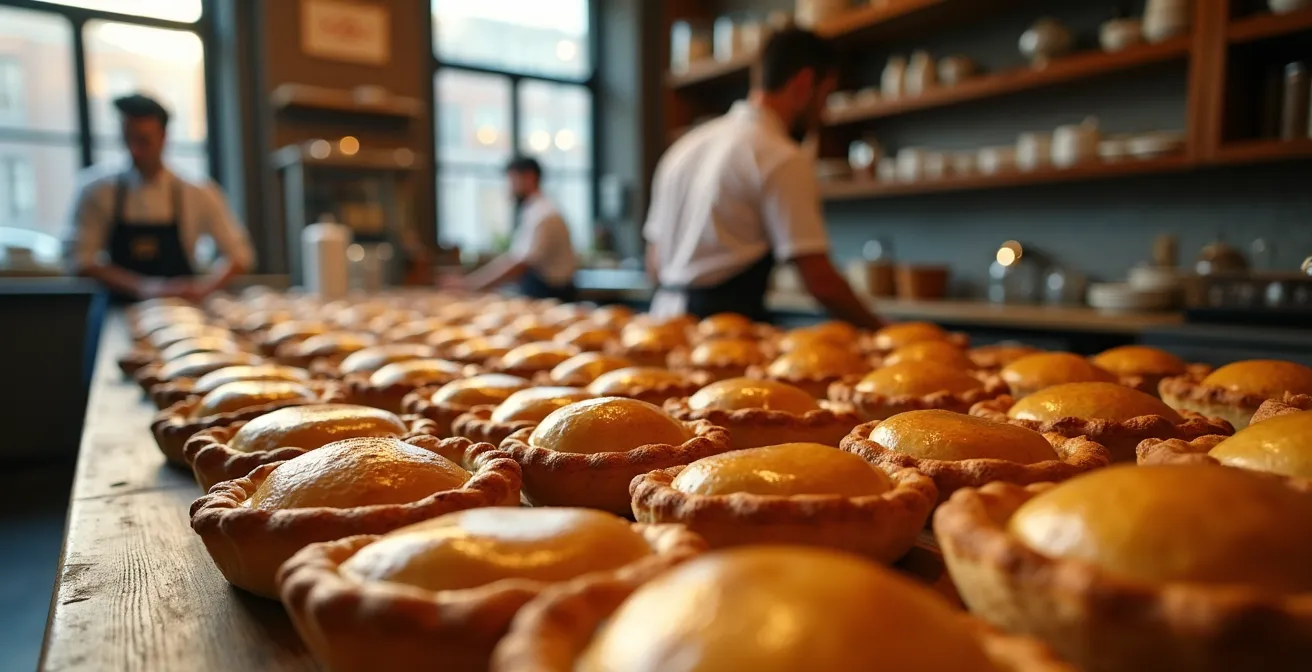
As seen in many of Montreal’s artisanal bakeries, the visual appeal of a perfectly golden, handmade tourtière is a promise of the quality and tradition held within. The best pies are often found not in a factory box, but on the cooling racks of a neighbourhood shop.
Ketchup or Fruit Ketchup: The Debate That Divides Families?
Once the tourtière is on the plate, a new and deeply cultural question arises: what do you serve with it? For outsiders, the answer seems simple: ketchup. But within Quebec, this is a subject of passionate debate, a true “condiment schism.” As Marc, a Canadian husband featured on the food blog Simply Whisked, notes, it’s traditionally served with “pickled red beets, chili sauce, or even ketchup.” The choice is far from trivial; it’s a statement of family tradition and regional identity.
The primary conflict is between standard, bright red tomato ketchup and *ketchup aux fruits*. The latter is a homemade, sweet-tart, and chunky condiment, often made with apples, peaches, tomatoes, onions, and vinegar. It represents Quebec’s self-sufficient culinary past, a way of preserving the summer harvest to brighten the long winter. To serve *ketchup aux fruits* is to honour that heritage. In many urban and younger circles, regular ketchup has become the norm, seen as a convenient, modern choice. Yet, for many traditionalists, its uniform sweetness and industrial origin are an affront to the complexity of a well-made tourtière.
The condiment choices extend even further, painting a more detailed map of Quebec’s palate. This is not just a binary choice, but a spectrum of regional tastes, each with its own cultural significance.
| Condiment Type | Region | Flavor Profile | Cultural Significance |
|---|---|---|---|
| Fruit Ketchup | Traditional Quebec | Sweet-tart homemade ketchup with coarse texture | Represents Quebec’s self-sufficient culinary past |
| Regular Ketchup | Montreal urban areas | Standard tomato-based | Modern North American influence |
| Maple Syrup | Rural Quebec | Sweet complement to spiced meat | Connection to sugar shack traditions |
| Cranberry Preserves | Eastern Quebec | Tart-sweet balance | Holiday tradition pairing |
This variety shows that there is no single “correct” condiment. The choice is a personal and regional signature, making the act of dressing your slice of pie a small but significant expression of cultural identity.
How to Reheat a Frozen Pie in a Hotel Room?
Bringing home a frozen tourtière as a culinary souvenir is a common practice for visitors to Quebec. But reheating it properly, especially in the limited confines of a hotel room, presents a challenge. A microwave can easily turn the flaky pastry into a soggy disappointment. The goal is to heat the dense filling through while preserving the structural integrity of the crust. While professional operations freeze pies on baking sheets and reheat them in a hot oven, a bit of ingenuity is needed for the traveler.
The key is moisture management and gentle heating. The most common mistake is using full power in the microwave, which cooks the exterior too quickly and dries out the crust. If an oven is available, that is always the superior method. However, a perfectly acceptable result can be achieved in a microwave with a few simple tricks. It’s also worth noting that tourtière is often enjoyed cold or at room temperature, so if all else fails, simply letting it thaw completely is a perfectly authentic way to eat it.
For those determined to enjoy a warm slice, here is a step-by-step guide for a hotel room environment:
- Thaw First: If possible, thaw the frozen tourtière in the room’s mini-fridge for at least three hours. This allows for more even heating.
- Oven Method (If Available): Preheat the oven (or a high-end toaster oven) to 400°F (205°C). Place the pie on a baking sheet and heat for 20-30 minutes, or until the center is hot.
- Microwave Method (with care):
- Set the microwave to 50% power. Heat the pie in 2-minute intervals, rotating it each time.
- Place a cup of water next to the pie inside the microwave. This creates steam and helps maintain moisture.
- Cover the pie loosely with a damp paper towel to prevent the crust from becoming tough and dry.
By controlling the heat and adding moisture, you can successfully revive a frozen tourtière and enjoy a warm, comforting taste of Quebec, even far from a proper kitchen.
Why Is It Harder to Find Tourtière in July?
A summer visitor to Quebec might be perplexed by the relative scarcity of tourtière in bakeries and markets. The reason is simple and deeply cultural: tourtière is quintessentially a food of the cold months, with its history inextricably linked to Christmas. It is the heart of the *Réveillon*, the traditional feast enjoyed by Catholic Québécois after midnight Mass on Christmas Eve. This meal was a celebration marking the end of Advent fasting, demanding a rich, substantial centerpiece to warm the body and soul after a cold walk from church.
This tradition of serving it for the Christmas Eve feast after midnight mass has cemented the pie’s status as a winter holiday staple. The spices used—cinnamon, cloves, allspice—are classic warming spices associated with winter festivities. In the heat of July, when markets are overflowing with fresh produce, a dense, spiced meat pie is simply not what the local palate craves. The culinary calendar shifts to lighter fare: fresh berries, sweet corn, and grilled dishes.
However, the line between tradition and modern commerce is blurring. Recognizable brands like the Quebecois restaurant chain St-Hubert have been producing tourtières year-round since the 1950s, making it a consistently available convenience food. While this ensures you can find a version of tourtière any day of the year in a grocery store’s freezer section, the artisanal, freshly made pies remain largely a seasonal specialty, appearing in force as the first autumn chill hits the air and peaking during the Christmas holidays.
The abundance of fresh summer produce at a Quebec market stands in stark contrast to the hearty, preserved foods that define the winter diet. This seasonal shift is the primary reason why finding a fresh, artisanal tourtière in July is a challenge.
Vegetarian at the Sugar Shack: Is It Even Possible?
The traditional *cabane à sucre* (sugar shack) meal is a formidable celebration of pork, eggs, and maple syrup. For a vegetarian, navigating this feast can seem impossible, with lard seasoning everything from the pea soup to the baked beans. However, as Quebec’s culinary scene evolves, so too does the sugar shack. Many modern establishments are now catering to vegetarian and vegan diets, recognizing the need to make this beloved tradition more inclusive. The key is to do your research and communicate your needs in advance.
Some sugar shacks now offer a dedicated vegetarian menu, which might include a *tourtière aux légumes* (vegetable tourtière). This modern adaptation swaps the meat for a filling of mushrooms, lentils, root vegetables, and savoury spices. As noted in modern recipe variations, one can “add vegetables such as carrots or celery to add subtlety of flavours” even to meat versions, showing a broader trend towards vegetable integration. Beyond a dedicated main course, many classic sugar shack items are naturally vegetarian, provided they are prepared without the customary addition of pork. An omelette, pancakes with maple syrup, and the iconic *tire sur la neige* (maple taffy on snow) are safe havens for any vegetarian.
Surviving as a vegetarian requires a proactive approach. A quick phone call before booking can clarify what options are available and ensure the kitchen is prepared. This foresight can transform the experience from a challenge into a delightful immersion in Quebecois culture.
Your Vegetarian Survival Plan for the Sugar Shack
- Inquire about a *tourtière aux légumes* (vegetable tourtière): Check if modern or gourmet sugar shacks offer this dedicated vegetarian main course.
- Confirm the soup base: Ask if the traditional pea soup can be prepared without lard. This often requires calling ahead.
- Identify naturally safe items: Focus on the omelettes, pancakes, and desserts like maple taffy on snow, which are typically meat-free.
- Verify the baked beans: Ask if the *fèves au lard* are available in a vegetarian version, as the name itself implies they are traditionally made with pork fat.
- Call ahead to confirm: Always contact the sugar shack in advance to confirm their vegetarian accommodations and availability.
Grand Cru vs. Industrial: How to Spot Real Charlevoix Lamb?
For the discerning foodie, moving beyond the standard tourtière opens up a world of “Grand Cru” variations. Just as with wine, the quality and origin of the ingredients dramatically elevate the final product. The difference between an industrial pie made with generic ground pork and an artisanal one made with, for example, true Charlevoix lamb is immense. Charlevoix lamb, a regionally protected designation, is known for its subtle flavour and tender texture, a direct result of the unique pastoral farming in that region. Spotting this level of quality requires looking beyond the supermarket and heading to specialty butchers who champion local producers.
Gourmet tourtières often feature premium meats that reflect a more refined “culinary terroir.” This can include duck, bison, or other game meats like elk and hare. When using these leaner meats, technique is paramount. Expert butchers and chefs know to use richer cuts, such as leg meat from game birds or rabbit, rather than breasts or loins, which can become dry during the long, slow cooking process. This attention to detail is a hallmark of a truly high-end tourtière.
The price and availability are clear indicators of quality. An industrial pie is a budget-friendly, year-round product. An artisanal pie from a good butcher will have a mid-range price, while a “Grand Cru” version featuring premium or protected-origin meats will be a premium-priced item found only at the most dedicated establishments.
| Meat Grade | Example | Price Point | Availability |
|---|---|---|---|
| Premium/Grand Cru | Duck, game (bison), Charlevoix lamb | Premium pricing | Specialty butchers, gourmet shops |
| Standard Artisanal | Veal, pork, and beef mix | Mid-range | Artisan bakeries, local butchers |
| Commercial | Ground pork and beef mix | Budget-friendly | Grocery stores year-round |
Choosing a premium tourtière is an investment in a superior gastronomic experience, one that celebrates the best of Quebec’s producers and the highest form of the pie-making craft.
Key Takeaways
- The defining feature of Tourtière du Lac-Saint-Jean is its structure: cubed meat and potatoes in a deep dish, distinguishing it from the ground-meat filling of a standard pâté à la viande.
- Authentic tourtière is a reflection of Quebec’s terroir; the meat (pork, game, or fish) historically depended on what the specific region could provide.
- The pie is traditionally a winter holiday dish, central to the Christmas Eve Réveillon feast, which explains its seasonal availability in artisanal shops.
How to Survive the “Cabane à Sucre” Meal Without Getting Sick?
The *cabane à sucre* meal is not just a meal; it is a marathon. A seemingly endless parade of rich, hearty, and maple-drenched dishes arrives at the table, and the tourtière is just one component. For the uninitiated, the sheer volume of food can be overwhelming, often leading to a state of being uncomfortably full. Surviving—and enjoying—this experience requires a strategy. The key is pacing and understanding the density of each dish. A single serving of authentic Tourtière du Lac-Saint-Jean can be a meal in itself, as it’s designed to feed many people.
The best approach is to start with small portions of everything. Begin with the lighter items like the pea soup, then move to the savory constellation of omelettes, baked beans, crispy *oreilles de crisse* (fried pork rinds), and the tourtière. Treat the *oreilles de crisse* not as a separate course but as a crunchy, salty topping to sprinkle over other dishes. Finally, brace for the dessert course, which is often a prelude to the main event: maple taffy on snow. The entire meal is a cultural touchstone, deeply connected to the festive traditions of Quebec. As The Canadian Encyclopedia authoritatively states, these feasts are part of the heritage of the *réveillon*, the celebratory meal after midnight Mass on Christmas Eve, emphasizing their role as moments of abundance and community.
By treating the meal as a tasting menu rather than an all-you-can-eat challenge, you can savour each element of this unique Quebecois tradition without succumbing to gastronomic overload. It is a feast to be respected, navigated with care, and remembered with pleasure.
To truly connect with Quebec’s heritage, approach its food with curiosity and respect. By seeking out the artisans who uphold these traditions, you are not just buying a meal; you are participating in the preservation of a rich and delicious culture. Your next step is to visit a local market or specialty butcher and start a conversation.