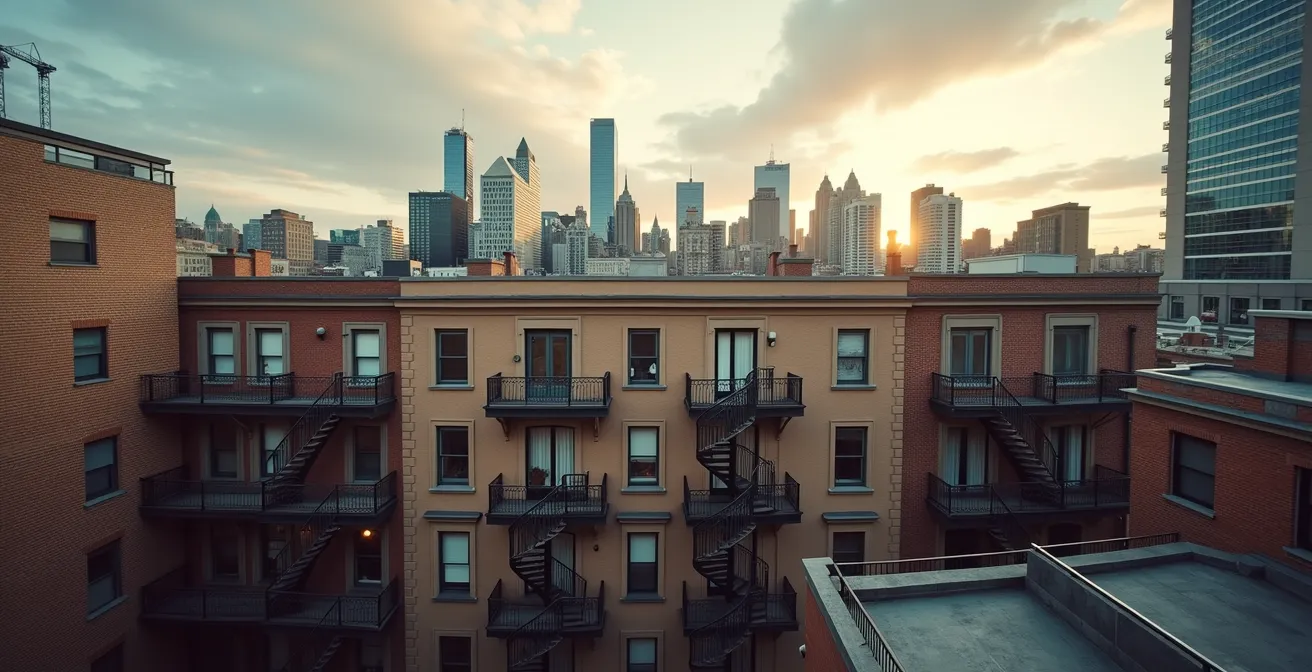
To truly photograph Montreal’s architecture, you must look past the famous landmarks and learn to read the city’s visual language hidden in its neighbourhoods.
- The city’s most unique features, like its outdoor staircases, are the result of specific historical and social narratives, not just aesthetic choices.
- Capturing the soul of areas like the Plateau or Mile End means focusing on texture, light, and ephemeral details rather than just building facades.
Recommendation: Shift your focus from “what to shoot” to “why it looks this way,” and you’ll unlock a more authentic and compelling perspective on Montreal’s architecture.
Every photographer visiting Montreal arrives with a checklist: the gothic spires of the Notre-Dame Basilica, the cobblestone streets of the Old Port, the panoramic view from Mount Royal. These are magnificent subjects, no doubt, but they represent only the first chapter of Montreal’s architectural story. As a photographer who has spent years walking these streets, I’ve learned that the city’s true character isn’t just in its monuments, but in the living, breathing fabric of its neighbourhoods. It’s in the curious case of the outdoor staircases, the dialogue between brutalist icons and modern glass, and the stories painted on brick walls.
Most guides will give you a map of photo spots. This guide aims to give you a new way of seeing. We will move beyond the tourist trail and delve into the architectural soul of the Plateau and Mile End. The goal isn’t just to capture beautiful images, but to understand the narrative behind them—the historical constraints, the cultural expressions, and the unique play of light that defines this city. We’ll explore why certain structures exist, how to respectfully capture private homes, and how to see the city’s icons not as static objects, but as part of a dynamic urban conversation.
This article will guide you through the less obvious but deeply rewarding architectural subjects Montreal has to offer. You’ll discover the stories behind the city’s unique features and learn practical techniques to capture them with authenticity and creativity.
Table of Contents: A Photographer’s Guide to Montreal’s Architectural Soul
- Why Do Montreal Staircases Go Outside Instead of Inside?
- How to Use the RÉSO Without Getting Lost in a Shopping Mall?
- Basilica or Biosphere: Which Icon Defines Montreal’s Skyline Better?
- The Risk of Photographing Private Homes on the Plateau
- When to Capture the Jacques-Cartier Bridge Illumination Perfectly?
- How to Walk the Murals Circuit Without Missing the Best Art?
- Round Barns: Why Were They Built and Where to Find Them?
- How to Navigate Montreal’s Summer Festivals Like a Local?
Why Do Montreal Staircases Go Outside Instead of Inside?
The iconic outdoor staircases of the Plateau and Mile End are more than just a charming quirk; they are a direct result of historical urban planning. With an estimated 30,000 to 40,000 of these structures shaping the city’s residential streets, they tell a story of density, public health, and clever design. During the population boom of the late 19th century, a municipal by-law mandated that new residential buildings have a small setback from the sidewalk to allow for a sliver of green space. To maximize the interior living area while complying with this rule, developers moved the stairwells outside, creating the distinctive “plex” apartment buildings we see today. This design also allowed for each unit to have its own private entrance, a desirable feature at the time.
From a photographer’s perspective, these staircases are a gift of geometry and light. They offer endless opportunities for capturing leading lines, spiral patterns, and the interplay of shadow and sun. Instead of shooting them head-on, try looking for abstract compositions. Focus on the textural honesty of the wrought iron, the peeling paint, and how the seasons transform them.
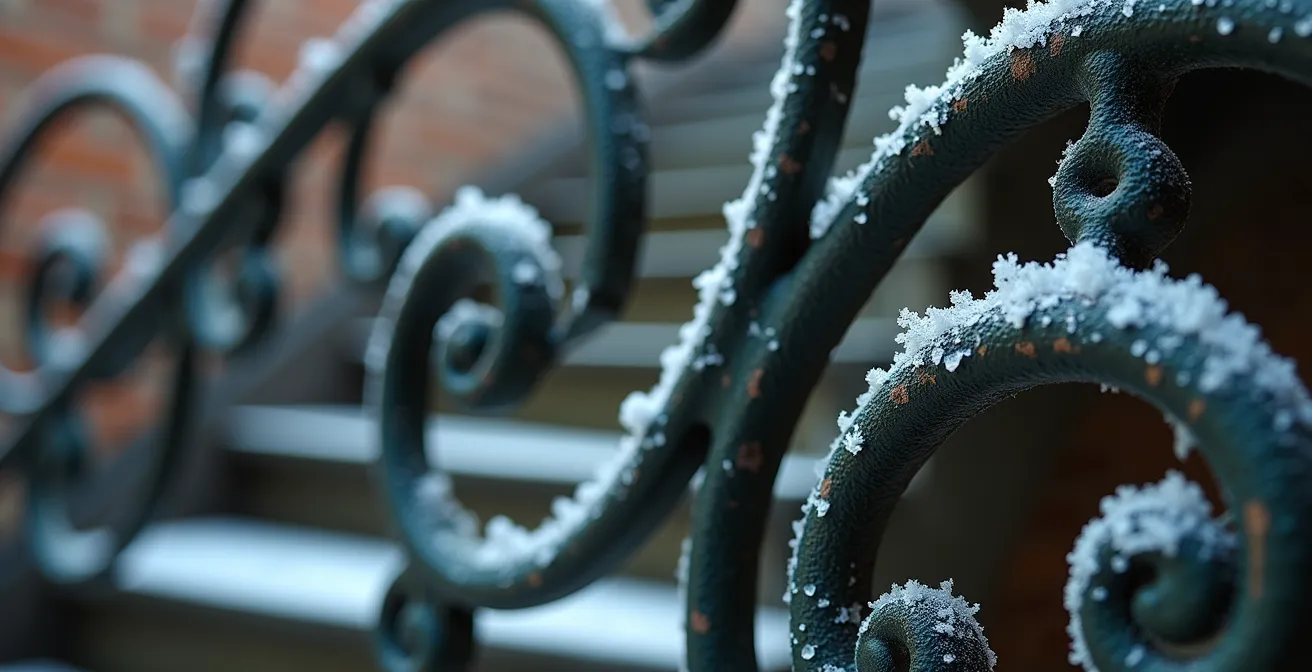
As you can see, a macro lens can reveal a world of detail. The frost on the metal in winter, the blooming flower boxes in summer, or the reflection in a puddle after a spring rain—each season offers a new narrative. The challenge is to capture not just the staircase, but the life it enables and the history it represents. They are not just structures; they are the vertical pathways of Montreal life.
How to Use the RÉSO Without Getting Lost in a Shopping Mall?
Montreal’s “Underground City,” or RÉSO, can feel like an endless maze of corridors connecting metro stations and shopping malls. For many, it’s a purely functional network to escape the winter cold. However, for the observant architectural photographer, it holds hidden pockets of surprising beauty. The key is to look beyond the generic commercial spaces and seek out the moments where the network connects with significant architectural projects. The system is less a single entity and more a series of privately owned public spaces (POPS) stitched together, resulting in a fascinatingly disjointed architectural experience.
Instead of using it as a simple thoroughfare, treat it as an archaeological dig. Look for the points of transition where the style, materials, and lighting suddenly shift. One of the most rewarding spots is the World Trade Centre Montreal, which integrates a historic ruelle (alleyway) and a stunning water feature under a vast glass atrium. It’s a moment of calm and grandeur that feels a world away from the adjacent food courts. As one visitor noted, this area is a prime example of the RÉSO’s hidden potential.
The atrium is very beautifully designed and ideal for some fascinating photographs.
– Reza N, Google Review – World Trade Centre Montreal
To photograph the RÉSO effectively, focus on the interplay between old and new architecture, the quality of artificial and natural light, and the human element. Capturing the flow of people through these spaces can create dynamic long-exposure shots, while focusing on the quiet, cathedral-like spaces like the WTC atrium allows for more contemplative architectural studies. The RÉSO’s true photographic value lies not in its entirety, but in these curated, architecturally significant nodes.
Basilica or Biosphere: Which Icon Defines Montreal’s Skyline Better?
The debate over Montreal’s defining skyline icon often pits the gothic grandeur of the Notre-Dame Basilica against the futuristic geometry of the Biosphere. But this is a false dichotomy. The true character of Montreal’s skyline is not defined by a single building, but by a harmonious and constrained dialogue between its various landmarks, all respectfully bowing to the presence of Mount Royal. A municipal law famously prohibits any new construction from exceeding the mountain’s summit, which stands at 233 meters above sea level. This single rule has shaped a distinctively wide and textured skyline rather than a jagged, competitive one.
To truly capture this, one must include other key players in the visual conversation. A prime example is Habitat 67, Moshe Safdie’s radical experiment in modular housing from Expo 67. Its stacked, pixelated form offers a brutalist counterpoint to the city’s more traditional spires. For photographers who love minimalism and geometry, “fans of brutalist architecture will have a ball here,” as it provides endless compositions of light, shadow, and interlocking cubes. The best photographs of the skyline don’t just frame one icon; they capture the tension and balance between them.
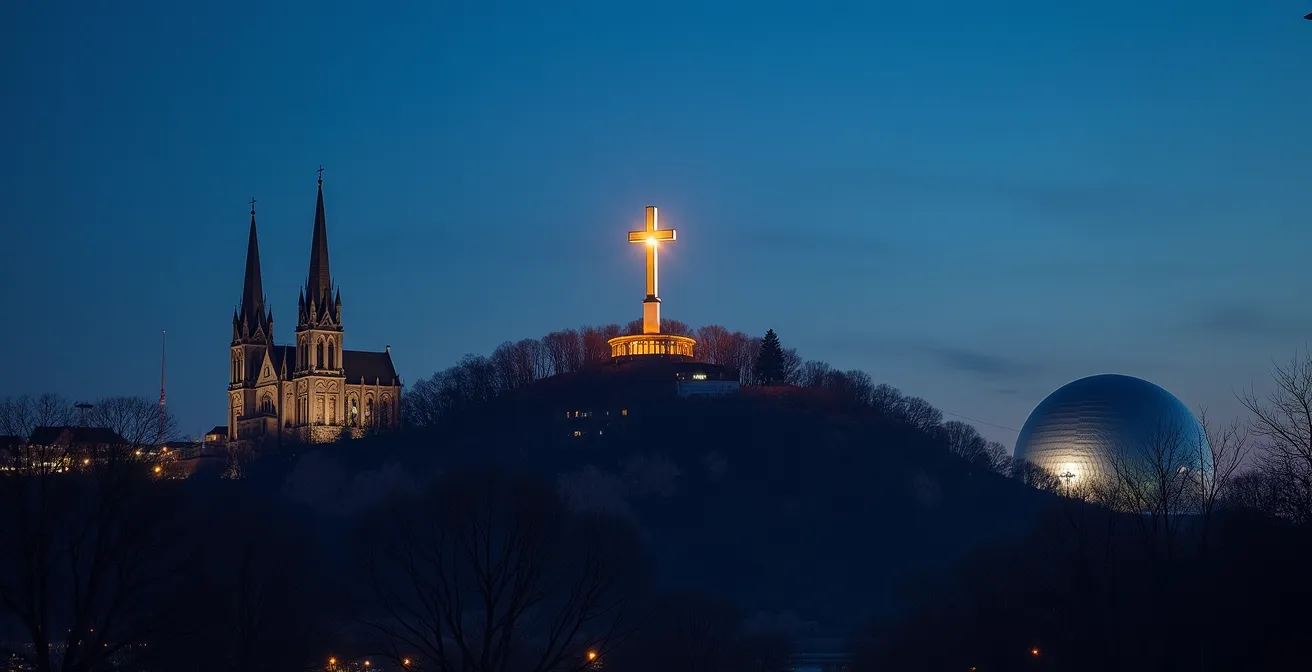
A classic viewpoint is from the Jacques-Cartier Bridge or Île Sainte-Hélène, especially at dusk. From here, you can frame the illuminated cross on Mount Royal as the city’s anchor, with the Basilica’s spires on one side and the Biosphere’s dome on the other. This composition tells the complete story: a city that respects its natural geography, honours its religious history, and embraces its forward-thinking ambition. The skyline isn’t a competition; it’s a well-orchestrated architectural ensemble.
The Risk of Photographing Private Homes on the Plateau
The residential streets of the Plateau Mont-Royal are a photographer’s dream, with their colourful facades, ornate cornices, and iconic spiral staircases. However, these are private homes, and capturing them requires a delicate balance between artistic expression and respect for privacy. In Quebec, this balance is governed by law. While photographing property from a public space is generally permitted, the Civil Code of Quebec protects an individual’s right to privacy (‘droit à la vie privée’). This means capturing an identifiable person on their property or through their window without consent can lead to legal issues. This isn’t just a rule; it’s a creative constraint that can push you to be a better photographer.
Instead of taking wide shots of entire homes, which can feel intrusive, adopt a more intimate and detailed approach. As one local guide suggests, “look for unique architectural details, patterns, and textures to capture in your photographs for a fresh perspective.” This is the essence of textural honesty. Use a longer lens (like an 85mm or 135mm) to isolate compelling elements: the intricate ironwork of a balcony, the pattern of weathered bricks, the reflection of the sky in a vintage window pane, or the shadow cast by a staircase. Use Montreal’s charming cobblestone streets and arched windows as natural framing devices to add depth and context to your shots.
This approach transforms a potential legal risk into an artistic opportunity. By focusing on details, you move away from a “documentary” style and towards a more abstract and personal interpretation of the neighbourhood’s character. You’re no longer just taking a picture of a house; you’re capturing the soul of its materials and the history they hold. Always be mindful, shoot from public sidewalks, and if a resident seems uncomfortable, simply smile and move on. The best shots are born from respect, not intrusion.
When to Capture the Jacques-Cartier Bridge Illumination Perfectly?
The Jacques-Cartier Bridge is more than just a critical piece of infrastructure; it’s a dynamic canvas of light. As one of the busiest bridges in Canada, with over 35 million vehicle crossings annually, its nightly illumination transforms it from a utilitarian structure into a living work of art. The “Living Connections” lighting system, installed for Montreal’s 375th anniversary, changes with the seasons and the city’s social media activity, making every night a unique photographic opportunity. Capturing it perfectly is less about a single “best time” and more about understanding this temporal dialogue and choosing your moment based on the story you want to tell.
The ideal conditions and creative approaches vary dramatically throughout the year. To get the most out of your shoot, you should plan according to the season and the specific effect you’re after. A tripod is non-negotiable for the long exposures required.
- Winter: The cold, clear air provides excellent atmospheric clarity. Look for moments after a fresh snowfall to capture the stark, clean lines of the steel structure against a pristine white landscape. The cold blue tones of the winter light complement the bridge’s illumination beautifully.
- Spring: Use the emerging green foliage from viewpoints on Île Sainte-Hélène. The fresh leaves can serve as a soft, natural frame for the industrial geometry of the bridge.
- Summer: This is the season for dynamic light. During the L’International des Feux Loto-Québec fireworks competition, you can capture stunning long exposures that combine the bridge’s static glow with the explosive trails of the pyrotechnics.
- Fall: The vibrant autumn colours, especially when shot from the Mount Royal lookout, provide a warm and colourful foreground that contrasts wonderfully with the cool tones of the bridge’s steel.
For classic night photography, use a wide-angle lens and set your aperture to a narrow f/11 to f/16 to create a “starburst” effect on the lights. A shutter speed between 1 and 30 seconds will blur the car lights into beautiful red and white trails, adding a sense of motion and life to the static strength of the bridge.
How to Walk the Murals Circuit Without Missing the Best Art?
Montreal is a world-renowned capital of street art, with its buildings serving as canvases for massive, breathtaking murals. The heart of this scene is Saint-Laurent Boulevard, particularly around the district that hosts the annual MURAL Festival. However, simply wandering down “The Main” can be overwhelming. A more strategic approach is to treat your walk as a curated gallery visit, understanding that these works of art are in constant dialogue with the architecture they inhabit. As Montreal Diaries suggests, you should “explore the Plateau-Mont-Royal and along Saint-Laurent Boulevard, especially near the MURAL Festival district” to find the highest concentration of quality works.
Explore the Plateau-Mont-Royal and along Saint-Laurent Boulevard, especially near the MURAL Festival district.
– Montreal Diaries, Most Instagrammable Places in Montreal Guide
The ultimate example of this fusion of art and architecture is the monumental portrait of Leonard Cohen. Adorning a 21-story building on Crescent Street, this is more than just a mural; it’s a cultural landmark. Photographically, the challenge is to capture its scale and its relationship with the city. For a powerful, direct shot, position yourself at the intersection of de Maisonneuve Boulevard and Crescent Street. However, to capture its place in the urban narrative, head to a more distant viewpoint. From the Kondiaronk Belvedere on Mount Royal, Cohen’s portrait becomes part of the downtown skyline, a gentle, poetic face watching over the city he immortalized in his songs.
Your photographic goal should be to frame these murals not in isolation, but with elements of their surroundings. Use a neighbouring building, a fire escape, or even the flow of pedestrians to give a sense of scale and place. The best mural photography tells a story about how art transforms the urban space, turning a simple brick wall into a point of cultural connection and visual delight. Don’t just photograph the art; photograph the art *in* the city.
Round Barns: Why Were They Built and Where to Find Them?
To truly understand Quebec’s architectural DNA, a photographer must occasionally venture beyond the city limits. The countryside, particularly the Eastern Townships (Cantons-de-l’Est), holds a unique architectural treasure: the round barn. These structures are a fascinating chapter in the province’s agricultural history. Built primarily in the early 20th century, they were monuments to an era of modernization and scientific farming. The circular design was promoted for its efficiency; it was believed to be more structurally sound, require less building material, and allow for a more efficient feeding process for livestock, with a central silo at its core.
For a photographer, these barns are objects of pure geometric beauty. Their curved walls and conical roofs stand in stark, organic contrast to the linear fields and angular farmhouses that surround them. They offer a unique challenge in composition, demanding a different approach than the straight lines of urban architecture. A road trip through the Townships becomes a photographic treasure hunt. The well-preserved barn near Mansonville is a key stop, but the joy is in discovering lesser-known examples along winding country roads.
To capture their essence, timing and lens choice are crucial. A wide-angle lens is essential to convey the barn’s unique shape and its relationship to the surrounding landscape. Shooting at sunrise or sunset—the golden hours—is particularly effective. The low, warm light will accentuate the texture of the aged wood and the sweeping curves of the roofline, casting long, dramatic shadows. This is not just about documenting a building; it’s about capturing a piece of Quebec’s heritage and the story of innovation it represents. This “geometric storytelling” adds a rich, rural chapter to your Montreal-area architectural portfolio.
Key Takeaways
- True Montreal architectural photography focuses on neighbourhood narratives, not just iconic landmarks.
- Understanding the “why”—the history and regulations behind designs like the outdoor staircases—leads to more meaningful images.
- Creative constraints, like privacy laws on the Plateau, can be a catalyst for more detailed and artistic photography.
How to Navigate Montreal’s Summer Festivals Like a Local?
In the summer, Montreal’s architecture doesn’t just stand still; it dances. The city’s world-famous festivals, particularly the Montreal International Jazz Festival, completely transform public spaces like the Place des Festivals in the Quartier des Spectacles. For a photographer, this is a prime opportunity to capture “temporal dialogue“—the interaction between permanent structures and the ephemeral architecture of stages, light installations, and art pieces. The city’s ability to foster this kind of creative synergy is a key reason why, as Frommer’s notes, UNESCO designated Montreal a ‘City of Design’, praising its knack for inspiring collaboration between public and private players.
Photographing festivals like a local means looking beyond the headline acts on the main stage. It’s about capturing how these temporary interventions reshape the urban experience. Elevated positions from surrounding buildings, like the parkades, offer fantastic opportunities to shoot crowd patterns and the geometric interplay of stages and existing architecture. At night, the Quartier des Spectacles becomes a playground of light. Use a tripod and long exposures to transform video projections and moving light installations into vibrant, abstract light trails. Don’t neglect the smaller neighbourhood festivals in areas like Verdun or Rosemont; they often offer more intimate and unique architectural transformations, allowing you to capture the community spirit woven into the city’s fabric.
Action Plan: Photographing Festival Architecture
- Identify key vantage points: Scout elevated positions (parkades, balconies) around Place des Festivals before the crowds arrive.
- Document the ephemeral: Focus on the temporary stages, art installations, and projection mapping that alter the permanent cityscape.
- Play with light and motion: Use a tripod to shoot long exposures at night, capturing light trails from installations and the flow of the crowd.
- Capture human interaction: Photograph how people engage with the festival architecture, not just the structures themselves.
- Explore beyond the main event: Visit smaller neighbourhood festivals to capture more intimate and unique urban transformations.
This approach allows you to document a fleeting, yet essential, part of Montreal’s architectural identity. You’re capturing the city not as a static museum, but as a living, breathing stage that is constantly reinventing itself. It’s the ultimate expression of the city’s creative soul.
Now that you’re equipped with a new way of seeing the city, the next step is to grab your camera and start building your own visual narrative of Montreal. Start by exploring one of these themes and let the city’s architectural stories guide your lens.
Frequently Asked Questions on Montreal Architectural Photography
Can I photograph private buildings in Montreal?
Under Quebec’s Civil Code, photographing property from public spaces is generally permissible, but capturing identifiable individuals without consent violates their right to privacy (‘droit à la vie privée’).
What are the best practices for respectful photography in residential areas?
Use longer lenses to isolate architectural details, avoid shooting directly into windows, and use Montreal’s cobblestone streets and arched windows as natural framing tools.
Are there restrictions on using photos of Montreal churches?
Some churches like Notre-Dame allow photography, but others may have restrictions. Always check signage or ask staff before shooting indoors.