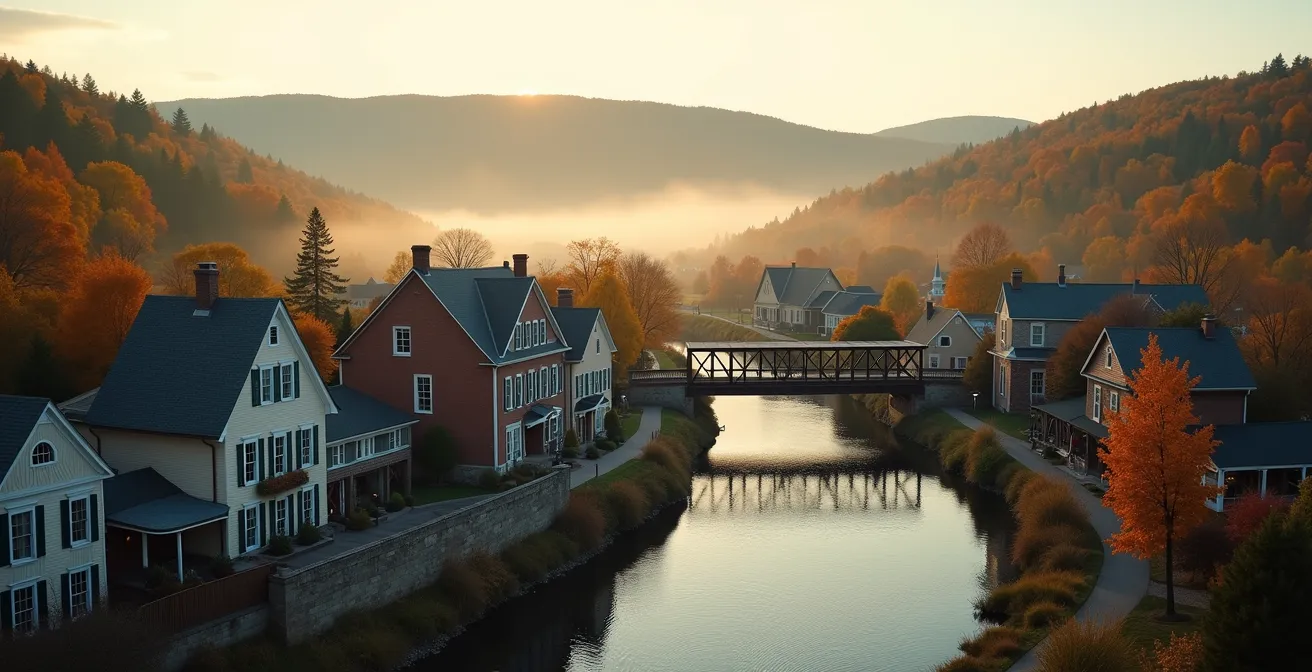
Tracing Loyalist heritage in Quebec isn’t about finding names on a list; it’s about deciphering a living history written in architecture and landscape.
- The iconic round barns are not just scenic oddities but marvels of functional engineering designed for the dairy boom.
- The region’s unique history is physically embodied by places like the Haskell Free Library, which intentionally straddles the Canada-U.S. border.
Recommendation: Start by learning to ‘read’ the functional design of a building or the cultural meaning of a tradition before looking for a name in an archive.
Driving through Quebec’s Eastern Townships, you can’t help but notice a distinct shift in the landscape. The steep-roofed farmhouses of the St. Lawrence Valley give way to stately brick manors and sprawling barns that feel transplanted from Vermont or New Hampshire. For history buffs, this is the first clue: you’ve entered Loyalist country. This region, settled by Americans loyal to the British Crown who fled after the Revolutionary War, holds a unique Anglo-Saxon heritage woven into the fabric of a predominantly French-speaking province.
Many guides will point you toward the well-trodden Townships Trail or list the prettiest villages. While these are excellent starting points, they often only scratch the surface, presenting the history as a series of static landmarks. They might tell you to visit a cemetery or look at Victorian homes, but they rarely explain what to look for, or how the very structure of a barn tells a story of economic ambition and agricultural innovation.
But what if the true key to unlocking this history wasn’t just in *what* you see, but in *how* you see it? As a heritage architect, I believe the past is not just documented in archives; it is encoded in the architectural DNA of the buildings and the cultural echoes of traditions that persist to this day. It’s about learning to read the functional genius of a round barn, understanding the porous nature of the border that shaped family ties, and deciphering the subtle ways English names were transformed by French-speaking clerks.
This guide will take you beyond the typical tourist route. We will explore the region not as a collection of sites, but as a living museum. Together, we will learn to read the landscape, appreciate the craftsmanship, and understand the deep-rooted narrative of the Loyalists and their descendants, from their most ambitious structures to the quietest corners of their cemeteries.
To help you navigate this rich historical tapestry, this article is structured to guide you from broad architectural patterns to the specific details of genealogical research. Each section acts as a lens through which to view a different facet of the region’s unique Anglo-Saxon heritage.
Summary: A Heritage Architect’s Guide to the Eastern Townships
- Round Barns: Why Were They Built and Where to Find Them?
- Cream Tea or High Tea: Where to Experience English Traditions?
- Can You Accidentally Cross the US Border While Hiking?
- Cemeteries and Archives: How to Find English Ancestors in a French Region?
- The Townships Trail: Which Segment Has the Best Victorian Homes?
- The Name Variation Mistake That Blocks 80% of Genealogy Searches
- The Citadel or the Ramparts: Which Tour Is Better for History Buffs?
- How to Spend a Weekend in Sherbrooke Like a Local?
Round Barns: Why Were They Built and Where to Find Them?
The round and polygonal barns scattered across the Eastern Townships are more than just picturesque landmarks; they are monuments to agricultural ingenuity. From an architect’s perspective, their form is a direct response to their function. Unlike traditional rectangular barns, these structures were designed for ultimate efficiency during the late 19th-century dairy boom, a period heavily influenced by Loyalist descendants. The circular layout allowed a single farmhand to feed cattle from a central point, a revolutionary concept that saved immense time and labour. Furthermore, the self-supporting roof structure required less lumber and offered superior stability against heavy winds and snow loads.
These were not follies but highly practical, engineered solutions. The region’s dairy industry was foundational, and the architecture reflects this. Today, there are over 360,000 dairy cows in Quebec, a legacy that began in these very fields. Tracing this history means understanding that the shape of these buildings is a direct result of the economic ambitions of the farmers who built them.
To see this functional genius for yourself, you can follow the “Coeurs villageois” tourist route, which connects many of the 31 towns and villages featuring these heritage structures. While driving, look for octagonal shapes and central silos, which are hallmarks of designs focused on efficient feeding. Visiting these barns isn’t just sightseeing; it’s a field study in the practical application of architectural theory to solve real-world agricultural problems.
Cream Tea or High Tea: Where to Experience English Traditions?
The Eastern Townships shares a climate and architectural and cultural heritage with much of New England, settled by Loyalists fleeing the United States during and after the Revolutionary War.
– Tourism Eastern Townships, Eastern Townships Cultural Heritage Guide
The Loyalist heritage is not only set in stone and timber; it’s also alive in the cultural traditions that persist today. The ritual of afternoon tea is one of the most charming and enduring of these cultural echoes. Far from being a mere tourist novelty, the continued practice of cream tea and high tea in the region is a direct link to the domestic and social customs brought by its English-speaking settlers. It represents a commitment to a way of life, a moment of civility and social connection that has been passed down through generations.
Experiencing this tradition offers a tangible taste of the region’s Anglo-Saxon roots. But just as the architecture varies, so do the tea experiences. From historically authentic Victorian manors to modern cafés that fuse English tradition with Quebec terroir, there are many ways to partake. For the purist, a visit to a historic inn in North Hatley offers a glimpse into the Gilded Age, while a foodie might prefer the innovative pairings found in Knowlton, where scones are served with local maple butter.
The following table outlines some of the best places to experience this delightful tradition, categorized by the type of experience they offer. Choosing one is not just about finding a good cup of tea; it’s about selecting which chapter of the Townships’ history you wish to immerse yourself in.
| Location | Category | Highlights | Best For |
|---|---|---|---|
| North Hatley | Most Historically Authentic | Victorian-era manor houses, traditional English service | Heritage enthusiasts |
| Knowlton (Lac-Brome) | Best Quebec Terroir Fusion | Scones with local maple butter, regional cheese pairings | Foodies |
| Sherbrooke area | Best Scenic View | Overlooking Massawippi River, heritage architecture backdrop | Photographers |
Can You Accidentally Cross the US Border While Hiking?
The short answer is yes, and this possibility is fundamental to understanding the Loyalist experience. The Canada-U.S. border in the Eastern Townships is not always a clearly marked, fenced-off line. In many places, it’s a concept drawn through dense forests, across fields, or even through buildings. This historic permeability is a core part of the region’s identity. For generations, families lived and farmed on both sides, creating a fluid, cross-border community long before modern passports and checkpoints existed.
The most extraordinary example of this is the Haskell Free Library and Opera House in Stanstead. This remarkable building, constructed in 1904, intentionally straddles the international boundary. A thick black line painted across the library’s floor marks the border: the reading room is in Quebec, Canada, while the circulation desk and main entrance are in Vermont, USA. You can literally take a book from a Canadian shelf and check it out in the United States without a passport. This isn’t an anomaly; it’s a purpose-built monument to the shared community and interconnectedness that defined the Loyalist diaspora.

For those exploring the region’s hiking trails, especially near Sutton or along the Sentiers de l’Estrie, the border can be an invisible line marked only by small orange obelisks. It’s entirely possible to step into the U.S. inadvertently. While this is rarely a serious issue for hikers who quickly correct their course, it serves as a powerful reminder of how fluid and arbitrary this line on a map once was for the families who called this entire area home.
Cemeteries and Archives: How to Find English Ancestors in a French Region?
For any genealogist or history buff, archives and cemeteries are sacred ground. In the Eastern Townships, however, the search for English-speaking ancestors comes with a unique challenge: navigating records often kept by French-speaking officials. This linguistic and cultural crossover is a common stumbling block, but it’s also where some of the most fascinating stories of adaptation and assimilation are found. The key is to think like a 19th-century French clerk hearing an English name for the first time.
A name like “Brill” might be recorded as “Breault,” “Ruiter” as “Ruitard,” and “Scriver” might even be directly translated to “Écrivain.” These are not mistakes but phonetic interpretations. Understanding this phenomenon is the single most important key to unlocking your family’s history in the region. Before you even begin a search, you must brainstorm every possible phonetic spelling and French equivalent of your ancestor’s surname.
The Eastern Townships Resource Centre (ETRC) at Bishop’s University is the primary hub for this kind of research. As an accredited archive, it preserves thousands of documents, from personal diaries to maps, that illustrate the life of the English-speaking community. Their experts can provide invaluable assistance in navigating these linguistic hurdles. Many a research breakthrough has happened when a genealogist realizes their ancestor has been “hiding” under a French-ified name all along.
This table shows common examples of how English Loyalist surnames were altered in French-Canadian records, providing a crucial starting point for any archival research.
| Original English Name | French-Canadian Variation | Reason for Change |
|---|---|---|
| Ruiter | Ruitard | Phonetic recording by French clerks |
| Brill | Breault | Sound adaptation to French pronunciation |
| Hager | Hogar | H-dropping in French speech patterns |
| Rykert | Ricard | Simplified to existing French surname |
| Scriver | Écrivain | Direct translation (writer/scribe) |
The Townships Trail: Which Segment Has the Best Victorian Homes?
The Townships Trail is a magnificent 430-kilometre route, but for an architecture enthusiast, not all segments are created equal. To truly appreciate the Victorian homes that define the region’s aesthetic, you must know where to look and, more importantly, *what* to look for. The prosperity of the late 19th century is on full display in the elaborate homes built by the descendants of the first Loyalist settlers. These are not just houses; they are statements of success, adorned with a rich vocabulary of architectural details.
Instead of aimlessly driving, I recommend approaching the trail with a specific architectural persona in mind. Are you a lover of Gilded Age grandeur, or do you prefer quaint village charm? Your answer will determine your route.
For those who admire grand mansions, the segment around Stanstead and North Hatley is unparalleled. Here you will find magnificent estates in the Queen Anne and Second Empire styles, complete with turrets, wraparound porches, and commanding views of the surrounding lakes. If your taste leans toward the Gothic Revival cottage, with its charming gingerbread trim and steeply pitched roofs, the villages of Frelighsburg and Knowlton offer a delightful and highly walkable experience. For a more rustic aesthetic, the area around Compton is dotted with beautiful Queen Anne farmhouses, many with original widow’s walks and expansive verandas that connect the home to the agricultural landscape.
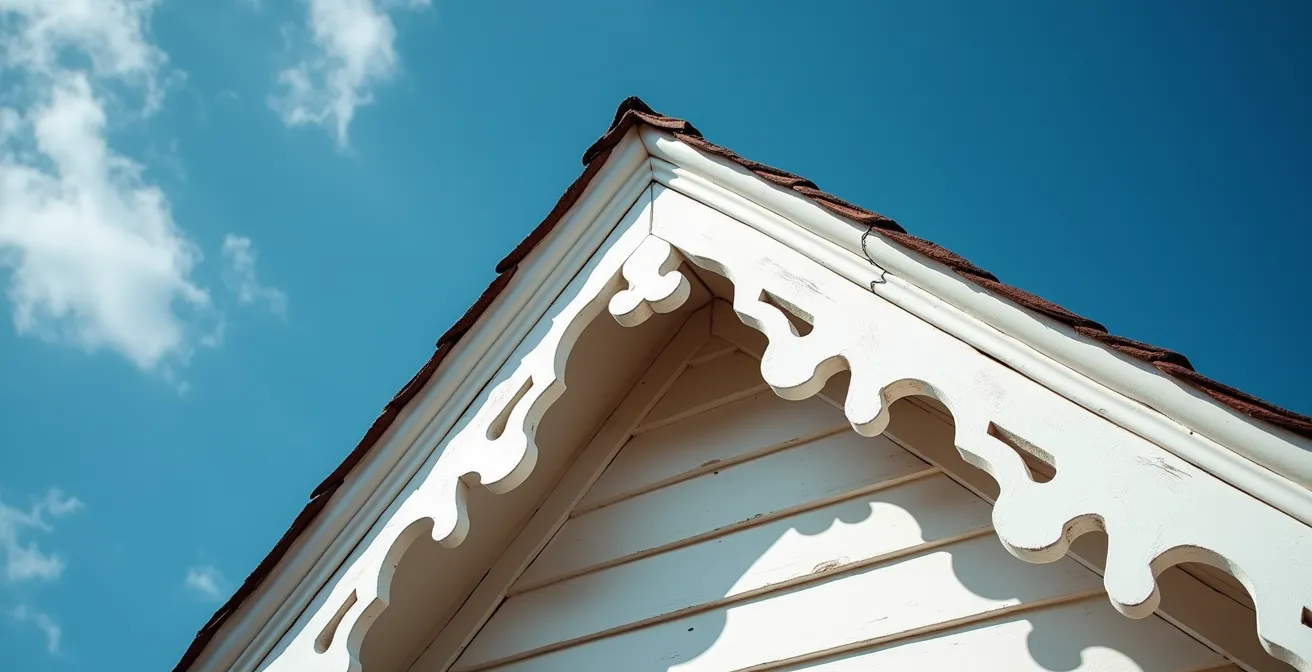
When spotting these homes, train your eye to look for specific details: decorative wooden brackets under the eaves, intricate fish-scale shingles on gables and turrets, colourful stained glass in transom windows, and ornate carved bargeboards along the roofline. These elements are the language of Victorian architecture, and learning to identify them transforms a simple drive into a captivating architectural tour.
The Name Variation Mistake That Blocks 80% of Genealogy Searches
As we’ve touched upon, the single greatest barrier to tracing Loyalist ancestry in Quebec is the name game. More than 80% of frustrating research dead-ends can be traced back to the failure to account for surname variations. This isn’t an exaggeration; it’s the central challenge of Anglo-heritage research in the province. As the Eastern Townships Research Centre notes, “Many Loyalists had their names recorded phonetically by French-speaking clerks who wrote names as they heard them, creating variations that persist in official records to this day.”
Failing to anticipate these changes is like searching for a book in a library using only one possible title. The information is there, but you’re looking in the wrong place. The solution requires a strategic and flexible approach. You must abandon the idea of a single, “correct” spelling and instead embrace the concept of a phonetic family of names. Your ancestor might appear as “Hager” in a Vermont census, “Hogar” in a Quebec parish register, and “Haegar” in a land deed.
Successfully navigating Quebec’s archives, such as the vast online resources of the Bibliothèque et Archives nationales du Québec (BAnQ), depends on using advanced search techniques. Wildcard searches (e.g., searching for ‘Br*’ to find Brill, Breault, and other variants) and Soundex algorithms, which group phonetically similar names, are not just helpful tools; they are essential. Furthermore, it’s vital to cross-reference findings with U.S. records from New York and Vermont, where original English spellings are more likely to be found, and to check Protestant parish records separately from Quebec’s main civil registers.
Your Action Plan for: Overcoming Name Variations
- List all possible phonetic spellings and French-sounding variations of your ancestor’s surname before starting.
- Use wildcard searches (like ‘Smit*’) in databases like BAnQ to capture multiple endings and spellings at once.
- Apply the Soundex algorithm in genealogy software to find names that sound similar, even if they are spelled differently (e.g., Brill and Breault).
- Cross-reference any Quebec findings with U.S. census and vital records from neighbouring states like Vermont and New York to confirm original spellings.
- Remember to search Protestant parish records, as these were often kept separately from Quebec’s Catholic-dominated civil registers and may retain English spellings.
The Citadel or the Ramparts: Which Tour Is Better for History Buffs?
When history buffs think of Quebec, their minds often go directly to the iconic fortifications of Quebec City: the imposing Citadel and the historic ramparts. These structures tell a grand story of empires, battles, and military strategy, a history written in cannon-proof stone. A tour of either is a magnificent lesson in French and British colonial military history. However, for those seeking to understand the Loyalist past, this is the wrong chapter of the history book.
The Loyalist story in the Eastern Townships is fundamentally different. It is not a tale of soldiers in a fortified city, but of pioneers, farmers, and builders on a new frontier. Their legacy isn’t found in bastions and barracks, but in the functional layout of a farm, the elegant proportions of a brick manor, and the quiet dignity of a village church. The history is more domestic, more agrarian, and more intimately tied to the land itself.
Choosing between the Citadel and the Ramparts is a question for someone exploring the military history of New France. For a buff of Loyalist history, the more relevant choice is between a tour of a Gothic Revival cottage in Frelighsburg or an exploration of a round barn near Compton. The former tells a story of social aspiration and aesthetic values, while the latter speaks to economic pragmatism and agricultural innovation. This is where the true character of the English-speaking settlement is revealed.
Therefore, the best “tour” for a Loyalist history enthusiast is to step away from the monumental and embrace the vernacular. It involves trading the view from a fortified wall for the view from a farmhouse veranda, and understanding that the history of this community is written in wood and soil, not in military stone.
Key Takeaways
- The distinct architecture of the Eastern Townships, like round barns and Victorian homes, is a direct reflection of the functional needs and cultural values of its Loyalist settlers.
- Genealogical research in the region requires a unique strategy to account for the phonetic “French-ification” of English surnames by clerks in historical records.
- The Loyalist heritage is a living one, visible not only in buildings but also in enduring cultural traditions and the unique, historically porous nature of the nearby Canada-U.S. border.
How to Spend a Weekend in Sherbrooke Like a Local?
To truly bring the Loyalist heritage to life, you must see it not as a static past but as a living, breathing part of the present. Sherbrooke, the region’s economic and cultural hub, is the perfect place to do this. A weekend spent here allows you to connect the archival with the actual, seeing how the city’s dual heritage continues to shape its identity. Spending a weekend like a local means engaging with the institutions and places that keep this history alive.
Your first stop should be the magnificent campus of Bishop’s University. Founded in 1843 to serve the region’s English-speaking population, its Gothic Revival architecture has earned it the nickname “Oxford on the Massawippi.” It’s not just a pretty campus; it houses the Eastern Townships Resource Centre, making it the intellectual heart of Anglo-heritage research. From there, a walk through the historic Vieux-Nord district reveals stunning examples of the homes built by the city’s English industrialist class.

A local weekend also means experiencing the modern fusion of cultures. Visit the bilingual Marché de la Gare on a Saturday morning to hear French and English mingling among the stalls. Explore microbreweries that celebrate both English ale and Belgian beer traditions. The key is to see the heritage not as a separate exhibit, but as an integrated layer of modern life. Attending an event by the Quebec Anglophone Heritage Network (QAHN) or simply visiting a pub with deep local roots connects you to the community that acts as the steward of this rich history.
Now that you are equipped with an architect’s eye and a historian’s curiosity, the next step is to get out and explore. Begin planning your own journey along the Townships Trail, not just to see the sights, but to read the rich, layered stories written into the landscape.