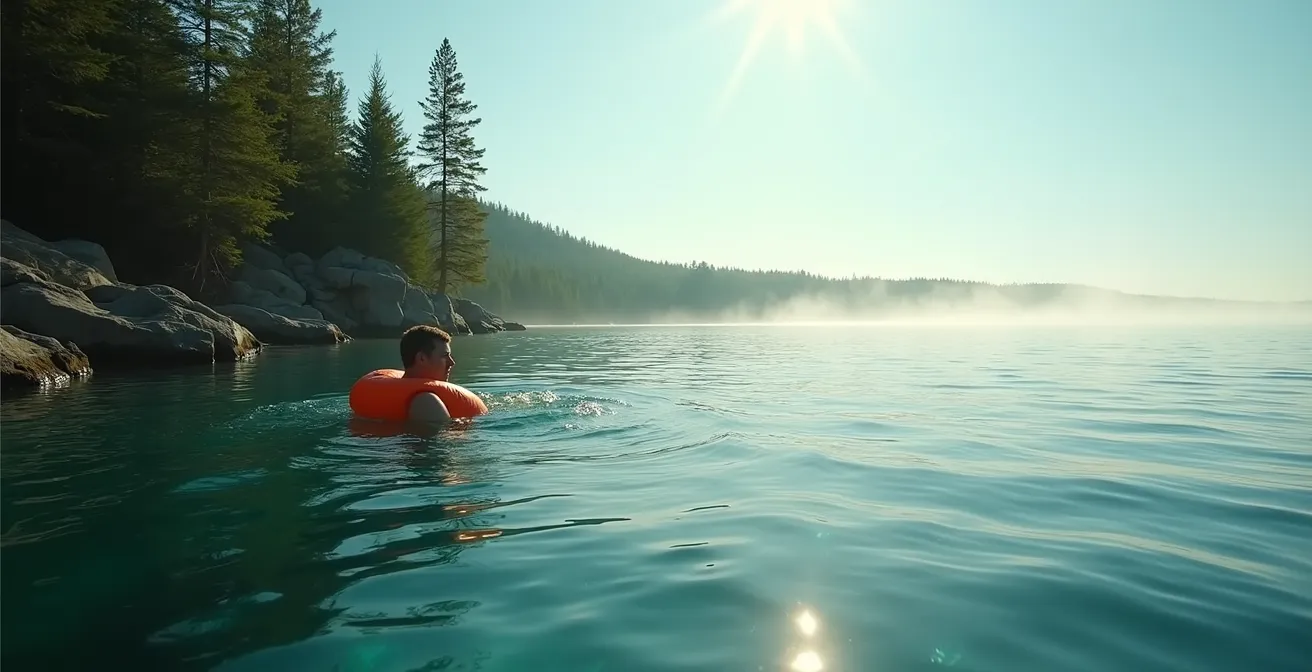
In summary:
- The biggest risks in Quebec’s unmonitored lakes are often invisible: parasites, toxic algae, and sudden temperature drops (thermocline shock).
- True safety comes from “water literacy”—learning to read environmental clues like wind direction, water colour, and shoreline vegetation before you get in.
- Always verify legal access through official sources like the SÉPAQ website or Quebec’s Crown Land interactive map to avoid trespassing.
- For insect protection, Icaridin-based repellents offer the best balance of effectiveness against both black flies and mosquitoes without damaging your gear.
On a hot summer day in Quebec, the call of a wild, unsupervised lake is almost irresistible. For families and hikers, it promises a refreshing escape far from crowded public pools. The common advice—don’t swim alone, watch for boats—is important, but it barely scratches the surface of what it means to be safe in these natural environments. The real dangers aren’t always the ones you can see.
As a lifeguard and water quality technician, I’ve learned that ensuring your family’s safety goes beyond packing life jackets. It’s about developing a new skill: water literacy. It’s the ability to look at a body of water and read the subtle, often invisible, clues it provides. Many assume that clear water is clean water, or that a warm day means a warm lake. These assumptions can lead to everything from intensely itchy rashes to life-threatening situations.
But what if the key to safety wasn’t a long list of rules to memorize, but rather a method for assessing the environment yourself? This guide is designed to give you that method. We’re going to move past the generic warnings and focus on the specific, often hidden, challenges of swimming in Quebec’s lakes. I’ll teach you how to spot the signs of microscopic parasites, identify potentially toxic algae blooms, understand the shocking truth about water temperature, and navigate the legalities of accessing these beautiful spots.
This article will provide you with the practical knowledge to assess any wild swimming spot with the eyes of a professional. By understanding the ‘why’ behind the risks, you’ll be empowered to make informed decisions that protect you and your loved ones, turning that tempting dip into a truly safe and enjoyable experience. The following sections break down exactly what you need to look for.
Summary: A Lifeguard’s Guide to Safe Wild Swimming in Quebec’s Lakes
- Swimmer’s Itch: How to Spot the Warning Signs in the Water?
- Why 25°C Air Temperature Doesn’t Mean the Lake Is Safe?
- Public vs. Private Access: Where Can You Legally Enter the Water?
- Blue-Green Algae: What Does It Look Like and Why Is It Toxic?
- How to Find a Swimming Spot Without Crowds using Topo Maps?
- Why Drinking a Beer While Driving a Boat Is a Criminal Offense?
- Black Flies or Mosquitoes: Which Repellent Actually Works in June?
- How to Rent a Pontoon or Houseboat in Quebec Without a Boating License?
Swimmer’s Itch: How to Spot the Warning Signs in the Water?
That tingling sensation you sometimes feel after a dip isn’t just your skin getting used to the air; it could be the first sign of cercarial dermatitis, better known as “swimmer’s itch.” This unpleasant, non-contagious rash is caused by the microscopic larvae of a parasite that cycles between aquatic snails and waterfowl like ducks and geese. You are an accidental host, and while the parasites can’t survive in human skin, they burrow in and die, triggering an allergic reaction that results in red, itchy bumps.
From a health perspective, prevention is all about location and immediate action. The parasites’ lifecycle gives us crucial clues. Since snails are a key host, you should be wary of areas with heavy aquatic vegetation or marshy shorelines where they thrive. Furthermore, research shows that larvae are more likely to be present in shallow water by the shoreline, exactly where children love to play. The wind can also concentrate them on downwind shores.
If you feel a tingling while in the water, exit immediately. The single most effective preventative measure is to dry yourself off vigorously with a towel as soon as you get out. This friction can physically remove many of the larvae before they have a chance to penetrate your skin. A freshwater shower right after is also beneficial, though it won’t dislodge any parasites that have already started burrowing. Being mindful of these environmental factors and taking swift action post-swim are your best defenses against this common lakeside nuisance.
Why 25°C Air Temperature Doesn’t Mean the Lake Is Safe?
One of the most dangerous misconceptions in wild swimming is equating warm air with warm water. While the surface of a Quebec lake might feel pleasant on a July afternoon, a significant and potentially deadly hazard lies just a few meters below: the thermocline. This is a thin layer of water where the temperature plummets dramatically, creating a risk of cold water shock even for strong swimmers. Jumping or diving from a rock or boat can plunge you from a comfortable 22°C surface into water that is suddenly 10°C or colder.
This sudden, shocking cold can trigger an involuntary gasp reflex, causing you to inhale water. It also rapidly constricts blood vessels, forcing your heart to work harder and potentially leading to cardiac arrest. Even if you survive the initial shock, the rapid cooling of your muscles can render you unable to swim, leading to incapacitation and drowning. This isn’t just theoretical; it’s a well-documented phenomenon. Many summer drownings in deep lakes are not due to a lack of swimming ability but to the overwhelming physiological response to the thermocline.
To avoid this, always enter deep, unknown water slowly. Wade in from the shore to allow your body to acclimatize gradually. Never jump or dive into a wild lake unless you are certain of both its depth and its temperature profile. Understanding how a lake is structured in layers is fundamental to your safety.
The table below breaks down the typical thermal layers of a Quebec lake in summer, a structure that, as this analysis of lake layers shows, is critical to understand for safety.
| Water Layer | Typical Depth | Summer Temperature | Risk Level |
|---|---|---|---|
| Epilimnion (Surface) | 0-10m | 18-24°C | Low |
| Thermocline | 10-15m | Rapid drop 18→7°C | High (shock risk) |
| Hypolimnion (Bottom) | 15m+ | 4°C (water densest) | Extreme |
Public vs. Private Access: Where Can You Legally Enter the Water?
Finding a beautiful lake is one thing; having the legal right to swim in it is another. In Quebec, waterfront property is often private, and simply walking to the shore can be an act of trespassing. For families looking for a safe and legal spot, understanding the different types of land access is crucial. Your main options for public access are national parks (SÉPAQ), controlled harvesting zones (ZECs), and Crown Land (terres du domaine de l’État).
SÉPAQ parks offer the most structured experience, with designated, supervised beaches that often require a daily access or parking fee. ZECs, primarily managed for hunting and fishing, also require an access pass but may offer more rustic swimming opportunities. The most adventurous and rewarding option is often Crown Land, which constitutes a vast portion of Quebec’s territory and is generally open to the public for recreation. However, you must be certain you are on Crown Land and not straying onto an adjacent private lot. The key tool for this is Quebec’s official ‘Carte interactive des terres du domaine de l’État’, an online map that shows public land boundaries.
This map helps you distinguish between public forests and private shorelines. The illustration below captures the essence of what you might see from above: a clear demarcation between accessible public forest and the developed private areas along a lake.
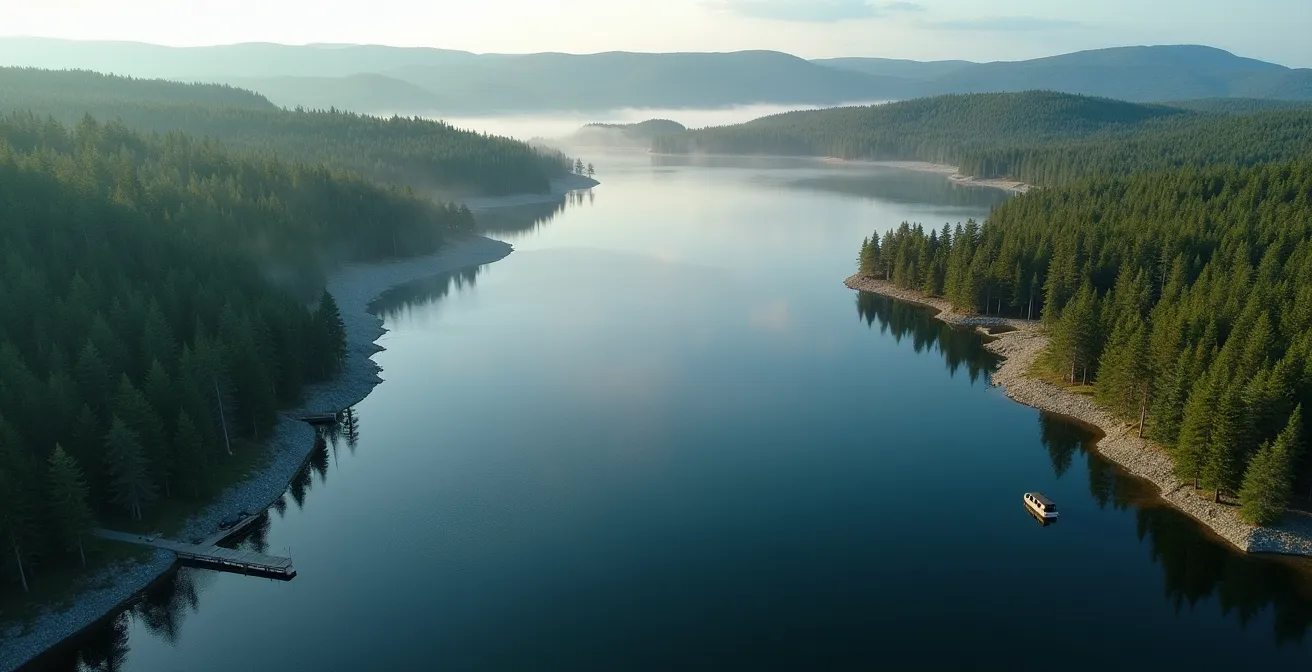
As the image suggests, public access is often found where undeveloped forest meets the water. Before you head out, use the interactive map to pinpoint these areas and plan your route. Remember that even on public land, access is a privilege, not a right to do whatever you want. Bathing is often restricted to designated areas, and you must always pack out everything you pack in to preserve these natural spaces for everyone.
Blue-Green Algae: What Does It Look Like and Why Is It Toxic?
Among the invisible threats in a lake, cyanobacteria, or blue-green algae, are one of the most serious from a public health standpoint. These are not true algae but bacteria that photosynthesize. Under a “perfect storm” of conditions—warm, calm water rich in nutrients like phosphorus (often from agricultural runoff or septic systems)—they can multiply rapidly to form a “bloom.” Some of these blooms produce potent toxins that can be harmful or even fatal to humans and pets if ingested, and can cause severe skin and eye irritation on contact.
Visually identifying a potential bloom is your first line of defense. A toxic bloom often looks like a spill of turquoise paint or a thick “pea soup” scum on the water’s surface. It can also appear as floating green clumps or streaks. A key giveaway is where it accumulates: because the algae float, the wind will push them across the lake. The highest concentrations, and therefore the greatest risk, will almost always be found along the downwind shoreline. Research on bloom timing also indicates the highest incidence occurs late in the day after sustained wind.
Never swim, let your children or pets play in, or even boat through water that looks suspicious. The toxins can become airborne in water spray. If you are unsure, you can perform a simple “jar test”: scoop some of the surface water into a clear jar, let it sit for a few minutes, and observe. Harmless green algae will typically sink or remain suspended, while cyanobacteria will often float to the top to form a green layer. When in doubt, stay out.
Your 5-Minute Shoreline Algae Assessment
- Assess the downwind shore first, as blue-green algae blooms are pushed and concentrated by the wind.
- Look for any surface scum that resembles pea soup or spills of bright green or turquoise paint.
- Scan the immediate shoreline for any dead fish, birds, or other animals, which can be a sign of acute toxicity.
- Perform a clear jar test: Scoop water and let it settle for five minutes. Cyanobacteria will typically float to form a surface layer, while benign sediment sinks.
- Note any unusual water coloration, especially bright, unnatural shades of green or blue.
How to Find a Swimming Spot Without Crowds using Topo Maps?
The desire to escape the crowds is a primary motivator for wild swimming, but finding those secluded spots requires more than just driving down a random dirt road. The most effective tool for this is not Google Maps, but a detailed topographic map. These maps provide a wealth of information that can help you identify promising, accessible, and safe swimming locations that others might overlook.
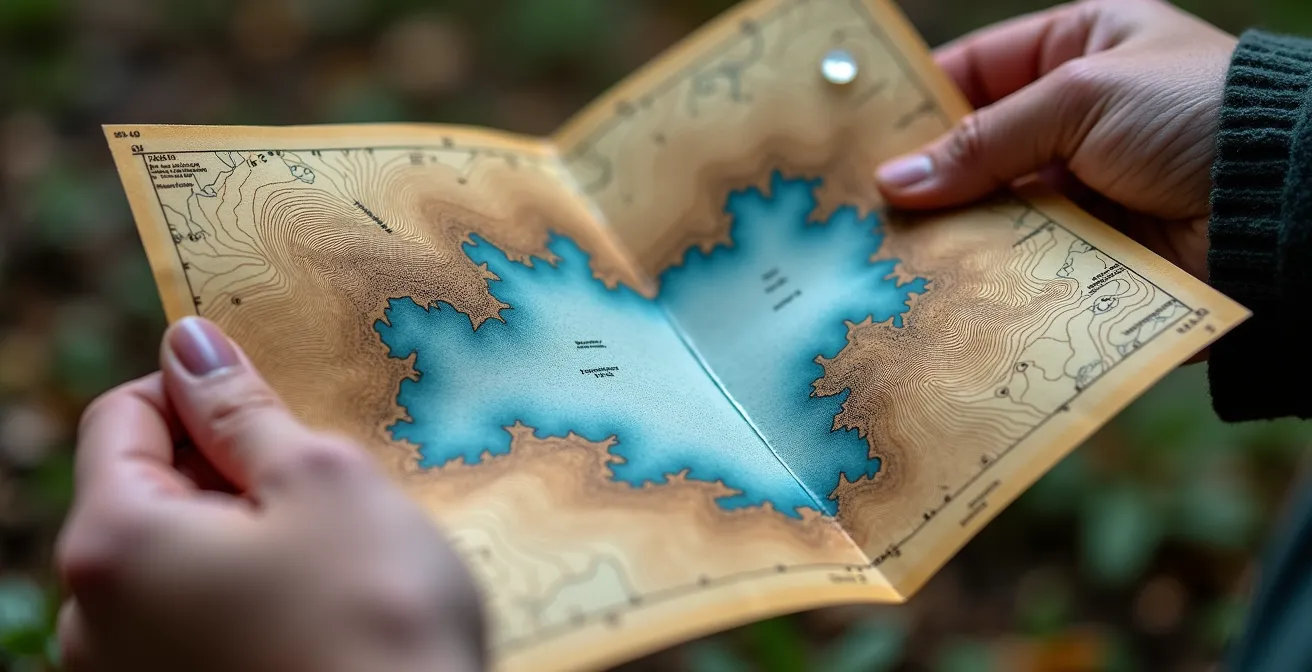
The key is learning to read the contour lines. These lines connect points of equal elevation and tell you about the steepness of the terrain, both on land and beneath the water. When contour lines are spaced far apart near the shoreline, it indicates a gentle, shallow slope—ideal for a safe, gradual entry into the water, especially for families with children. Conversely, when the lines are packed tightly together, it signals a steep bank or an underwater cliff, a spot that might be great for a deep, clean swim but poses a higher risk due to the immediate drop-off and potential thermocline.
The image below shows how to interpret these patterns. By studying the map before you leave, you can target a cove with a gentle entry point, assess the difficulty of the hike in, and even find spots that are naturally sheltered from the wind.
Combining this topographic knowledge with the Crown Land interactive map is the ultimate strategy. First, identify a legally accessible lake on the Crown Land map. Then, switch to a topographic view of that lake to pinpoint the specific coves or beaches with the safest entry profiles. This two-step cartographic approach transforms your search from a game of chance into a planned, safe expedition, leading you to those perfect, peaceful swimming holes.
Why Drinking a Beer While Driving a Boat Is a Criminal Offense?
On a boat, the atmosphere can feel more relaxed than in a car, leading many to believe the rules around alcohol are also more lenient. This is a critical and dangerous mistake. In Canada, operating a boat while impaired by alcohol or drugs is a criminal offense under the Criminal Code, with the same legal consequences as driving a car under the influence. This means fines, license suspension, and even jail time. The law is clear: the person at the helm cannot consume alcohol.
The reason for this strictness is backed by grim statistics. The sun, wind, and motion of the boat (what’s known as “boater’s fatigue”) can accelerate the effects of alcohol, impairing your judgment, coordination, and reaction time much faster than on land. A single beer on the water can have the impact of several on your couch. This impairment is a leading contributor to tragic and preventable accidents. From a safety technician’s standpoint, alcohol is a major red flag on the water.
According to the Lifesaving Society Canada’s drowning prevention plan, the numbers speak for themselves. In the approximately 96 recreational boating deaths that occur annually in Canada, males account for 90% of the incidents. Most alarmingly, data shows that alcohol is present in 35% of all boating fatalities. This isn’t just about a ticket; it’s about a direct and proven link to death. The rule is simple: if you are driving the boat, you don’t drink. Period. The “captain” is responsible for every life on board, and that responsibility demands sobriety.
Black Flies or Mosquitoes: Which Repellent Actually Works in June?
Anyone who has spent time in the Quebec wilderness during late spring and early summer knows the misery that biting insects can inflict. The two main culprits are mosquitoes and the dreaded black flies (mouches noires). While both are a nuisance, they require a smart protection strategy, as not all repellents are created equal. Black fly season peaks from late May to late June, and they are particularly vicious near the running water of lake inlets and outlets—precisely where you might find beautiful, stream-fed swimming spots.
For years, DEET has been the go-to repellent. While it is effective, it has a significant downside: it can damage synthetic materials, melting the plastics on your sunglasses, watch, or outdoor gear. A more modern and, in my view, superior alternative is Icaridin (also known as Picaridin). It has been proven to be equally effective against both mosquitoes and black flies but is completely safe for your clothing and equipment. It’s also less greasy and has a much milder odour, making it a far more pleasant option for the whole family.
Beyond chemical repellents, physical barriers are your best friend during peak season. Wearing light-coloured, long-sleeved clothing and a bug head net may not be fashionable, but it is an incredibly effective way to prevent bites without constantly reapplying chemicals. Timing is also key; black flies are most active at dawn and dusk, so planning your swim for midday can help you avoid the worst of the swarm.
This table compares the most common repellent options to help you make an informed choice for your next outing.
| Repellent Type | Black Flies | Mosquitoes | Gear Safety | Duration |
|---|---|---|---|---|
| DEET 30% | Effective | Very Effective | Damages synthetics | 6-8 hours |
| Icaridin 20% | Effective | Very Effective | Gear safe | 8-10 hours |
| Essential Oils | Minimal | Moderate | Safe | 1-2 hours |
| Physical barriers | Very Effective | Effective | N/A | Continuous |
Key Takeaways
- Water temperature is deceptive. The thermocline, a layer of shockingly cold water, is a serious risk in deep lakes, even on the hottest days.
- Always inspect the downwind shore for signs of blue-green algae, which often looks like pea soup or paint spills and can be toxic.
- Icaridin is the superior all-around insect repellent for the Quebec bush, as it’s effective against both black flies and mosquitoes without damaging your gear.
How to Rent a Pontoon or Houseboat in Quebec Without a Boating License?
Exploring a large lake by pontoon or houseboat is a fantastic way to access remote swimming coves and enjoy the water from a different perspective. A common question is whether you need a Pleasure Craft Operator Card (PCOC) to do so. In Canada, there is a practical exception for renters: if you are renting a boat, you are not required to have a PCOC, provided you complete a rental boat safety checklist with the rental company before you depart.
This process is more than just a formality; it’s a critical safety briefing that essentially serves as a temporary license for that specific boat on that specific body of water. This is your opportunity to gain essential, localized knowledge. The staff at the rental agency are experts on their lake. They know where the hidden rocks and shallow sandbars are, which coves are sheltered from the afternoon wind, and the local speed limits near shorelines. Do not rush this briefing. Ask pointed questions to ensure you are fully prepared.
Treat this briefing as a vital part of your safety plan. Ask the agent to show you the location of all safety equipment—life jackets, fire extinguisher, anchor, and emergency kit—and explain their use. Verify the emergency contact procedure. This briefing is your best defense against the unknown. Quebec’s recreational lakes, from the popular Lac Tremblant to Lac des Sables in Sainte-Agathe, each have unique hazards. The rental safety checklist is designed to arm you with the specific knowledge needed to navigate that lake safely, making it a crucial component of responsible boating.
By internalizing these assessment techniques, you transform yourself from a passive visitor into an active, informed participant in the natural environment. The next logical step is to apply this knowledge on your next outing. Start by practicing a shoreline algae and temperature assessment before your next swim; make it a habit, and you will enjoy Quebec’s beautiful wild lakes with true peace of mind.