In summary:
- Most travel guides give you a generic checklist for Sherbrooke; this guide gives you the local hacks.
- Discover the city’s rhythm by tackling the mural tour backwards and knowing the unwritten rules of Lac des Nations.
- Understand why your wallet feels heavier here thanks to a thriving student economy that keeps prices down.
- Experience living history, from traditional English tea to tracing the Loyalist roots that shaped the region.
- Get a concrete plan for a perfect Thursday night out, from craft beer happy hours to live indie music.
So, you’re thinking of a weekend in Sherbrooke? Good choice. As a university student here, I see tourists come and go. They follow the same well-worn paths, snap a photo of a mural, and leave thinking they’ve “done” Sherbrooke. They’ve seen the surface, but they’ve missed the city’s pulse, its unique rhythm that makes it more than just a pin on a map between Montreal and the US border.
Most guides will tell you to see the murals, visit the lake, and explore downtown. That’s not bad advice, it’s just incomplete. It’s the equivalent of being told to “see the Eiffel Tower” in Paris without anyone telling you the best spot to picnic away from the crowds. They don’t tell you the *why* behind the city’s quirks or the *how* to navigate it like someone who belongs here.
But what if the key wasn’t just seeing the sights, but understanding the city’s flow? This guide is your insider pass. We’re going to look past the obvious and dive into the local knowledge that turns a good trip into a great one. We’ll explore why your poutine costs less than in Montreal, the unwritten rules of walking the city’s most popular trail, and how to find the real soul of the city, not just its postcard-perfect facade.
This article will guide you through the city’s essential experiences, each framed with a local’s perspective. From art and food to nature and nightlife, you’ll get the practical tips and deeper context needed to explore Sherbrooke authentically. Prepare to discover the city’s unique character hiding in plain sight.
Table of Contents: How to Experience Sherbrooke’s True Vibe in a Weekend
- How to Walk the Murals Circuit Without Missing the Best Art?
- Why Are Restaurant Prices in Sherbrooke Lower Than Montreal?
- Lac des Nations: Running or Walking, What Is the Etiquette?
- Is the STS Bus System Convenient for Tourists?
- Wellington Street: Where to Find Live Music on a Thursday?
- Why Do Montreal Staircases Go Outside Instead of Inside?
- Cream Tea or High Tea: Where to Experience English Traditions?
- How to Trace the Loyalist History in the Eastern Townships?
How to Walk the Murals Circuit Without Missing the Best Art?
The first thing everyone tells you is to “see the murals.” And you should. These massive, photo-realistic trompe-l’oeil paintings are the city’s outdoor art gallery. But here’s the local secret: don’t just follow the map from start to finish. To do it right, you need a strategy.
The official route has a surprisingly steep climb up Frontenac Street that can zap your energy early on. The pro move is to follow the route in reverse. You get a much gentler incline and save your legs for exploring. Before you even start, download the BaladoDiscovery app. It has audio guides and augmented reality features that bring the history painted on the walls to life, explaining the characters and stories that most people just walk past.

For the best photos, timing is everything. The murals on the eastern-facing walls are best captured in the soft morning light, which makes the colours pop and avoids harsh shadows. The full circuit is made of two loops totaling about 7 km, so give yourself a solid half-day. Start at the tourist office on King Street West to grab a free physical map and a parking pass if you drove. This isn’t just a walk; it’s a history lesson disguised as a scavenger hunt, and doing it right makes all the difference.
Why Are Restaurant Prices in Sherbrooke Lower Than Montreal?
One of the best things about being a student in Sherbrooke is that you can actually afford to eat out. If you’re coming from Montreal, you’ll notice your money goes further here, and it’s not your imagination. The reason is simple: Sherbrooke is a city built around its student population. With major institutions like Université de Sherbrooke and Bishop’s University, the city’s economy is geared towards people on a budget.
This “student economy” creates a baseline of affordability that benefits everyone. Landlords can’t charge exorbitant rent, and more importantly, restaurants and bars have to stay competitive to attract students. It’s a fundamental part of the city’s financial DNA. Data confirms this feeling; a detailed comparison shows that overall, restaurant prices in Montreal are 4.7% higher than in Sherbrooke.
This difference is even clearer when you look at the total cost of living. According to one analysis, the average monthly cost for a student in Sherbrooke is around CAD $2,001, while it’s closer to CAD $2,481 in Montreal. That nearly $500 difference is felt everywhere, from the price of a pint at a microbrewery to a late-night poutine. So when you’re enjoying a great meal on Wellington Street that costs 20% less than you’d expect, you can thank the thousands of students who make Sherbrooke a vibrant—and affordable—place to live and visit.
Lac des Nations: Running or Walking, What Is the Etiquette?
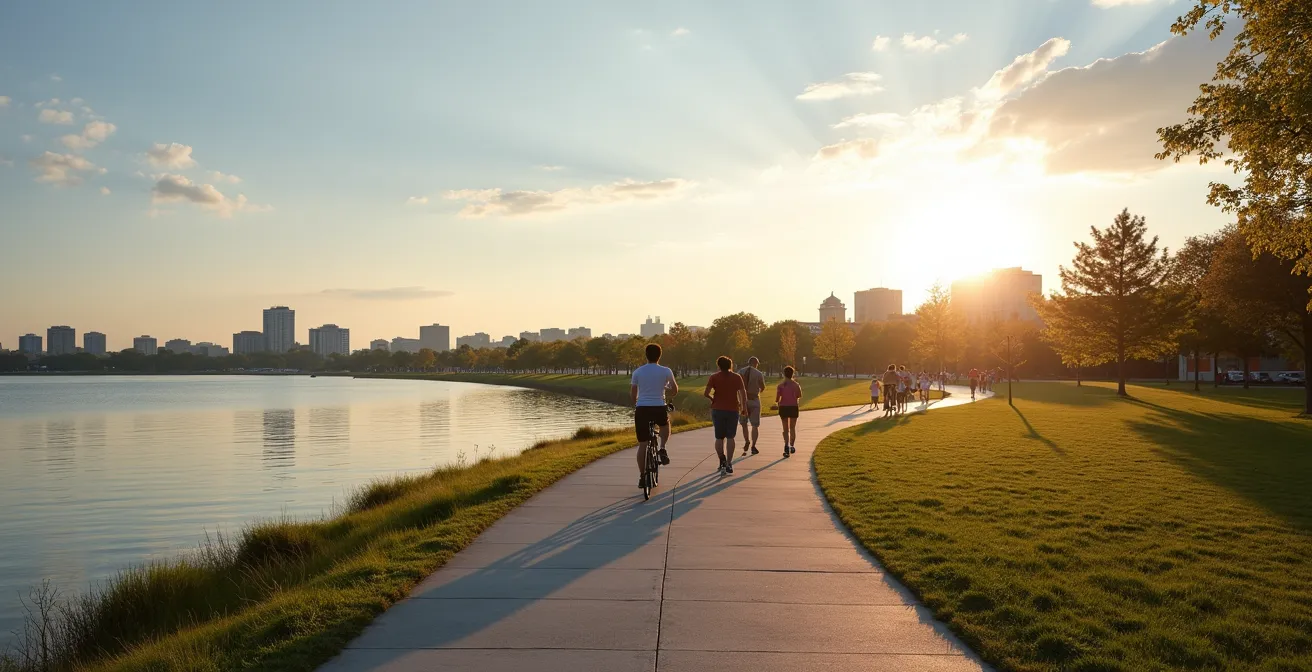
The Lac des Nations promenade is Sherbrooke’s backyard. It’s a beautiful 3.5-kilometer loop around the water that’s buzzing with life year-round. But like any popular local spot, there are unwritten rules. Following them will make you look less like a tourist and more like someone who gets the local rhythm.
First and most important: the flow of traffic is counter-clockwise. Going against the grain is the number one way to stick out. Second, think of the path as having two lanes. The inside lane, closer to the lake, is the “fast lane” for runners and cyclists. The outside lane is the “leisurely lane” for walkers, families with strollers, and anyone taking their time. Respecting this division is crucial for a smooth experience for everyone.
To make a real afternoon of it, do what the locals do:
- Start your journey at the Marché de la Gare, right by the path. Grab some local cheese, bread, or other snacks for a post-walk treat.
- The loop is a perfect warm-up or cool-down for exploring the larger Jacques-Cartier Park, which connects directly to the promenade.
- If you want to avoid the biggest crowds, the best times for a peaceful walk are early in the morning or later in the afternoon, especially on sunny weekends.
It’s more than just a walk; it’s a social ritual. It’s where students de-stress after exams, families spend their Sundays, and athletes train. Understanding its simple etiquette lets you participate in that ritual, not just observe it.
Is the STS Bus System Convenient for Tourists?
For a city of its size, Sherbrooke’s bus system (the STS) is surprisingly effective for getting to the main tourist hubs, especially if you’re staying downtown or near a university. It’s the lifeline for students without cars, which means key routes are frequent and reliable. You won’t be able to get *everywhere*, but for a weekend trip, it covers the essentials without the hassle of parking.
Recently, the STS introduced a tap-to-pay system that accepts credit cards directly on the bus, which is a game-changer for visitors who don’t want to fumble for cash or find a place to buy tickets. You can also get weekend passes at the main downtown station or at many local `dépanneurs` (convenience stores). The system is designed around connecting the city center to the universities and the main shopping mall, which conveniently covers most visitor destinations.
To plan your trip, here’s a quick guide to the most useful routes for tourists.
| Route | Destinations | Frequency | Tourist Highlights |
|---|---|---|---|
| Downtown – UdeS | City center to Université de Sherbrooke | Every 15-20 min weekdays | Campus tours, student life experience |
| Downtown – Carrefour | City center to Carrefour de l’Estrie mall | Every 30 min | Shopping, restaurants |
| Downtown – Lennoxville | City center to Bishop’s University area | Every 30-45 min | Historic campus, English heritage sites |
The main limitation to be aware of is that service is reduced on weekends, and late-night routes are limited. If you’re planning a late night out, especially after 10 PM, having a taxi or Uber as a backup plan is a smart move. But for daytime exploration, the bus is a cheap and efficient way to see the city.
Wellington Street: Where to Find Live Music on a Thursday?
If you want to tap into the city’s authentic nightlife, Thursday is the night. It’s the unofficial start of the student weekend, and Wellington Street and its surroundings come alive with energy and music. Forget waiting for Friday; a Thursday night out is a true Sherbrooke experience. The key is knowing where to go and when.
Your night should start with a “5 à 7” (happy hour). The best place for this is Siboire Dépôt, a microbrewery in a beautifully restored old train station. It’s famous for its craft beers, especially its signature lager. As Eastern Townships Tourism notes, Siboire is a local institution.
La Sherbière, the city’s unofficial ambassador, and a lager concocted by Siboire. You’ll find plenty of places to raise a pint on King Street West, Depot Street and Galt Street West.
– Eastern Townships Tourism, 5 Things to Do in Sherbrooke
After happy hour, it’s time for music. You have options depending on your vibe:
- Boquébière: This is the spot for indie and folk music lovers. It’s known for intimate shows featuring emerging local and Quebec artists.
- Le Murdoch: If you’re looking for a bigger, more energetic crowd and popular cover bands, this is your place.
- Student Bars (near UdeS): For a more raw and unpredictable experience, head towards the university campus to find student bars hosting open mic nights.
- La Petite Salle: Check the schedule for this cultural center on Wellington; it often features up-and-coming bands in a small, dedicated performance space.
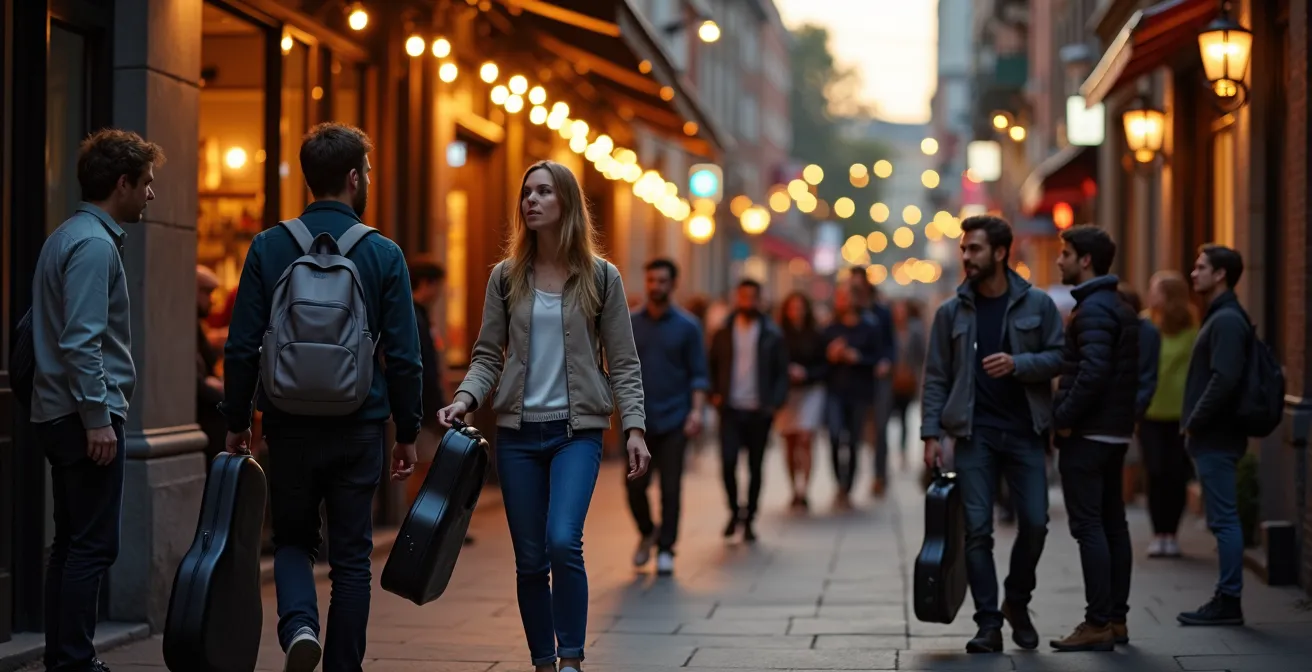
The scene is always changing, so a quick check of online event listings in `La Tribune` or `Voir Estrie` is always a good idea. But this Thursday night itinerary is your blueprint for diving headfirst into Sherbrooke’s vibrant, student-fueled music scene.
Why Do Montreal Staircases Go Outside Instead of Inside?
If you’ve spent time in Montreal, you’re familiar with the iconic outdoor staircases that corkscrew up the fronts of triplexes. They’re a defining feature, born from a 19th-century bylaw meant to maximize green space on small lots. But in Sherbrooke, you won’t find them. The city has a completely different architectural signature, one carved by nature itself: its topography.
Sherbrooke wasn’t built on a flat grid; it was built on and around steep hills (known as `côtes`) and the deep gorge of the Magog River. This rugged landscape forced a different kind of urban development, creating a multi-level city with a unique circulation system. Instead of grand staircases on the front of buildings, Sherbrooke’s character is defined by its hidden public stairways and steep streets connecting different elevations.
Case Study: Sherbrooke’s Topographical Urban Planning
The city’s layout is a direct response to its environment. Streets like Côte King are incredibly steep, and entire neighbourhoods are built on different levels. The solution was a network of public staircases tucked between buildings or running up hillsides. These aren’t just for show; they are vital pedestrian arteries that locals use daily. This creates a fascinating urban exploration experience, where you can turn a corner and discover a new path that takes you to a completely different street level. It’s this verticality, born from the land itself, that gives Sherbrooke its unique urban character, a stark contrast to Montreal’s flat-lot ingenuity.
So, while Montreal’s staircases are a famous solution to a man-made problem (lot size), Sherbrooke’s verticality is a direct conversation with its natural landscape. Exploring these hidden stairs and steep streets is one of the best ways to understand the city’s fundamental design.
Cream Tea or High Tea: Where to Experience English Traditions?
While Sherbrooke is predominantly French-speaking, the city and the surrounding Eastern Townships have deep Anglo-Loyalist roots. Nowhere is this “living history” more charmingly preserved than in the tradition of English tea. And the epicentre of this tradition is the Uplands Cultural and Heritage Centre in the borough of Lennoxville, the historic heart of the region’s English-speaking community.
This isn’t some modern café’s take on tea; it’s a practice so integral to the local heritage that it’s been officially recognized. According to Uplands, the city inventoried local traditions to be protected, and “Tea at Uplands” was one of the 14 practices retained. It’s a tradition that has been served at the centre for over 30 years, a genuine cultural ritual. The experience is fully immersive, with guides in period costumes serving tea in authentic silverware and porcelain cups while interpreting the history behind the custom.
If you want to step back in time and experience this delightful piece of the region’s history, you have several excellent options:
- Uplands Cultural and Heritage Centre: The gold standard. Available Wednesday to Sunday during the high season. Booking is a must.
- Colby-Curtis Museum: Offers afternoon tea on Wednesdays in the summer, providing another historic venue.
- Maison Merry: Located in nearby Magog, this historic house offers a terrace tea service, often with staff in period costume.
- Beaulne Museum: This Coaticook museum sometimes hosts a Victorian tea service that echoes local family traditions.
Participating in an English tea service here is more than just a snack. It’s a delicious way to connect with the unique cultural duality that defines the Eastern Townships.
Key takeaways
- Sherbrooke’s affordability is directly linked to its large student population, which keeps prices for food and entertainment competitive.
- The city’s “local rhythm” includes unwritten rules, like walking counter-clockwise around Lac des Nations and knowing Thursday is the real start to the weekend nightlife.
- The region’s Loyalist history isn’t confined to museums; it’s a living heritage you can experience through its architecture, university campuses, and cultural traditions like English tea.
How to Trace the Loyalist History in the Eastern Townships?
The history of the United Empire Loyalists—American colonists who remained loyal to the British Crown and fled north after the Revolution—is the foundation of the Eastern Townships. This isn’t ancient history; it’s written on the landscape, in the place names, and in the institutions they built. For a visitor, tracing this history is like a treasure hunt, and Sherbrooke is the perfect base camp.
The most prominent living monument to this legacy is Bishop’s University. As The Canadian Encyclopedia explains, Bishop’s was founded in 1843 to provide a liberal education for the English-speaking population of the region and to train Anglican clergy. In 1853, it received a royal charter to grant degrees, solidifying its role as a pillar of Loyalist educational tradition. Walking through its historic campus in the bilingual borough of Lennoxville feels like stepping onto a New England college green.
But the history extends far beyond the university. The Loyalists brought their own way of life, including their religion, architecture, and even their method of dividing the land. You can see the English influence in the Protestant church steeples that dot the countryside and in the grid-like road patterns of the townships, which stand in contrast to the long, narrow “rang” system of French-Canadian settlement. Exploring these clues is the best way to connect with the region’s foundational story.
Your Loyalist History Field Guide: Points to Verify
- Start Point: Begin at the Uplands Cultural and Heritage Centre in Lennoxville to grasp the English settlement patterns and context.
- Architectural Clues: Walk through historic Lennoxville streets, actively looking for English place names and distinct architectural styles on buildings.
- Cemetery Visit: Explore Elmwood Cemetery, identifying the family monuments and gravestones of prominent Loyalist families.
- Campus Heritage: Tour the Bishop’s University campus with a focus on its 1843 Anglican founding heritage, visible in the chapel and older stone buildings.
- Road System Check: As you drive outside the city, notice the shift from the French ‘rang’ system to the square ‘township’ grid patterns on a map.
Frequently Asked Questions about How to Spend a Weekend in Sherbrooke Like a Local?
Where can I buy a weekend STS bus pass?
Weekend passes are available at certain dépanneurs (convenience stores) or at the main STS station downtown.
Can I use credit card on STS buses?
Yes, STS recently introduced a tap-to-pay system accepting credit cards on all buses.
What are the service limitations for tourists?
STS has reduced service on weekends and limited late evening routes. Consider taxi or Uber as backup options after 10 PM.