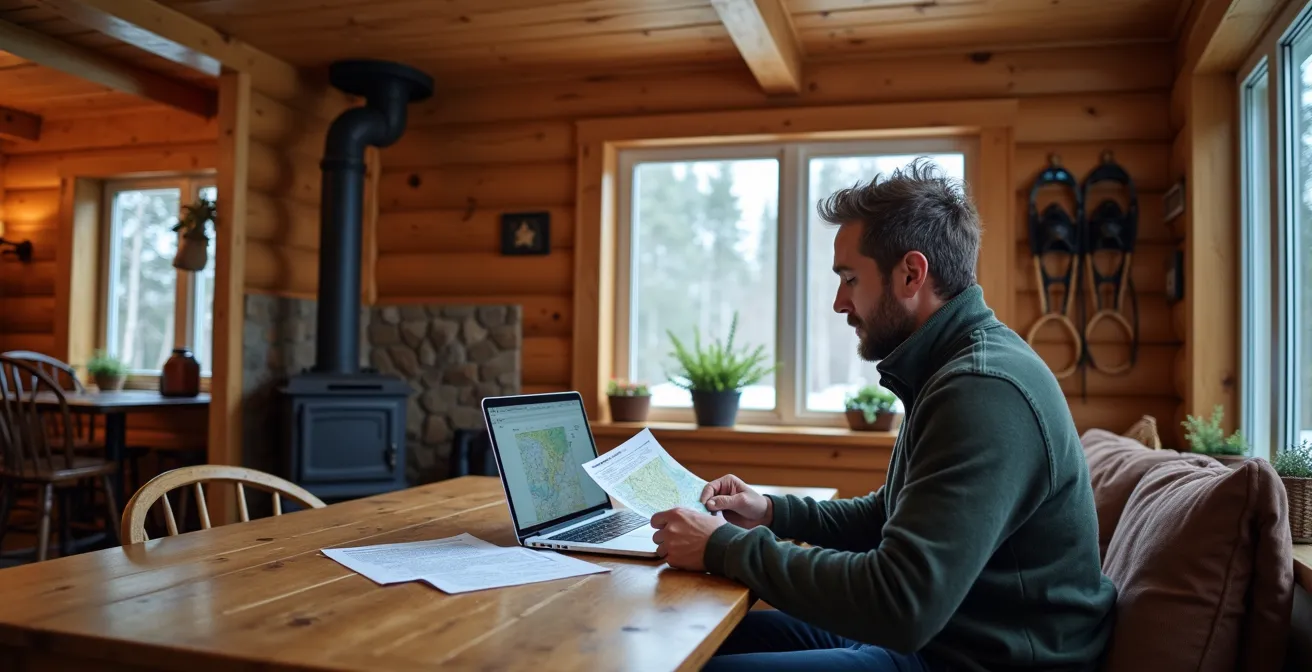
To avoid Quebec rental fraud, you must shift from a traveler’s mindset to a fraud investigator’s, treating every listing as a case to be solved before any money changes hands.
- The CITQ registration number is your primary, non-negotiable tool for verifying a listing’s legitimacy in Quebec. No number, no rental.
- Payment by credit card is the only method that offers a true financial safety net against deposit scams, thanks to chargeback protections.
Recommendation: Before booking, conduct a “forensic verification” by reverse-searching images, validating the CITQ number on the official Bonjour Québec registry, and getting all rules and payment terms in a written contract.
The dream of a Quebec chalet getaway—a cozy fireplace, serene lake views, the vast expanse of La Belle Province—is a powerful lure. Platforms like Airbnb and Facebook Marketplace make finding that perfect spot seem easier than ever. But this convenience has a dark side. The digital marketplace is a hunting ground for sophisticated scammers who exploit that dream, turning it into a financial and emotional nightmare. You might think common sense is enough to protect you, but the landscape of rental fraud has evolved into a complex web of deception.
The reality is that online rental scams are not just a nuisance; they are a rampant criminal enterprise. Recent statistics are alarming, with one report showing that over 108,000 cases of fraud were reported in Canada in 2024, resulting in financial losses of over $638 million. This isn’t about just losing a deposit; it’s about stolen identities, ruined vacations, and the pervasive feeling of being violated. Scammers are no longer amateurs; they use high-quality photos, create convincing fake profiles, and apply psychological pressure to rush you into a bad decision.
But what if the key to protecting yourself wasn’t just being cautious, but becoming methodical? This guide is not a simple checklist of platitudes. It is a forensic manual. We will adopt the mindset of a fraud investigator, scrutinizing every detail of a listing as a piece of evidence. From dissecting photos for digital fingerprints to understanding the legal shield of Quebec’s specific regulations, you will learn to dismantle a potential scam before it ever gets off the ground. This is about transforming your vulnerability into strength by knowing exactly what to look for, what to demand, and when to walk away.
This article provides a systematic approach to securing your rental. Each section tackles a critical piece of the puzzle, equipping you with the investigative techniques needed to navigate the Quebec chalet market safely and confidently.
Summary: How to Rent a Chalet in Quebec Without Getting Scammed?
- The Photo Mistake That Reveals a Fake Chalet Listing
- Why You Must Look for the CITQ Number on Every Rental Ad?
- Cash or Credit: How to Protect Your Security Deposit?
- Party House or Quiet Zone: How to Know the Rules Before Booking?
- Where to Put Your Garbage to Avoid Attracting Animals?
- Why You Need to Book Treehouses 6 Months in Advance?
- Filming Public Spaces: What Are the Privacy Rights of People Below?
- How to Choose Glamping Accommodations That Are Actually Comfortable?
The Photo Mistake That Reveals a Fake Chalet Listing
The first piece of evidence in any rental investigation is the photography. Scammers often steal professional photos from legitimate listings, real estate sites, or even stock photo libraries. Your job is to find the inconsistencies—the digital fingerprints they leave behind. A beautiful, sun-drenched deck photo is useless if you’re booking for a February ski trip. This is a classic red flag: seasonal inconsistency. If the photos show lush green forests but you’re booking for winter, or a snow-covered landscape for a summer rental, you must question the listing’s authenticity immediately.
This initial visual scan is your first line of defense. Look for Quebec-specific details that are hard to fake. Does the wood stove look like a local brand such as Drolet or Enerzone? Can you spot any recognizable landmarks or architecture typical of the region? Generic, overly polished “luxury” photos that could be from anywhere in the world are highly suspicious. A real owner’s photos often have a more personal, less sterile feel. Your goal is to find proof that the photos were taken at the listed property and at an appropriate time.
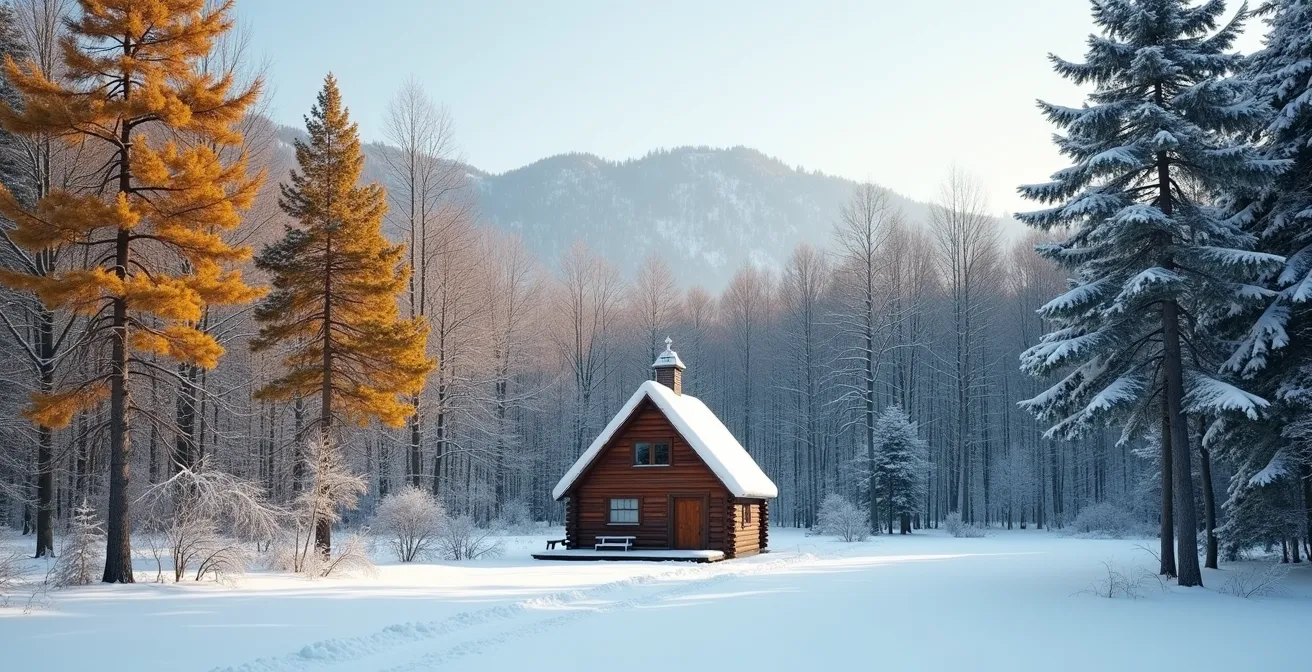
As the comparison above illustrates, the environment around a Quebec chalet changes dramatically with the seasons. Use this to your advantage. A powerful and simple tool in your arsenal is a reverse image search. Using services like Google Images, you can upload the listing’s photos to see if they appear anywhere else online. If the same chalet photo shows up on a real estate site in another country or is associated with a different rental entirely, you have likely uncovered a scam. This single step can expose a fraudulent listing in seconds.
Your Action Plan: Spotting Fake Rental Photos
- Check for seasonal inconsistencies: Compare the foliage, snow levels, or lake conditions in the photos with your booking season.
- Conduct a reverse image search: Use Google Images to see if the photos appear on other, unrelated websites.
- Compare across platforms: If the chalet is listed on multiple sites, check for discrepancies in the photos or descriptions.
- Look for Quebec-specific details: Identify local brands, architectural styles, or recognizable landmarks that ground the photo in the region.
- Use Google Street View: Verify that the exterior of the property at the given address matches the photos in the listing.
- Cross-reference with official records: For high-value rentals, check Quebec’s Registre foncier to confirm the building’s description matches the listing.
Why You Must Look for the CITQ Number on Every Rental Ad?
If photos are the first clue, the CITQ number is the definitive proof of legitimacy. In Quebec, it is illegal for most short-term tourist accommodations to operate without being registered with the Corporation de l’industrie touristique du Québec (CITQ). This registration assigns a unique number to the property, which legally must be displayed on every advertisement, whether on Airbnb, Facebook, or a private website. Treating this number as optional is a critical error. The absence of a CITQ number is the loudest red flag a listing can have.
Do not simply take the number at face value. Scammers are known to use fake or stolen numbers. Your next investigative step is to verify it. The official Bonjour Québec website hosts a public directory where you can enter the CITQ number and confirm that it matches the address and owner details of the property you intend to rent. If the number is missing, fake, or belongs to a different property, you must cease all communication and report the listing immediately. This is your most powerful legal shield.
It’s important to understand the nuance here. According to some sources, in Quebec, more than 5,000 tourist residences are awaiting classification. This means a new, legitimate owner might be in the process of getting their number. In this rare case, they must be able to provide you with official correspondence from the CITQ as proof. If they cannot, assume it is a scam. An honest owner will understand and appreciate your due diligence.
This table breaks down what to look for when performing your verification. As outlined by rental experts at platforms dedicated to secure chalet rentals, the differences between a legitimate listing and a scam are often clear when you know where to look.
| Legitimate CITQ-Certified | Potential Scam Indicators |
|---|---|
| CITQ number visible on all platforms | No CITQ number or fake number |
| Number verifiable on Bonjour Québec site | Number doesn’t match property details |
| Owner name matches official records | Different names across platforms |
| Consistent pricing across sites | Unusually low prices for peak season |
| Professional photos with Quebec details | Generic luxury photos from anywhere |
Cash or Credit: How to Protect Your Security Deposit?
Once you’ve verified a listing’s legitimacy, the next critical phase is protecting your money. The payment method is not a matter of convenience; it’s a strategic choice that determines your level of protection. Scammers will almost always pressure you to pay via methods that are fast and untraceable, such as e-transfers, wire transfers, or cryptocurrency. You must refuse. These are the equivalent of handing over a bag of cash—once it’s gone, there is virtually no way to get it back.
Your one and only tool for secure payment is a credit card. This is non-negotiable. Paying with a credit card provides a crucial layer of protection through the right to a “chargeback.” If the rental turns out to be fraudulent, doesn’t match the description, or if you’re unfairly charged for damages, you can dispute the transaction with your credit card company. This initiates an investigation and is your best chance of recovering your funds. A legitimate owner operating a professional business will always have a system to accept credit card payments.
The security deposit itself is a major point of vulnerability. The financial stakes are high; the Canadian Anti-Fraud Centre (CAFC) has noted that online rental scams increased by 15 per cent between 2019 and 2020 with Canadians losing approximately $586,000. To protect yourself, you need to create your own evidence trail. Upon arrival, before you even bring your bags inside, do a full walkthrough of the chalet and document everything.
- Take a timestamped video or photos of the property’s condition, paying close attention to any existing damage, scuffs, or stains.
- Document every single issue, no matter how minor, and immediately send this documentation to the owner in writing (email or via the platform’s messaging system) to create a dated record.
- Before you leave, do another walkthrough video showing you’ve left the property clean and in good order.
- Save all communications with the owner. This digital paper trail is your best defense against false claims on your security deposit.
Party House or Quiet Zone: How to Know the Rules Before Booking?
A scam isn’t always a fake listing. Sometimes, the trap is in the contract. A dream vacation can quickly turn into a nightmare of fines and disputes if you are unaware of the chalet’s specific rules and, just as importantly, the local municipal bylaws. Many chalets, especially those in residential areas, have strict regulations regarding noise levels, occupancy limits, and guest policies. Assuming you can have a few extra daytime guests or play music outdoors could be a costly mistake.
Your investigative work must extend to the local regulations. Before booking, ask the owner for a copy of the full rental agreement and scrutinize it for clauses related to penalties. Then, perform your own due diligence. A simple web search for “[Municipality name] + nuisance bylaw” can reveal local laws. Popular rental areas like Mont-Tremblant, Saint-Côme, or Petite-Rivière-Saint-François are known for having stringent rules to protect the tranquility for full-time residents. Ignorance is not a defense, and owners can and will enforce contractual penalties in Quebec courts.
Insist on written clarification from the owner on key points before you book. Your questions should be specific:
- What is the absolute maximum number of occupants permitted on the property at any time, including daytime visitors?
- What are the exact hours for noise curfews (e.g., no outdoor music after 10 PM)?
- Are there any restrictions on outdoor fires, and if so, what are they?
Getting these answers in writing via the booking platform or email creates a contractual record that protects you from a “he said, she said” dispute later. This proactive investigation prevents you from falling into a contractual trap where your security deposit is unfairly withheld for a rule you were never made aware of.
Where to Put Your Garbage to Avoid Attracting Animals?
This may seem like a trivial detail, but in the natural environment of Quebec, mishandling waste is a serious issue that can lead to significant financial penalties and dangerous wildlife encounters. It is another form of “hidden cost” scam where owners can justify keeping your deposit for non-compliance. You must treat waste management with the same investigative rigor as any other part of the rental agreement. The rules are there for a reason: to prevent attracting animals like raccoons, skunks, and even black bears.
Before your stay, you must get clear, written instructions from the owner on the exact waste disposal procedures. Ask specific questions:
- Where are the designated garbage and recycling bins located?
- Are the bins animal-proof (e.g., with locking mechanisms)?
- What is the pickup schedule, and what are my responsibilities on departure day?
- Are there specific sorting requirements for recycling or compost?
Many chalet rental companies, like Sépaq, have implemented robust, bear-proof waste systems in regions like the Laurentians and Charlevoix because the risk is so real. Leaving garbage bags on a deck or in a flimsy bin is an open invitation for wildlife, and any resulting damage or required special cleanup will be charged directly to you.
Check the rental contract for a “garbage clause.” Many owners include steep penalties for failing to follow the rules, which can be in addition to any municipal fines you might incur. The Quebec Ministry of Forests, Wildlife and Parks (MFFP) provides official directives on human-wildlife cohabitation, and municipalities enforce them. An owner is well within their rights to pass these fines on to you. By clarifying these procedures beforehand, you protect both your deposit and the local ecosystem.
Why You Need to Book Treehouses 6 Months in Advance?
Unique accommodations like treehouses, bubbles, and avant-garde tiny homes are in extremely high demand across Quebec. This scarcity creates a perfect storm for fraud: high demand, low supply, and a sense of urgency that makes travelers lower their guard. Scammers capitalize on this “fear of missing out” by creating fake listings for sought-after properties, knowing that eager renters are more likely to skip crucial verification steps to secure a spot. When a listing for a popular treehouse is suddenly available last-minute at a great price, your investigator instincts should be on high alert.
Legitimate unique stays are often booked 6 to 12 months in advance, especially for peak seasons. Their owners have no need for last-minute deals or high-pressure sales tactics. Therefore, you must apply even more scrutiny to these listings. The first step is to look for a digital footprint beyond the single ad you saw. A reputable, in-demand property will have a professional website, social media presence, and mentions in travel blogs or regional tourism directories. For instance, legitimate operators are often members of tourism associations like Aventure Écotourisme Québec. A listing that exists only on Facebook Marketplace with no other online presence is a massive red flag.
Do not let the excitement for a one-of-a-kind experience cloud your judgment. All the rules of forensic verification still apply. Insist on a CITQ number (certified as ‘Unusual Lodging’), pay only by credit card, and get a detailed contract. If the “owner” pressures you for an immediate e-transfer to “hold your spot because many others are interested,” you are almost certainly dealing with a scam. A real business has a secure, patient booking process. Let someone else fall for the trap; your diligence will ensure you eventually book a real, incredible experience, not a fake one.
Filming Public Spaces: What Are the Privacy Rights of People Below?
Your investigation isn’t just about protecting your money; it’s about protecting your personal safety and privacy. An increasingly common issue is the presence of undisclosed surveillance cameras in rental properties. In Quebec, your right to privacy is not just a courtesy; it is enshrined in law. You must be aware of your rights and know how to check for violations. Any form of indoor surveillance that is not explicitly disclosed and consented to is illegal.
The law is clear and provides a powerful tool for your protection. As stated in the Civil Code of Quebec, your privacy is a fundamental right. This is not open to interpretation by a property owner.
Under the Civil Code of Quebec Article 35, every person has a right to the respect of their private life. Undisclosed indoor security cameras in rentals are illegal.
– Civil Code of Quebec, Article 35 – Right to privacy
This means cameras inside the chalet—in living rooms, bedrooms, or hallways—are illegal unless you have been informed of their exact location and purpose beforehand and have explicitly agreed to it in writing. However, cameras monitoring the exterior of the property, such as those pointed at entrances, driveways, or outbuildings for security purposes, are generally considered legal. The key distinction is whether the camera has a view of a space where you have a reasonable expectation of privacy.
Upon arrival, you should conduct a physical sweep for any unauthorized recording devices. Here’s how:
- Scan for suspicious devices: Look for unusual items or electronics pointed towards beds, bathrooms, and living areas. Be wary of things like smoke detectors with a lens, odd-looking alarm clocks, or USB chargers.
- Use a flashlight: Turn off the lights and slowly sweep your phone’s flashlight around the room. A camera lens will often reflect the light back at you.
- Check the Wi-Fi network: Use a network scanning app on your phone to see all devices connected to the chalet’s Wi-Fi. Look for any devices that seem out of place or have names related to cameras.
If you find a hidden camera, do not touch it. Document its location with photos, leave the property immediately, and report it to the local police and the booking platform. Your privacy is non-negotiable.
Key Takeaways
- Always Verify the CITQ Number: This is the single most important step to confirm a rental’s legitimacy in Quebec. No number means no booking.
- Credit Card is Your Only Safety Net: Never use e-transfers or cash. Credit card chargebacks are your primary defense against fraud and deposit disputes.
- Document Everything: Create an evidence trail with timestamped photos/videos of the property’s condition upon arrival and departure to protect your security deposit.
How to Choose Glamping Accommodations That Are Actually Comfortable?
Glamping has exploded in popularity, offering a taste of nature without sacrificing comfort. But this trend has also created a new type of scam: the “comfort scam.” This is where a listing promises a luxurious, four-season experience, but delivers a poorly insulated tent or dome that is unbearable in the Quebec winter or sweltering in the summer. Verifying comfort claims is just as important as verifying a listing’s existence, especially when dealing with the province’s extreme weather.
Do not trust vague marketing terms like “winterized” or “four-season.” These have no official definition and are often used to mislead. A true four-season glamping unit in Quebec requires serious engineering. Your investigation should focus on finding evidence of these features. Scrutinize the photos for an industrial-grade heating unit (a tiny space heater is a huge red flag), proper insulation, and a design built to handle heavy snow loads. Ask the owner directly: Are the water lines heated to prevent freezing? Is the access road professionally plowed in winter? A legitimate operator will be proud to provide these technical specifications.
The CITQ shield applies here as well. These properties should be registered under the ‘Unusual Lodging’ category. The absence of a CITQ number is just as suspicious for a yurt or dome as it is for a traditional chalet. The following table provides a clear comparison to help you distinguish a genuinely comfortable glamping setup from one that will leave you cold.
| Legitimate Four-Season Ready | Potential Comfort Scam |
|---|---|
| Proper insulation specifications provided | Vague claims about ‘winterized’ |
| Heated water lines to prevent freezing | No mention of plumbing in winter |
| Industrial heating unit visible in photos | Only shows tiny space heater |
| Plowed access road guaranteed | No mention of winter road access |
| CITQ certified as ‘Unusual Lodging’ | No CITQ certification |
By adopting this investigative mindset—verifying every claim, creating evidence trails, and understanding your rights—you take control of the rental process. The goal is not paranoia, but empowerment. It ensures the Quebec chalet you book is a place of relaxation and joy, not a source of regret and financial loss. Your dream vacation is worth the due diligence.
Frequently Asked Questions About Renting a Chalet in Quebec
What happens if I leave garbage outside in bear country?
You can face municipal fines which the owner will pass on to you, plus potential property damage costs if wildlife is attracted.
Where can I find official wildlife cohabitation guidelines?
Quebec’s Ministry of Forests, Wildlife and Parks (MFFP) provides directives on human-wildlife cohabitation and proper waste management.
Should I check the rental contract for garbage clauses?
Yes, many owners impose significant penalties for non-compliance with waste disposal rules, in addition to any municipal fines.