Planning a trip to Nunavik requires abandoning a tourist mindset and adopting a supply chain coordinator’s strategy to manage costs effectively.
- The extreme costs are driven by the logistical challenges of a remote, harsh environment, not arbitrary tourist markups.
- Proactive management of weight (food, gear) and time (flight buffers) are the most significant levers for savings, not searching for “deals.”
Recommendation: To immediately cut costs, apply the “24-Hour Buffer Rule” for all connecting flights and plan to ship non-perishable food ahead via air cargo.
The first glance at the cost of a trip to Nunavik can be shocking. When a flight from Montreal to Kuujjuaq costs more than a round trip to Europe, and a week-long adventure easily tops $5,000, it’s natural to ask if an arctic dream is even possible on a reasonable budget. Many travelers apply standard cost-saving tactics: booking in advance, looking for deals, or packing light. But these strategies, designed for well-trodden tourist paths, fail in the North.
The fundamental mistake is approaching Nunavik with a tourist’s mindset. The key to making this region accessible is to think like a logistics coordinator for a remote northern supply chain. The high prices aren’t a “tourist tax”; they are a direct reflection of the immense operational challenges of moving people and goods across a vast, roadless territory with extreme weather. Your budget isn’t won by finding a hidden discount code, but by systematically managing the core logistical drivers: weight, volume, timing, and access protocols.
This guide will deconstruct the costs and challenges of a Nunavik journey through that logistical lens. We will analyze why flights are so expensive, how to pack for maximum efficiency, the critical importance of food-shipping strategy, and how to navigate land access and cultural engagement with the precision of a professional. By shifting your perspective, you’ll uncover the real opportunities for savings that others miss.
This article provides a structured approach to planning your adventure, breaking down each logistical challenge into a manageable step. The following summary outlines the key areas we will cover to transform your planning process from frustrating to strategic.
Summary: How to Plan a Trip to Nunavik: A Logistics-Based Approach
- Why Are Flights to Kuujjuaq More Expensive Than to Europe?
- What to Pack for the Tundra Where Summer Can Mean Snow?
- Landholding Corporations vs. Public Land: Where Can You Actually Hike?
- The Delay Mistake That Ruins Connecting Flights from the North
- How to ship Your Own Food North to Save 50% on Groceries?
- Beaver or Otter Plane: How Much Gear Can You Actually Bring?
- Inuit vs. First Nations vs. Metis: What Terms Should You Use?
- How to Engage with Indigenous Tourism Respectfully in Quebec?
Why Are Flights to Kuujjuaq More Expensive Than to Europe?
The primary reason for the sticker shock on Nunavik flights is a misunderstanding of the market. You are not booking a seat on a competitive leisure route; you are booking passage on an essential lifeline. The economics are closer to a resource-extraction charter than a commercial airline. Analysis of flight cost data shows an average price of $2,919 for the relatively short 1,446 km journey from Montreal to Kuujjuaq. This isn’t an arbitrary markup; it’s a reflection of harsh operational realities.
First, there is limited competition. Only a couple of airlines serve these routes, creating a duopoly that does not need to compete on price in the same way carriers on the Montreal-Paris route do. Second, operating costs are extraordinarily high. Specialized aircraft are required to land on gravel runways, fuel is more expensive, and maintenance cycles are more intense due to the harsh climate. Weather frequently causes delays and cancellations, adding further operational costs that are baked into the ticket price.
The critical takeaway for a budget-conscious traveler is that you cannot “hack” this cost. There are no last-minute deals or secret off-season discounts. The price is a fixed logistical reality. Therefore, the most effective budget strategy is not to waste time searching for a cheaper flight, but to accept this cost and focus on the variables you can control: the cost of food, gear, and local transport, which we will address next.
What to Pack for the Tundra Where Summer Can Mean Snow?
In the context of northern logistics, packing is a problem of maximizing versatility while minimizing weight and volume. It’s not just about staying warm; it’s about managing “payload efficiency” for expensive bush plane flights and adapting to radical weather shifts. Summer in Nunavik can mean a pleasant 20°C (70°F) during the day and drop to near freezing at night. A single day can bring intense sun, biting winds, rain, and even snow. This is why local experts like Inuit Adventures emphasize a technical layering system as a non-negotiable core of your gear.
This system consists of three key parts: a moisture-wicking base layer (like merino wool), an insulating fleece jacket (mid-layer), and a high-quality waterproof and windproof outer shell. This allows you to adapt to any condition by adding or removing layers, rather than carrying multiple bulky, single-purpose coats. Beyond clothing, your gear list must address other environmental realities. Polarized sunglasses are essential to combat the relentless glare off water and snow, while a bug jacket or strong repellent is critical for the intense mosquito and black fly season of July and August. For any travel outside of community limits, a satellite phone is a mandatory safety tool, as cell service is non-existent.
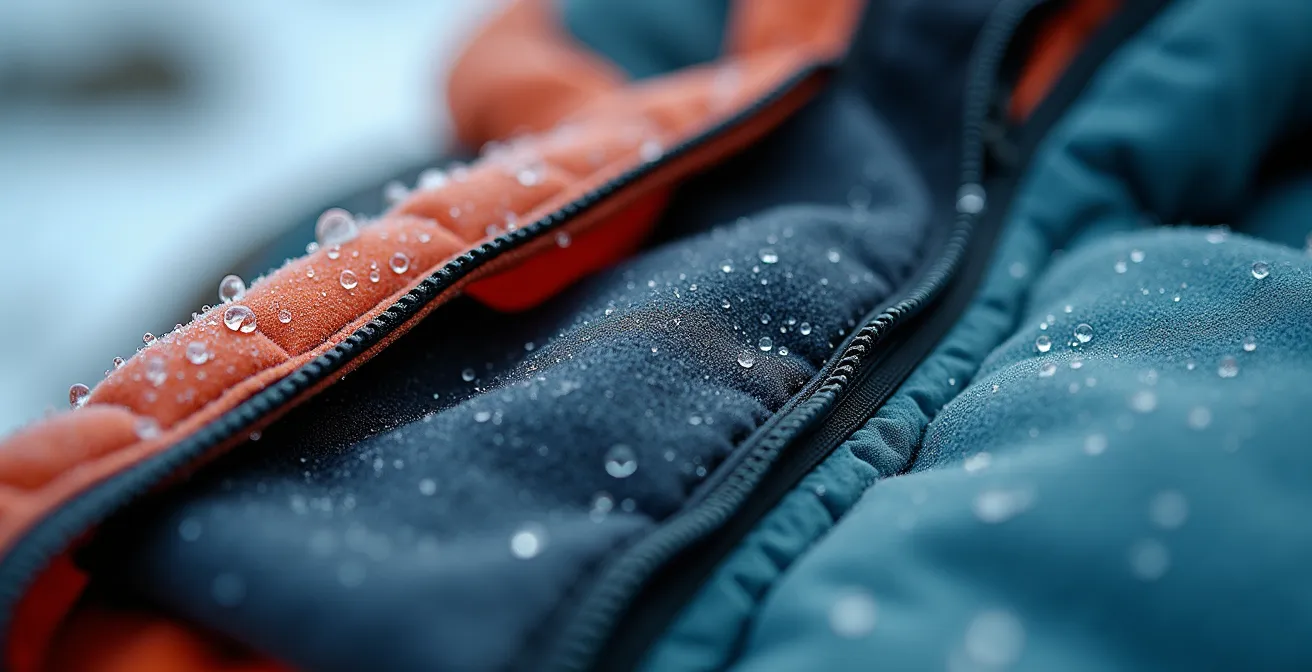
As the image of technical fabrics shows, the focus is on performance materials that offer maximum protection for minimum weight. Every item in your bag should be evaluated not on whether it’s “nice to have,” but on whether it serves a critical function in this highly variable environment. This disciplined approach is the first major step in controlling the secondary costs of your expedition.
Landholding Corporations vs. Public Land: Where Can You Actually Hike?
The assumption that you can simply arrive and hike anywhere in Nunavik’s vast wilderness is a critical planning error. The region, covering an area of 500,000 km² with just 12,090 inhabitants (90% of whom are Inuit), is not a giant, open-access park. Land tenure is a complex system governed by the 1975 James Bay and Northern Québec Agreement, and respecting it is a legal and cultural imperative.
The land is divided into three main categories, each with different access rules:
- Category I Lands: These lands are for the exclusive use of Inuit beneficiaries and are located around the 14 northern villages. To access, hunt, or even hike on these lands, you must obtain prior permission from the local Landholding Corporation (LHC). Showing up without authorization is trespassing.
- Category II Lands: On these lands, Inuit have exclusive hunting, fishing, and trapping rights. While general access for hiking or camping may be tolerated, these rights must be respected. You cannot interfere with any local activities.
- Category III Lands: These are public or “Crown” lands, managed by the Quebec government. While generally open for public use, it’s a crucial sign of respect and a vital safety measure to inform the local municipal office or police detachment of your itinerary before heading out.
For travelers seeking a more structured experience, Nunavik’s four magnificent national parks—Pingualuit, Kuururjuaq, Tursujuq, and Ulittaniujalik—offer established infrastructure and clear guidelines for access. From a logistical standpoint, treating land access as a formal protocol is essential. Research your intended route, identify the land category, and contact the appropriate authority well in advance. This isn’t just about being polite; it’s about following the law and ensuring your safety in a remote environment.
The Delay Mistake That Ruins Connecting Flights from the North
In northern travel, the single biggest logistical mistake a traveler can make is failing to adequately buffer for delays. Weather in Nunavik is famously unpredictable and can change in minutes, grounding flights for hours or even days. As a result, booking a same-day connecting flight (especially an international one) out of Montreal on your return from Kuujjuaq is an extremely risky gamble. A simple fog bank in the north can cause a cascade of missed flights, expired tickets, and massive rebooking fees.
The supply chain mentality requires building redundancy into your schedule. Local operators and experienced travelers live by a simple rule: never book a critical connection on the same day you are scheduled to fly out of the North. Baggage can also be delayed or lost, so keeping essentials like medication, passports, money, and a change of clothes in your carry-on is not just a suggestion, but a critical risk-management practice. Adopting a proactive strategy to mitigate the high probability of delays is far more effective than hoping for the best.
Action Plan: Your Anti-Delay Flight Strategy
- Apply the 24-Hour Buffer Rule: Never book same-day international or other critical connecting flights when returning from Nunavik. Plan an overnight stay in Montreal.
- Avoid High-Risk Flights: Flights scheduled after 3 PM statistically have a higher risk of cancellation due to developing weather or accumulated delays from earlier in the day. Book morning flights when possible.
- Pack a Resilient Carry-On: Your carry-on must contain all absolute essentials: medications, documents, money, and at least one change of clothes. Do not check these items.
- Confirm Insurance Coverage: Before purchasing travel insurance, verify that the policy explicitly covers trip interruption and cancellation due to weather-related delays, a common exclusion.
- Book Flexible Tickets: When possible, opt for flexible or semi-flexible fare classes that allow for changes with minimal financial penalty. The slightly higher upfront cost is insurance against a much larger loss.
Treating your travel schedule with this level of diligence transforms a potential trip-ruining disaster into a manageable inconvenience. It’s the difference between a panicked scramble at the airport and a relaxed evening in Montreal before your flight home.
How to ship Your Own Food North to Save 50% on Groceries?
One of the most significant and controllable expenses in Nunavik is the cost of food. Because everything must be flown in, food prices in Northern stores can be double or triple what you would pay in a major city like Montreal or Quebec City. A shopping cart with basic staples can easily run into hundreds of dollars. For a trip of a week or more, this can decimate a budget. The logistical solution is simple and highly effective: ship the bulk of your non-perishable food north ahead of your arrival.
This “supply chain” strategy is standard practice for residents and long-term workers. By packing a box with items like dehydrated meals, pasta, rice, coffee, protein bars, and dried fruit, you can leverage the much cheaper rates of air cargo versus paying retail for the same goods. Airlines serving the region offer cargo services (like Canadian North Cargo) that allow you to send sealed, well-labeled boxes to their warehouse in your destination community for pickup upon arrival. While there is a cost to shipping, it is a fraction of the savings you will realize.

This approach requires advance planning. You need to prepare your shipment weeks before your trip, calculate your needs, and pack methodically. This single act of logistical foresight can save you 50% or more on your total food bill, freeing up significant funds for other experiences. It is perhaps the most powerful application of the “logistics coordinator” mindset to make a Nunavik trip affordable.
Beaver or Otter Plane: How Much Gear Can You Actually Bring?
For any travel beyond Nunavik’s village centers, you will likely rely on a bush plane—typically a DHC-2 Beaver or DHC-3 Otter. This is the “last mile” of your supply chain, and understanding its limitations is critical. Unlike a commercial jet, where baggage allowance is a generous standard, a bush plane’s capacity is dictated by a hard, inflexible reality: total payload. This includes passengers, gear, and the fuel required for the flight. Your packing discipline directly impacts the feasibility and cost of the trip.
The choice of aircraft often depends on the size of your group and the amount of gear. A smaller plane like the Beaver is more nimble, but a larger group with extensive gear will require an Otter. The key is that these are often chartered by the flight hour, not per seat, so coordinating with other travelers to share the cost is a major budgeting tool.
| Aircraft Type | Typical Payload | Passenger Capacity | Key Limitation |
|---|---|---|---|
| DHC-2 Beaver | ~1,200 lbs (540 kg) | 5-6 passengers | Weight and volume restricted |
| DHC-3 Otter | ~2,100 lbs (950 kg) | 10-11 passengers | Charter by flight hour, not per seat |
| Boeing 737 | Standard baggage allowance | 60+ passengers | Scheduled service only |
To manage these constraints, you must adopt a payload-efficient packing strategy. This means prioritizing high-density, low-volume gear and using soft-sided, compressible bags that can be manipulated to fit into tight cargo holds. Before your departure, you must communicate the total weight of your group and gear to the pilot. They will make the final calculation, including fuel, to determine if the flight is safe and legal. Ignoring these weight restrictions is not an option; it’s a fundamental issue of aviation safety.
Inuit vs. First Nations vs. Metis: What Terms Should You Use?
Cultural competence is a key part of any logistical operation in a new region. Using correct terminology is a fundamental sign of respect and awareness. In Canada, there are three distinct groups of Indigenous peoples recognized in the Constitution: First Nations, Inuit, and Métis. These terms are not interchangeable, and each group has its own unique history, culture, and language.
The Indigenous people of Nunavik are Inuit. The term “Eskimo” is considered outdated and offensive in Canada. The local dialect of their language is Inuktitut, and it is a vibrant part of daily life. As the Wikivoyage Travel Guide for the region notes, precision in language is deeply appreciated:
Nunavik means ‘great land’ in the local dialect of Inuktitut and the Inuit inhabitants of the region call themselves Nunavimmiut.
– Wikivoyage Travel Guide, Nunavik Travel Guide
It’s also important to know that not all Indigenous people in the broader northern Quebec region are Inuit. For example, the Naskapi Nation of Kawawachikamach, located near the southern border of Nunavik, are a First Nations people. Making this distinction shows that you have done your homework and are engaging with the local context in a meaningful way. When in doubt, it is always best to listen to how people refer to themselves. Using the correct terms is a simple yet powerful way to demonstrate respect.
Key Takeaways
- Flight costs to Nunavik are a fixed logistical reality; true savings come from meticulously managing controllable variables like food costs and gear weight.
- The “24-Hour Buffer Rule” for connecting flights is a non-negotiable risk management strategy to mitigate the high probability of weather-related delays.
- Respectful engagement in Nunavik is demonstrated through concrete actions: prioritizing Inuit-owned businesses, learning correct terminology, and adhering to community protocols like the “Ask First” rule for photography.
How to Engage with Indigenous Tourism Respectfully in Quebec?
Respectful engagement in Nunavik goes far beyond simple politeness. It requires a shift from a consumer mindset to one of quiet observation and genuine support for the local community. The goal, as exemplified by operators like Inuit Adventures, is to immerse visitors in the culture—not to treat communities as exhibits. This means participating in experiences where Elders share stories or guides explain wildlife movements, creating a two-way exchange rather than a one-way transaction.
To put this into practice, your logistical planning should actively prioritize the local economy and respect community norms. One of the most powerful actions you can take is to support Inuit-owned businesses. When booking a tour, guide, or accommodations, ask the question: “Are you an Inuit-owned company?” Prioritize businesses affiliated with organizations like the Fédération des coopératives du Nouveau-Québec (FCNQ), which funnels profits back into the communities.
In daily interactions, a mindset of observation over interrogation is key. Instead of arriving with a list of questions, spend time quietly observing daily life. Photography is a particularly sensitive area. Always apply the “Ask First” rule before taking photos of people, especially children and Elders. In many community spaces, it’s best to keep your camera away entirely. When purchasing arts and crafts, try to buy directly from the artists themselves. This ensures they receive the full value of their work and provides a moment for genuine human connection. This approach transforms you from a passive tourist into an active, respectful participant in the local ecosystem.
By adopting this logistical and respectful framework, your trip to Nunavik can transform from a financially daunting prospect into a deeply rewarding and manageable adventure. To begin applying these principles, the next logical step is to start your research by identifying Inuit-owned tour operators and service providers who can help build your itinerary.
Frequently Asked Questions on Planning a Trip to Nunavik
What is the correct term for Indigenous people of Nunavik?
The Indigenous people of Nunavik are Inuit. The term Nunavimmiut (singular: Nunavimmiuq) means ‘people of Nunavik’ and is the preferred self-identifying term.
What language do Inuit speak in Nunavik?
The primary Indigenous language is Inuktitut, specifically the Nunavimmiutitut dialect. Key phrases include ‘Ainngai’ (Hello), ‘Nakurmiik’ (Thank you).
Is there a difference between Inuit and First Nations in the region?
Yes, the Naskapi Nation of Kawawachikamach near Schefferville are First Nations people, not Inuit. This distinction is important for cultural accuracy.