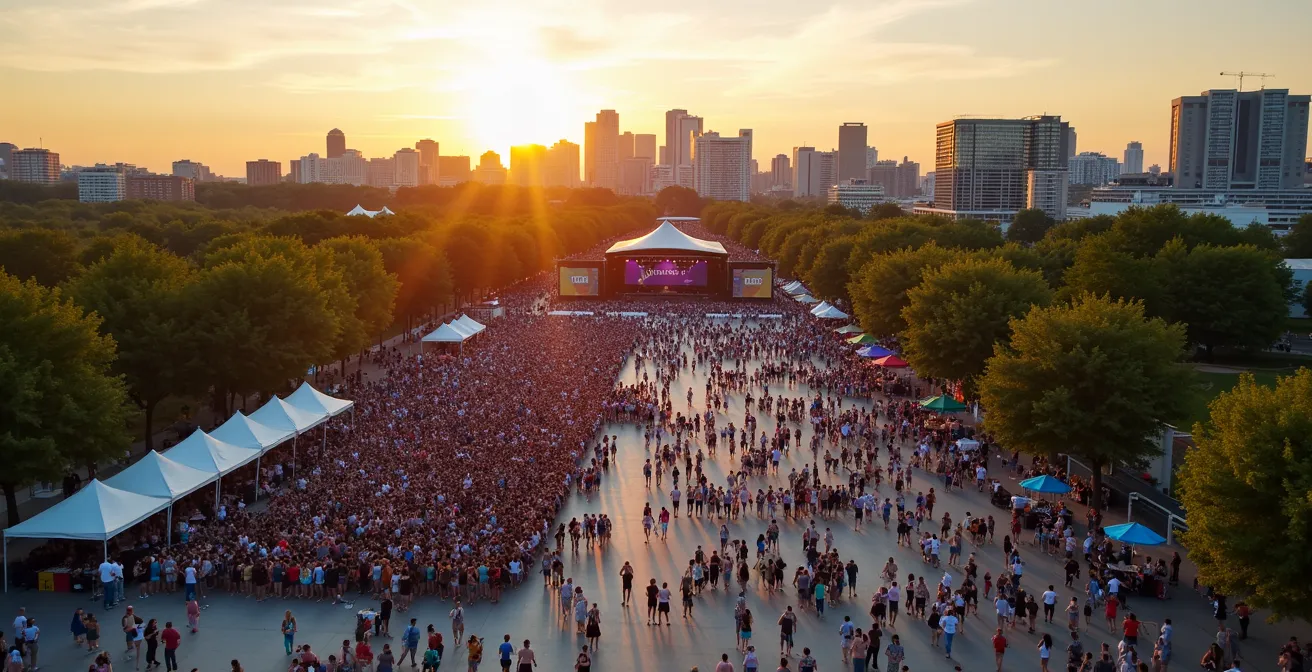
The secret to mastering Montreal’s festivals isn’t just knowing the schedule; it’s understanding the city’s operational flow to bypass its biggest friction points.
- Transportation strategy is about avoiding hub stations *after* a show, not just using the metro.
- Accommodation savings of 30-40% are found two metro stops away, outside the downtown premium zone.
- The best experiences often come from leveraging ‘in-between’ spaces: side streets for music discovery and the RÉSO for climate control.
Recommendation: Treat your festival visit like a logistical mission. Plan your entry, exit, and rest points with the same care you put into choosing which artists to see.
Every summer, Montreal transforms into a world-class stage. From the legendary Jazz Festival to the electric energy of Osheaga, millions flock to the city for an unparalleled cultural experience. The common advice is predictable: book early, stay hydrated, use the metro. But for the thousands caught in a human traffic jam at Berri-UQAM station post-fireworks or paying a 50% premium for a mediocre hotel room, this advice feels painfully inadequate. This isn’t just about enjoying the music; it’s about navigating a complex, temporary city-within-a-city.
Most guides focus on the “what”—the artists, the food, the main attractions. They rarely cover the “how”—the underlying logistics that separate a stressful ordeal from a seamless adventure. What if the key wasn’t just downloading the festival app, but understanding the pedestrian flow and sound bleed in the Quartier des Spectacles? What if you could use the city’s own infrastructure, like the RÉSO underground network, not just as a passageway but as a strategic tool for beating the heat and crowds?
As an event coordinator, I see festivals as a system of flows and bottlenecks. The real pro move isn’t having a front-row spot; it’s knowing how to get home in 20 minutes while everyone else is waiting for surge-priced Ubers. This guide is your backstage pass to the operational strategy of festival-going in Montreal. We’ll bypass the generic tips and focus on the logistical hacks that locals and industry pros use to manage their tickets, accommodation, transport, and energy. Forget being a tourist; you’re about to learn the flow of the festival from the inside out.
This article provides a complete operational playbook for your festival experience. Below is a summary of the logistical challenges we will deconstruct, from securing legitimate tickets to mastering your exit strategy.
Summary: Your Operational Guide to Montreal’s Festivals
- Scalpers vs. Official Sites: How to Avoid Fake Festival Tickets?
- Booking Hotels for Jazz Fest: How Far in Advance is Necessary?
- Metro or Uber: How to Get Home After the Shows End?
- Outdoor Stages vs. Indoor Halls: Where is the Real Vibe?
- How to Survive a 35°C Festival Day Without Heatstroke?
- How to Use the RÉSO Without Getting Lost in a Shopping Mall?
- Is It Worth Paying for Indoor Shows When Outdoor Stages Are Free?
- How to Discover New Music at the Jazz Festival Without Knowing the Artists?
Scalpers vs. Official Sites: How to Avoid Fake Festival Tickets?
The first point of failure for many festival-goers is the ticket purchase itself. When a sought-after show sells out, the temptation to turn to secondary markets like Kijiji or Facebook Marketplace is huge. However, this is where the risk of counterfeit tickets or exorbitant markups is highest. From a logistical standpoint, a fake ticket isn’t just a financial loss; it’s a complete shutdown of your event-day plans. The primary rule of festival operations is to secure your entry through official channels first and foremost. Always start with the festival’s official website or their authorized ticketing partner (e.g., Ticketmaster).
If you must venture into the secondary market, you need to operate with a high level of suspicion. Scammers rely on urgency and a buyer’s fear of missing out. The Office de la protection du consommateur du Québec provides clear guidelines, but the core principle is to verify everything. A legitimate seller should be able to provide proof of purchase, and you should always opt for a payment method that offers some form of protection, like an Interac e-Transfer, over untraceable cash. Remember, a deal that seems too good to be true almost always is.
To mitigate your risk, treat any private sale as a verification process. Scrutinize the seller’s profile, the ticket details, and the terms of the exchange. A few minutes of due diligence can prevent a major disappointment at the gate.
Your Checklist for Vetting Resale Tickets
- Seller insists on cash only and refuses secure options like Interac e-Transfer.
- The seller’s online profile is new (under 3 months old) or has zero history of other transactions.
- High-pressure tactics are used, such as “I have other offers” or “you need to decide now.”
- The price is wildly different from the face value (a major red flag if it’s more than 25% lower or higher).
- The seller is unwilling to meet in a safe, public location for the exchange, ideally near a police station.
- They cannot provide a screenshot or forward the original purchase confirmation email from the official vendor.
Booking Hotels for Jazz Fest: How Far in Advance is Necessary?
Accommodation is the second logistical pillar, and timing is everything. The generic advice to “book early” is useless without context. The operational reality is that hotel and rental prices in Montreal are dictated by a tiered system of demand based on proximity and event schedules. For major festivals like the Jazz Fest or Osheaga, hotels within a one-kilometer radius of the main venues (the “Downtown Core”) can see premiums of 40-60%. This premium zone requires booking much further in advance.
The strategic move is to book *outside* this immediate radius but along a key metro line. Properties near the Lionel-Groulx station, for instance, are just two stops away on the Green Line. This position offers potential savings of $80-$120 per night while keeping your travel time to the festival site under 15 minutes. Student residences at McGill or Concordia universities also open for summer rentals, providing spartan but affordable options ($60-90/night) right downtown. This requires booking 3-4 months ahead but is a classic budget-savvy local move.
The following table breaks down the booking reality. Note how overlapping events, like the Grand Prix, act as a massive demand multiplier, requiring almost a year of lead time for prime locations.
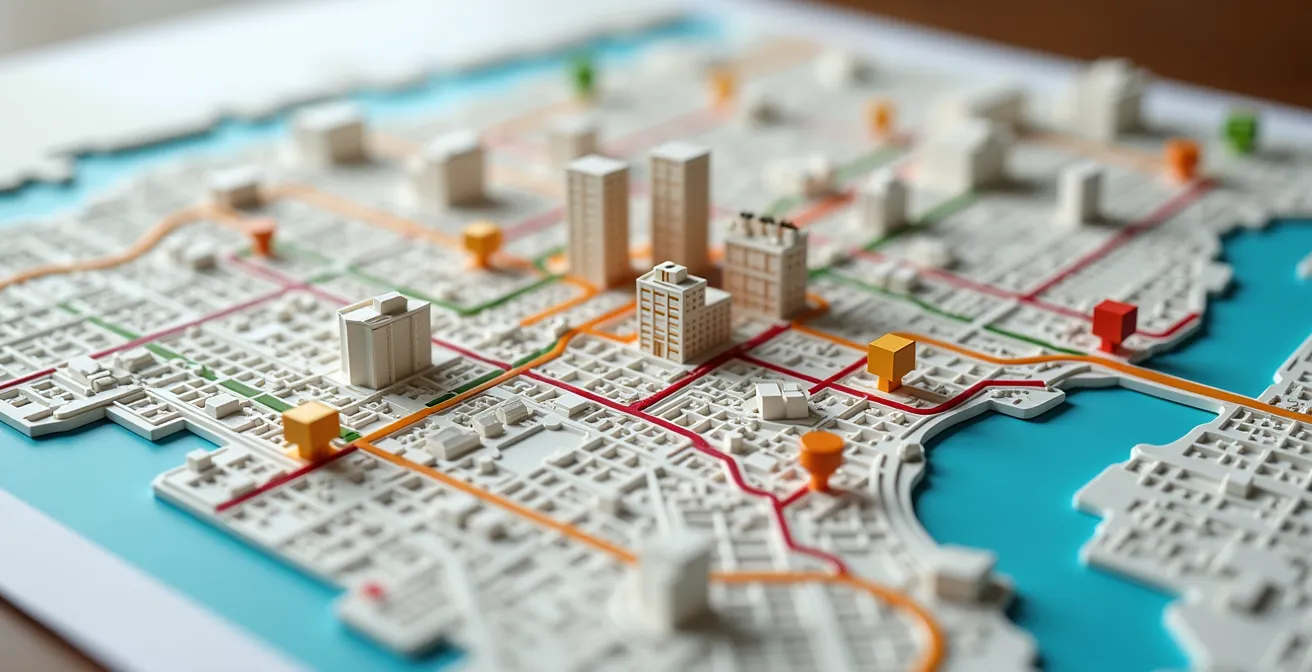
This booking timeline provides a clear strategic framework. Choosing a hotel along the Green or Orange metro lines outside the immediate downtown core is the most efficient way to balance cost and convenience.
As this comparative table from an analysis of Montreal’s festival season shows, your booking window is directly tied to the event’s scale.
| Festival | Downtown Core (1km radius) | Green Line Hotels | Student Residences |
|---|---|---|---|
| Jazz Festival | 4-5 months | 2-3 months | 3 months |
| Osheaga | 6-8 months | 4 months | 4 months |
| Grand Prix Overlap | 9-12 months | 6 months | 5 months |
| Just for Laughs | 3-4 months | 2 months | 2 months |
Metro or Uber: How to Get Home After the Shows End?
Post-show transportation is the single biggest friction point of any major urban festival. While Montreal’s STM metro system is incredibly efficient and runs on an extended schedule during festivals, the Place-des-Arts station becomes a severe bottleneck between 11 PM and midnight. Relying on Uber or taxis is a failing strategy; surge pricing will be at its peak, and road closures make pickups nearly impossible. The professional solution is not to avoid the metro, but to avoid the primary station. This is where the “Two-Station Strategy” comes into play.
Instead of joining the massive queue at Place-des-Arts, you execute a simple flanking maneuver. A brisk 10-minute walk east takes you to Berri-UQAM, the central hub for the Orange, Green, and Yellow lines. While busy, its capacity is far greater, and crowds disperse more quickly. Alternatively, walking 10 minutes west to McGill station provides less-crowded access to the Green Line. This simple repositioning can save you 30-40 minutes of standing in a packed station. Before the show, ensure your OPUS card is loaded or buy your return ticket to bypass the ticket machine queues on your way out.
For those staying closer or feeling energetic, the BIXI bike-share system is another excellent option. During major events, BIXI deploys temporary “valet stations” near Place des Arts and Parc Jean-Drapeau with guaranteed docking space. This service, often with over 200 extra spots, bypasses the common issue of finding full stations, a problem that affects a significant portion of downtown docks after midnight.
The Two-Station Exit Strategy
- For Orange/Green/Yellow lines: Walk 10 minutes east from Place des Festivals to the Berri-UQAM hub.
- For the Green Line: Walk 10 minutes west to McGill station for significantly smaller crowds.
- For Old Montreal hotels: Use the Champ-de-Mars station on the Orange line, which is often overlooked.
- Before leaving: Check the STM’s mobile app, which sometimes provides real-time crowd level indicators.
- Prepare in advance: Pre-load your OPUS card or purchase a round-trip fare earlier in the day to skip exit queues.
Outdoor Stages vs. Indoor Halls: Where is the Real Vibe?
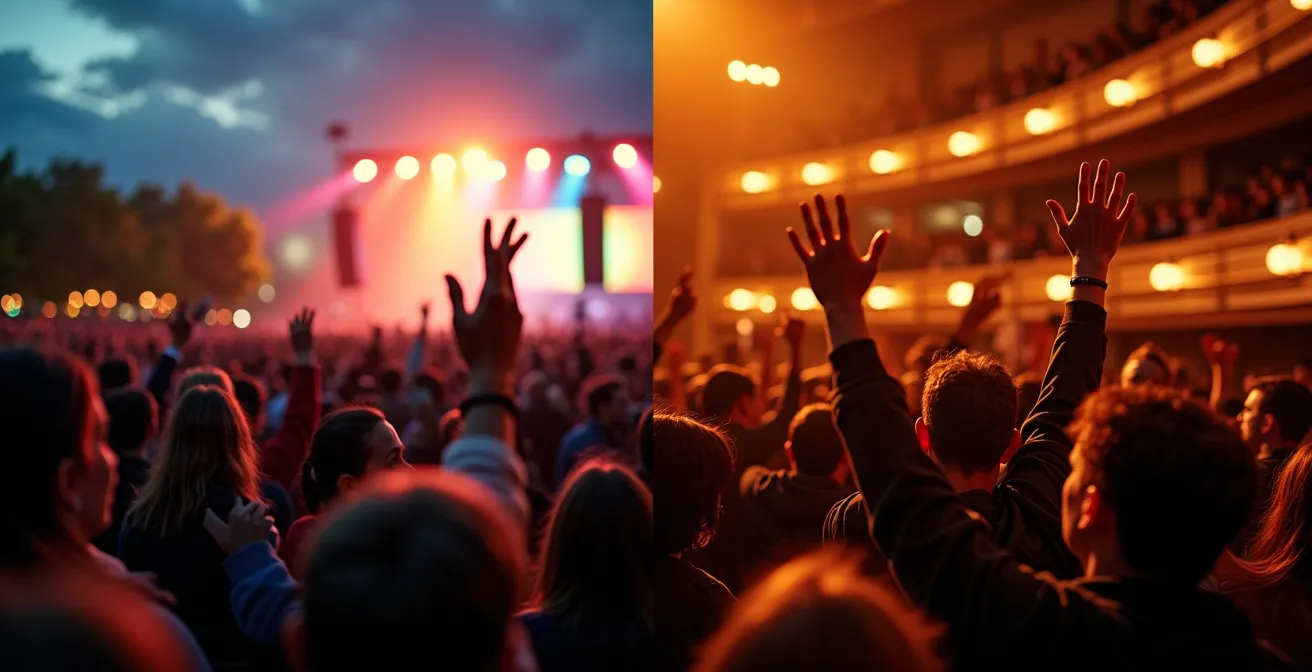
The “vibe” of a festival is not a matter of chance; it’s a product of your physical position. The choice between a massive, free outdoor show and a ticketed indoor performance is a strategic one. The outdoor stages at Place des Festivals offer an irreplaceable, communal energy. The downside is variable sound quality and immense crowds. The “Bring Your Own Chair” (BYOC) culture at the Jazz Fest is a perfect example of local optimization. Designated zones, typically 30-50 meters from the stage, allow for clear sightlines without the density of the standing-room-only sections.
The real insider trick is mastering audio positioning. From an event production perspective, the best sound is always found near the sound engineer’s booth. At the main Scène TD, this “sweet spot” is located in the center, approximately 40 meters from the stage. Positioning yourself between Sainte-Catherine and De Maisonneuve Boulevard provides optimal audio from the main stage while minimizing the sound bleed from smaller, adjacent stages—a common issue that can muddy the experience.
Indoor halls like Place des Arts’ Salle Wilfrid-Pelletier or the nearby MTELUS offer a completely different value proposition: pristine, studio-grade acoustics and an intimate connection with the artist. You trade the sprawling festival atmosphere for a focused, weather-proof, and sonically perfect experience. Neither is definitively “better”; they serve different purposes. The professional approach is to use both: the free stages for discovery and atmosphere, and paid tickets for your must-see artists where audio quality is paramount.
How to Survive a 35°C Festival Day Without Heatstroke?
Endurance is a critical, yet often overlooked, part of festival logistics. A sweltering 35°C day with high humidity can quickly lead to heat exhaustion, derailing your plans. “Staying hydrated” is the obvious advice, but the strategic question is *how* and *where*. The Quartier des Spectacles is a concrete-heavy environment, but it’s dotted with “oases of cool” if you know where to look. Your mission is to alternate between sun exposure for shows and planned cooldown periods in the shade or air conditioning.
The lobbies of Place des Arts are open to the public until 11 PM, offering free AC and water fountains on every floor. A five-minute walk away, the Complexe Desjardins shopping mall provides an expansive, air-conditioned food court—a perfect spot for a cheap meal and a break from the heat until 9 PM. On-site, look for the designated misting stations (usually at the corners of Jeanne-Mance and Sainte-Catherine) and the eight water refill stations marked with large blue flags. According to venue analysis, the west side of Sainte-Catherine offers 70% more shade between the peak UV hours of 4 PM and 6 PM. This is a crucial piece of positioning intelligence.
Finally, a quick stop at a local pharmacy (the Jean Coutu or Pharmaprix inside Complexe Desjardins) is a pro move. Essentials like sunscreen, electrolyte packets, and a cooling facial mist (like the popular Dr. Renaud brand) are worth their weight in gold. Managing your body temperature is as important as managing your schedule.
Oases of Cool: Your Heat Survival Map
- Primary AC Base: Place des Arts lobby (open late, free, multiple water fountains).
- Secondary Base: Complexe Desjardins (5-min walk, AC, food court, large washrooms).
- On-Site Relief: Locate the misting stations at the main intersections of the festival grounds.
- Hydration Points: Identify the 8 water refill stations marked by blue flags as soon as you arrive.
- Local Pharmacy Run: Grab a Canadian-made cooling mist from a Jean Coutu for on-the-go relief.
- Strategic Shading: Actively seek shade between 2 PM and 5 PM, when the UV index is at its highest.
How to Use the RÉSO Without Getting Lost in a Shopping Mall?
Montreal’s “underground city,” or RÉSO, is a powerful tool for the savvy festival-goer, but it’s notoriously disorienting. Spanning over 32 kilometers, it connects metro stations, shopping malls, and office towers. On a rainy day or during a heatwave, it’s your best friend. The key is to ignore the distracting commercial signage of the malls and follow only the official blue RÉSO signs. Your “mission” is to get from a peripheral metro station to the heart of the festival without being exposed to the elements.
A classic route is starting at the Bonaventure metro station (a major hub). From there, you follow the blue signs directing you toward Place Ville Marie. This is a critical junction. Inside, you can find some of the cleanest public washrooms in the network and a Pharmaprix for any emergency supplies. From Place Ville Marie, you continue through the “Passage du Centre” to the Eaton Centre, and then take the north corridor past Hudson’s Bay to connect directly to McGill Metro. The final leg is an underground passage that leads you straight into the Place des Arts metro station and the connected Complexe Desjardins, depositing you right at the festival’s edge.
This underground route not only serves as a climate-controlled corridor but also as a strategic resource hub. The food courts at Place Montréal Trust or Eaton Centre offer affordable meals ($8-12) compared to the inflated prices at festival food trucks ($18-25). Mastering this “underground highway” is a hallmark of a true Montreal pro.
Your Underground Mission to the Festival
- Entry Point: Start at Bonaventure Metro, a key link for the Orange and Green lines.
- Navigation Rule: Strictly follow the blue “RÉSO” signs, not the signs for individual malls or stores.
- Key Corridor: Navigate through Place Ville Marie and the Eaton Centre towards McGill Metro.
- Final Connection: Use the underground exit at the north end of McGill station that connects to Place des Arts.
- Safety Checkpoints: Note the green “Sortie” (Exit) signs posted every 200 meters for emergency surface access.
Is It Worth Paying for Indoor Shows When Outdoor Stages Are Free?
This is a fundamental question of resource management: are you optimizing for social energy or artistic purity? The answer determines how you allocate your budget and time. Free outdoor shows are the heart of the festival’s democratic spirit. They offer a vibrant, communal atmosphere where you can wander, meet people, and soak in the collective energy. The trade-off is logistical: distant views, variable sound quality affected by wind and crowd noise, and total exposure to the weather.
Paid indoor shows are a different product entirely. You are paying for controlled conditions: studio-grade acoustics, an intimate proximity to the artist (often 5-20 meters away versus 50+ meters outdoors), and a guaranteed performance regardless of rain. It’s a focused listening experience designed for appreciation rather than socialization. However, this comes at a cost, not just for the ticket but also for mandatory, higher-priced drinks and food.
Experienced locals often employ the ‘Best of Both’ hybrid strategy. They spend the early evening (6-8 PM) at the free outdoor stages, enjoying the social vibe and discovering new artists without any financial commitment. Then, they attend a single, pre-booked indoor show later in the evening (e.g., a 9:30 PM slot) for a must-see headliner. This approach captures both the expansive festival energy and the intimate performance, often for a total cost of $40-60, versus the $150+ it might cost to book a full evening of indoor shows.
| Factor | Free Outdoor | Paid Indoor | Winner |
|---|---|---|---|
| Audio Quality | Variable (wind/crowd) | Studio-grade | Indoor |
| Artist Intimacy | Distant (50+ meters) | Close (5-20 meters) | Indoor |
| Weather-Proof | Rain cancellations | Guaranteed show | Indoor |
| Social Atmosphere | Festival vibe, meet people | Focused listening | Outdoor |
| Food/Drink Cost | Bring your own | $12+ drinks mandatory | Outdoor |
Key Takeaways
- Your exit strategy is more important than your arrival plan; always use flanking metro stations like Berri-UQAM or McGill.
- Significant savings on accommodation are found by booking along a metro line, just outside the 1km downtown premium zone.
- Use indoor public spaces like Place des Arts and the RÉSO as strategic “cooling and resource” hubs, not just passageways.
How to Discover New Music at the Jazz Festival Without Knowing the Artists?
One of the greatest joys of a festival like the Montreal Jazz Fest is stumbling upon your next favorite artist. But with hundreds of names on the program, this discovery can feel overwhelming. The key is to abandon the checklist mentality and embrace strategic wandering. Instead of trying to read every bio in the program, locals use the “acoustic wandering” technique. This involves walking the peripheral streets of the festival—like Clark, De Montigny, or Saint-Laurent after 8 PM—and simply following the sounds that catch your ear. This method led to the early discovery of now-famous Quebec artists like Kaytranada and Half Moon Run.
For a more structured approach, you can create a “stage hopping” itinerary. The various stages are themed, allowing you to sample different genres efficiently. You could spend 20 minutes at the Scène Rio Tinto (known for world music), then walk three minutes to the Scène Loto-Québec (which features emerging local artists), before sampling the main stage headliner for 15 minutes. This method maximizes your exposure to diverse sounds in a short amount of time, increasing your chances of finding something new that resonates.
Don’t neglect the smaller, official “off-festival” venues. The “Pubs en Musique” series places artists in more intimate bar settings around the Quartier Latin. These can be the best places to see incredible talent up close before they graduate to the bigger stages. Discovery isn’t about luck; it’s about a strategy that prioritizes exposure and curiosity over a pre-set schedule.
A 90-Minute Music Discovery Itinerary
- Start at Scène Rio Tinto: Spend 20 minutes absorbing the global rhythms and world music acts.
- Move to Scène Loto-Québec: A quick 3-minute walk to sample Quebec’s top emerging artists for 20 minutes.
- Info Stop: Take 5 minutes at the Club Soda entrance to check their schedule board for unexpected gems.
- Main Stage Sample: Stand at the back of the Scène TD main stage area for 15 minutes to catch the headliner’s vibe.
- Explore the Fringes: Dedicate 15 minutes to wandering the side street performances on Clark or De Montigny.
- End with Intimacy: Pop into a “Pubs en Musique” venue for a final 15 minutes to discover an artist in a close-up setting.
By applying these logistical strategies, you shift from being a passive attendee to an active participant, fully in control of your experience. You’ll spend less time stressed and more time immersed in the magic that makes Montreal’s festival season world-renowned. To put these plans into action, begin by assessing your own tolerance for crowds and budget to choose the right mix of strategies for your trip.