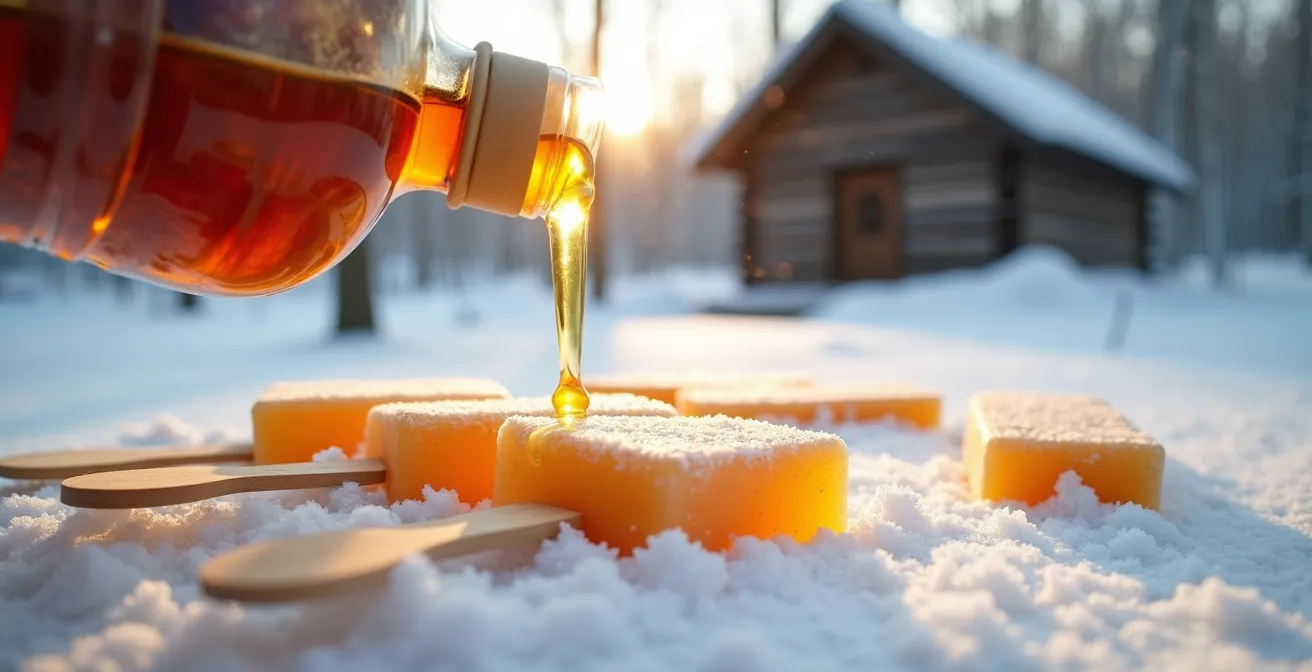
The secret to perfect maple taffy isn’t magic; it’s understanding the science of sugar crystallization.
- Achieving the precise temperature range transforms syrup into the ideal soft, chewy texture.
- Using genuinely clean snow—or a clever alternative—is non-negotiable for both safety and success.
Recommendation: Use a candy thermometer for your first few attempts to build an intuition for the “soft-ball stage” and guarantee delicious results that honour this cherished Québec tradition.
The sweet, steamy aroma of boiling maple syrup and the sight of it being poured over fresh snow is a core memory for anyone who has visited a Québec cabane à sucre. Recreating this magic at home seems simple enough: just boil some syrup and pour it on snow. Yet, many family attempts end in frustration, yielding either a sticky, liquid mess or a jaw-breaking hard candy that shatters on contact. The common advice often overlooks the crucial details that make the difference between disappointment and delight.
But what if the key wasn’t just in following a recipe, but in understanding the simple science behind it? As a food chemist, I can tell you that making perfect maple taffy is a fascinating experiment in sucrose crystallization that anyone can master. It’s about controlling temperature to manage water content and creating the perfect thermal shock to set the candy. This isn’t just about a sweet treat; it’s about connecting with a piece of living heritage, or patrimoine vivant, right in your own backyard.
This guide will walk you through each step from a scientific perspective, demystifying the process so your family can achieve flawless taffy every time. We will explore everything from the ideal syrup temperature and snow safety to portion control for little ones and the best grade of syrup to use, ensuring your homemade sugar shack experience is a resounding success.
Summary: How to Make Perfect Taffy on Snow at Home?
- Why Your Taffy Turns Hard or Stays Liquid?
- Clean Snow vs. Dirty Snow: Is It Safe to Eat Snow from the Yard?
- Stove or Microwave: Which Is Better for Boiling Syrup?
- How Many Sticks of Taffy Are Too Many for a Toddler?
- How to Clean Hardened Taffy off Your Pots and Pans?
- The Experience of Making: Why This Tradition Matters More Than the Treat
- Your Backyard Sugar Shack: Setting Up for Taffy Success
- How to Choose the Right Grade of Maple Syrup for Your Needs?
Why Your Taffy Turns Hard or Stays Liquid?
The consistency of your final taffy is not a matter of luck; it’s a direct result of sugar chemistry. Maple syrup is primarily a solution of sucrose and water. Boiling it does one thing: it evaporates water, increasing the sugar concentration. The final texture of your candy is determined entirely by how concentrated that sugar solution becomes, which is precisely measured by temperature. This critical point is known as the soft-ball stage.
According to food science, the perfect texture for maple taffy is achieved when the syrup reaches a specific temperature range. Research shows the ideal target is between 112°C and 116°C (234-240°F). Below this range, there is too much water left in the syrup. When poured on snow, it won’t solidify properly, creating a sweet slush. If you boil it past this point, you enter the “hard-ball” or even “hard-crack” stages, where the sugar concentration is so high that the resulting candy becomes brittle and hard.
If you don’t have a candy thermometer, you can use the traditional method. Periodically drop a small amount of syrup into a glass of very cold water. When it forms a soft, malleable ball that you can flatten between your fingers, you’ve reached the soft-ball stage. If it dissolves, keep boiling. If it forms a hard thread, you’ve gone too far, but you can salvage it by dissolving the hardened candy in hot water to make a delicious maple sauce for desserts.
Clean Snow vs. Dirty Snow: Is It Safe to Eat Snow from the Yard?
The second key ingredient for taffy is a bed of clean, fresh snow. But what constitutes “clean”? While snow looks pure as it falls, it can act as a natural air filter, trapping atmospheric pollutants, dirt, and microbes as it descends. Using snow from a city backyard, especially if it’s been on the ground for a while or is near a roadway, is not recommended. The pristine white can be deceiving, potentially hiding contaminants you don’t want in your food.
For the safest and best-tasting taffy, the ideal solution is to collect fresh snowfall in a clean bowl or on a baking sheet placed outside during a heavy snowstorm. This minimizes contact with the ground and other surfaces. Ensure the snow is packed very firmly into your tray; if it’s too loose, the hot syrup will melt right through it instead of solidifying on top.
Urban Snow Harvesting Solutions from Québec Families
To overcome the challenge of finding clean snow in urban environments, many resourceful families have developed clever methods. Based on community discussions, a popular technique involves placing a baking sheet on an outdoor table during heavy snowfall to collect a pristine layer. It’s also noted that the snow shouldn’t be packed into a solid block of ice; a firm but still slightly crystalline structure allows the hot syrup to sink in just enough to create the perfect taffy ribbons.
If you don’t have access to fresh, reliable snow, don’t despair. A fantastic alternative is to use shaved ice. You can make your own with a blender powerful enough to crush ice cubes into a fine, snow-like texture. Spread this shaved ice in a shallow pan for a perfectly clean and safe base for your taffy, available any time of year.
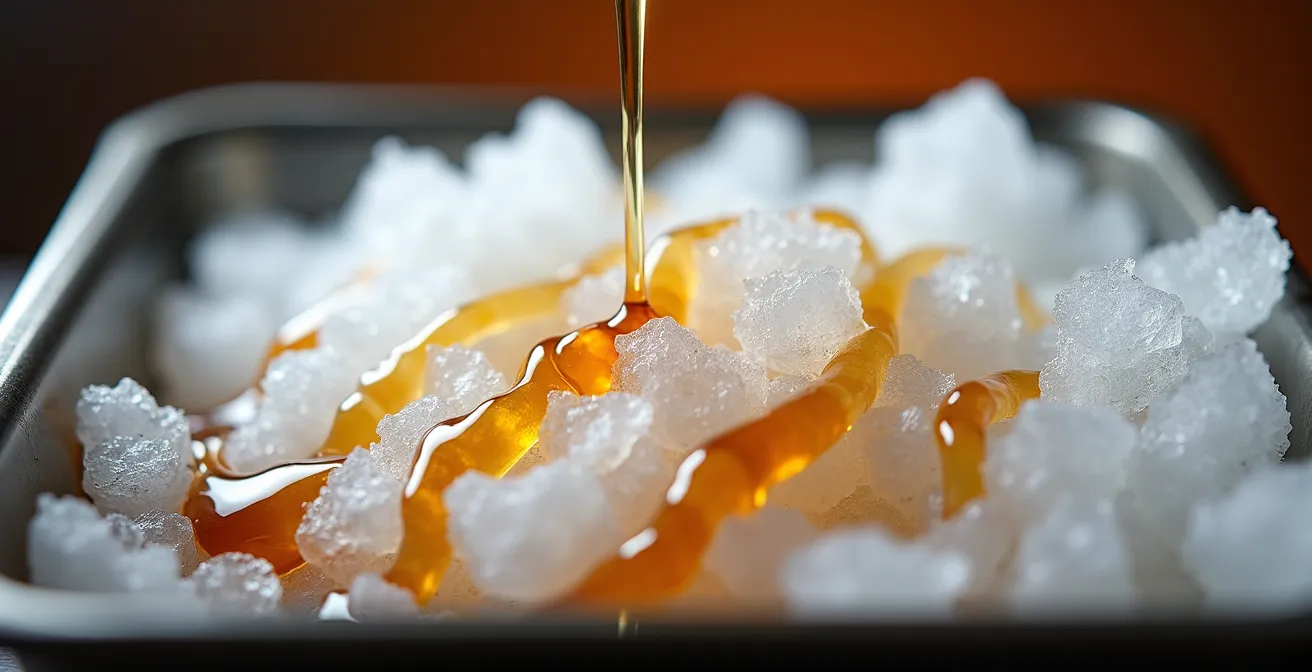
This method ensures you get the right thermal shock to set the syrup without any of the worries associated with ground snow. The goal is a clean, cold surface to rapidly cool the syrup, and shaved ice performs this function beautifully.
Stove or Microwave: Which Is Better for Boiling Syrup?
When it comes to heating your maple syrup, you have two main options in a modern kitchen: the traditional stovetop or the convenient microwave. While the microwave is faster, the stovetop method is overwhelmingly superior for making maple taffy due to one critical factor: temperature control. As we’ve established, hitting the precise soft-ball stage is essential, and this requires careful monitoring that the microwave simply cannot provide.
A microwave heats unevenly and can cause the syrup to superheat and boil over suddenly, creating a dangerous and sticky mess. Measuring the temperature accurately inside a microwave is nearly impossible. The stovetop, by contrast, provides consistent, even heat that you can adjust with precision, allowing you to use a candy thermometer and watch the syrup’s transformation closely.
This comparison table, based on guidance from maple producers, breaks down the key differences and shows why the traditional method remains the gold standard. As you can see from data provided by sources like the Canadian maple industry, the stovetop wins on control and authenticity.
| Method | Temperature Control | Safety | Traditional Authenticity | Time Required |
|---|---|---|---|---|
| Stovetop | Precise with candy thermometer | Safe with proper monitoring | Authentic cabane à sucre method | 15-20 minutes |
| Microwave | Difficult to monitor accurately | Risk of superheating and eruption | Modern convenience method | 7-10 minutes |
The appeal of the microwave’s speed is understandable, but the risk of failure is high. As the Canadian maple-making community often advises, the lack of precise heat is a major drawback.
You might not be able to get it hot enough. That heat level is essential. Take a candy thermometer and take precautions that it doesn’t make a mess boiling over in the microwave.
– Happy Hooligans Community, Canadian Maple Syrup Making Discussion
For a successful and enjoyable experience that honors the tradition, stick with the stovetop. It’s part of the ritual and gives you the control needed for perfect results.
How Many Sticks of Taffy Are Too Many for a Toddler?
Maple taffy is a pure, delightful concentration of sugar. While it’s a natural product, it is still a candy, and moderation is key, especially for young children. A single serving of taffy can contain a significant amount of sugar, and it’s easy for little ones (and adults!) to get carried away in the excitement. The question of “how many is too many” is less about a specific number and more about a mindful approach to consumption.
Health experts recommend limiting free sugar intake for all ages. According to guidance from Health Canada, added sugars should make up a small portion of one’s daily caloric intake. While maple syrup contains minerals and antioxidants not found in refined white sugar, it is still considered a “free sugar.” For toddlers, whose dietary needs are much smaller, one small stick of taffy is a perfectly sufficient and wonderful treat.
To help manage portion sizes without dampening the fun, here are some practical strategies for families:
- Use smaller sticks: Opt for coffee stirrers or half-sized popsicle sticks to create smaller, more manageable portions for children.
- Set clear limits: Decide and communicate beforehand that everyone will have one special stick of taffy to savor slowly.
- Introduce a palate cleanser: Follow the authentic cabane à sucre tradition by offering a sour pickle after the taffy. This cleanses the palate and signals that the sweet part of the activity is over.
- Share a pull: Make one or two larger taffy ribbons for the entire family to share, rather than giving each person an individual, large serving.
- Balance the treat: If you’re making a full sugar shack meal at home, serve the taffy after a protein-rich main course, which can help moderate blood sugar levels.
By framing the taffy as a special, savored part of a larger experience rather than an all-you-can-eat event, you can teach mindful eating habits while still enjoying every moment of this sweet tradition.
How to Clean Hardened Taffy off Your Pots and Pans?
The aftermath of making taffy can be intimidating: a pot coated in a rock-hard, sticky layer of cooled syrup that seems impossible to scrub off. But before you reach for a chisel, remember the science. That hardened residue is simply recrystallized sucrose, and its greatest weakness is its own composition.
As maple production guides explain, the simple science is that hardened taffy is water-soluble. This means the easiest way to clean it is not with force, but with chemistry. Simply fill the pot with water, place it back on the stove, and bring the water to a boil. The hardened sugar will dissolve effortlessly into the hot water, leaving your pot perfectly clean with no scrubbing required. Just pour the sugary water down the drain and give the pot a final wipe.
Experienced sugar shack operators use a pre-emptive approach to make cleanup even easier. This method prevents the sugar from hardening in the first place.
The Pre-emptive Cleanup Method from Québec Sugar Shacks
The moment you have finished pouring the syrup onto the snow, immediately fill the empty, still-hot pot with hot tap water. The residual heat from the pot will be enough to dissolve most of the remaining syrup. For any leftover taffy or particularly thick residue, a quick boil will finish the job. Some producers even pour cold water over remaining syrup to prevent crystallization, later using the leftovers to create other maple products like butter or sugar.
This simple trick transforms what looks like a monumental cleaning task into a minor, two-minute job. It’s a perfect example of how understanding the properties of your ingredients can save you a lot of time and effort.
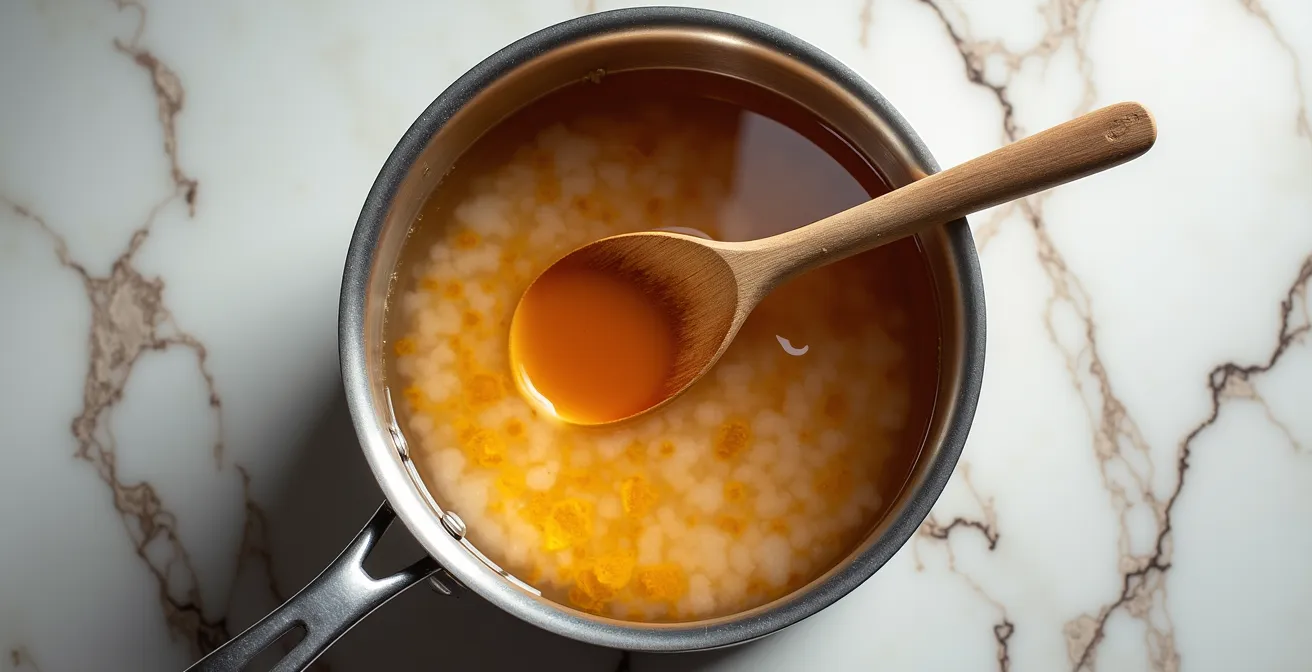
Soaking the pot is the most effective and satisfying way to deal with the cleanup, turning a potential chore into another small moment of kitchen science magic.
The Experience of Making: Why This Tradition Matters More Than the Treat
Maple taffy is more than just a candy; it is a hands-on experience deeply woven into the cultural fabric of Eastern Canada. As a cherished tradition, it is recognized as being an integral part of life in Québec, Eastern Ontario, New Brunswick, and northern New England. The real value of making it at home isn’t just the final product, but the process itself—the act of participating in and passing down a piece of living heritage.
When you make taffy with your family, you are not just following a recipe; you are creating memories. The joy comes from watching the syrup bubble, braving the cold to pour it on the snow, and the shared laughter as everyone tries to roll the sticky concoction onto their stick. It’s about the carefree feeling of those outdoor winter days. This active participation transforms a simple culinary activity into a meaningful cultural ritual, making you a carrier of Québec’s patrimoine vivant.
Furthermore, the process is a rich learning experience for children. They are not just watching; they are doing. They learn about temperature and chemistry in a tangible way, practice patience while waiting for the syrup to reach the right stage, and develop an appreciation for traditional food preparation. It connects them to the seasons and to the generations before them who practiced the very same ritual. Buying taffy at a store can never replicate the sense of accomplishment and connection that comes from making it yourself.
Your Backyard Sugar Shack: Setting Up for Taffy Success
Creating a seamless and safe taffy-making experience at home is all about preparation. A little bit of setup transforms your backyard or balcony into a mini cabane à sucre and ensures the focus stays on the fun, not on frantically searching for supplies. The key is to create dedicated zones for cooking and for the “snow pouring” activity.
First, designate your cooking area. This should be a stable surface for your stovetop or portable burner, safely away from where children will be playing. Keep your pot, candy thermometer, and the can of maple syrup in this zone. Your second zone is the “taffy station,” which should be an outdoor table or picnic bench. This is where you will have your pans of firmly packed snow, popsicle sticks, and a plate for the finished treats. You’ll likely need 2-3 full pans of snow for every cup of syrup, so have them ready to go.
A fun and practical tip for families is to use a child’s sled as your mobile supply vehicle. Kids love the responsibility of hauling the pans of clean snow to the station or transporting the finished taffy sticks to eager tasters. It adds an element of play and makes them an integral part of the operation.
Your 5-Point Taffy Success Audit
- Points of Contact: Identify all your zones. Where will you boil the syrup (kitchen)? Where will you pour it (backyard table)? Where will everyone eat?
- Collecte: Inventory your equipment before you start. Do you have a deep pot, a candy thermometer, enough maple syrup, popsicle sticks, and multiple pans for snow?
- Cohérence: Check your setup against your goals. Is the hot syrup zone safely separated from the kids’ play area? Are you using real maple syrup to keep the experience authentic?
- Mémorabilité/Emotion: What will make this memorable? Involve the kids by letting them pack the snow or use a sled for transport. Plan to take photos of their sticky smiles.
- Plan d’intégration: Fill in the gaps. Do you have the traditional pickles ready for a palate cleanser? Have you filled the pot with hot water for easy cleanup later?
A well-planned setup not only ensures safety but also enhances the magic of the tradition, allowing everyone to participate smoothly and joyfully.
Key Takeaways
- Taffy consistency is pure science: the 112-116°C (234-240°F) “soft-ball stage” is the non-negotiable target for perfect texture.
- Use only freshly collected snow or shaved ice for safety and quality; snow that has been on the ground can contain hidden contaminants.
- The process of making taffy together is a cherished part of Québec’s living heritage (patrimoine vivant), making the memories as important as the treat itself.
How to Choose the Right Grade of Maple Syrup for Your Needs?
The final, and perhaps most important, ingredient choice you’ll make is the maple syrup itself. Not all maple syrup is the same, and the grade you choose will have a significant impact on the final flavour of your taffy. The modern Québec and Canadian grading system classifies syrup based on its colour and the intensity of its flavour, which are determined by when in the season the sap was harvested.
Syrup made from early-season sap is light and delicate, while late-season sap produces a much darker, more robust syrup. For taffy, you want a flavour that is distinctly “maple” but not so overpowering that it becomes bitter when concentrated. For this reason, Amber Rich Taste syrup is the traditional and most popular choice for taffy making and general baking in Québec.
The official system provides a clear guide to help you choose. This system is universally followed by Québec producers, and understanding it allows you to select the perfect syrup for any use. The grading was discussed by Alan Bryson, President of Érablière Omaple, in an interview with CBC News about the system, where he noted that amber is the favourite for most Quebecers.
| Current Grade | Old Quebec Name | Light Transmission | Best Use | Harvest Time |
|---|---|---|---|---|
| Golden Delicate | Extra Clair | ≥75% | Yogurt, ice cream topping | Very early season |
| Amber Rich | Clair | 50-74.9% | Taffy, traditional baking | Mid-season |
| Dark Robust | Médium | 25-49.9% | Cooking, glazes | Late season |
| Very Dark Strong | Foncé | <25% | Marinades, savory dishes | End of season |
While Amber is recommended, experimenting is part of the fun. As Alan Bryson suggests, trying different grades can help you discover your personal preference. A Dark Robust syrup will give you a more intense, caramelized flavour, which some people may prefer. However, for your first attempt at creating an authentic cabane à sucre experience, you can’t go wrong with Amber.
Now that you are equipped with the science and traditions behind this wonderful activity, it’s time to start your own backyard sugar shack. Gather your family, choose your syrup, and embrace the process to create delicious taffy and even sweeter memories.