
Contrary to popular belief, a successful digital detox isn’t about the willpower to ignore your phone; it’s about managing the predictable anxiety of the ‘stimulus vacuum’.
- Withdrawal symptoms like phantom vibrations are a normal neurological response to disconnection, not a sign of personal weakness.
- True safety in the Quebec wilderness comes from proactive preparation (satellite technology, offline maps), not unreliable cell phone coverage.
Recommendation: Embrace a “Digital Sunset” ritual—a conscious transition that turns the moment you lose signal into the official start of your restoration, not a moment of loss.
The allure is undeniable: a remote cabin nestled in the vast forests of Quebec, a crackling fire, and the promise of profound silence. You booked this trip to escape the endless notifications, the 24/7 demands, the digital noise. Yet, as the date approaches, a different feeling creeps in—anxiety. What if there’s an emergency? What will you do with the crushing silence? Is it even safe? This fear is the central paradox for urban professionals seeking disconnection. You crave the quiet, but your brain, conditioned for constant stimulus, dreads it.
Most advice offers platitudes: “Just enjoy nature,” or “Bring a good book.” While well-intentioned, this ignores the root of the problem. Your anxiety isn’t a character flaw; it’s a predictable neurological response. Your brain is about to enter a stimulus vacuum, and it’s protesting. The phantom vibrations in your pocket are just the beginning. The key isn’t to fight this feeling, but to understand and manage it. It’s not about forcing disconnection, but about guiding your mind through a process of cognitive re-calibration.
This guide is designed for that specific purpose. We will not dismiss your fears but address them head-on with practical, Quebec-specific strategies. We’ll explore what’s really happening in your brain, how to establish a legitimate safety net without a cell signal, and how to transform the intimidating silence of the boreal forest into a source of deep restoration. We will look at the psychological preparation, the practical tools, and the on-the-ground realities of a true digital detox in the wild.
To help you navigate this journey from urban anxiety to woodland peace, this article is structured to address your concerns systematically. From understanding your brain’s reaction to ensuring your physical safety, each section provides the insights and tools you need to prepare for a genuinely restorative experience.
Summary: Your Complete Guide to a Quebec Digital Detox
- Withdrawal Symptoms: What Happens When the Signal Disappears?
- No Cell Service: How to Call for Help in an Emergency?
- Why Complete Silence in the Woods Can Be Terrifying at Night?
- Is It Safe for a Woman to Stay Alone in an Isolated Cabin?
- Board Games or Books: What to Do When the Sun Goes Down?
- The Error of Relying on Cell Phones in Zones 15 Minutes Outside Towns
- Where Does the Signal Die on the North Shore?
- How to Prepare for a Hike in the Boreal Forest Without Getting Lost?
Withdrawal Symptoms: What Happens When the Signal Disappears?
The first 24 hours are the most challenging. The sudden absence of pings, likes, and emails creates a void your brain desperately tries to fill. This is not just a feeling; it’s a physiological event. You might feel irritable, restless, or find yourself reaching for a phone that isn’t buzzing. This is the “stimulus vacuum” in action. One of the most common and unsettling manifestations is phantom vibration syndrome. If you’ve ever felt your phone vibrate only to find no notification, you’re not alone. In fact, research indicates that 70-90% of smartphone users experience these phantom sensations. It’s a conditioned neurological response, your brain’s habit of anticipating a digital reward.
Recognizing these symptoms as a predictable withdrawal process is the first step toward managing them. Instead of frustration, meet these moments with a plan. The goal is cognitive re-calibration—teaching your brain to find new, calmer focal points. The initial anxiety is a signal that your nervous system is beginning to downshift from a state of hyper-vigilance. Rather than fighting the urge to check your phone, acknowledge it and redirect your attention to the physical world. This is an active process of rewiring your attention span, moving from fractured digital focus to a more sustained, present-moment awareness.
A simple but powerful tool for this is a grounding technique. When you feel the pull of digital anxiety, consciously engage your senses with your immediate environment. This pulls your focus away from the internal feeling of lack and into the external reality of your peaceful surroundings. This isn’t about suppressing the withdrawal; it’s about giving your brain a better, more tangible task to perform. The following steps provide a mental toolkit to help you navigate these initial, crucial hours.
No Cell Service: How to Call for Help in an Emergency?
The most significant source of anxiety for many is the “what if” scenario. What if you get injured, your vehicle breaks down, or you face a medical emergency with no bars on your phone? This is a valid and serious concern. Relying on a cell phone for safety in remote Quebec is a critical mistake. The solution is not to hope for a signal but to invest in a technology designed for exactly these situations: a satellite messenger.
These devices operate independently of cellular networks, using satellite constellations to send messages, share your GPS location, and, most importantly, trigger an SOS alert. When an SOS is activated, it doesn’t just go into the void. It is routed to an international emergency response coordination center, which then contacts the appropriate local authorities. In Quebec, this means the Sûreté du Québec (SQ), which coordinates all backcountry search and rescue operations. According to Quebec’s established search and rescue protocol, a specialized SQ unit is dispatched, with response times depending on your location and weather, often involving helicopter deployment from bases in key locations like Sept-Îles or Quebec City. This system is your real lifeline.
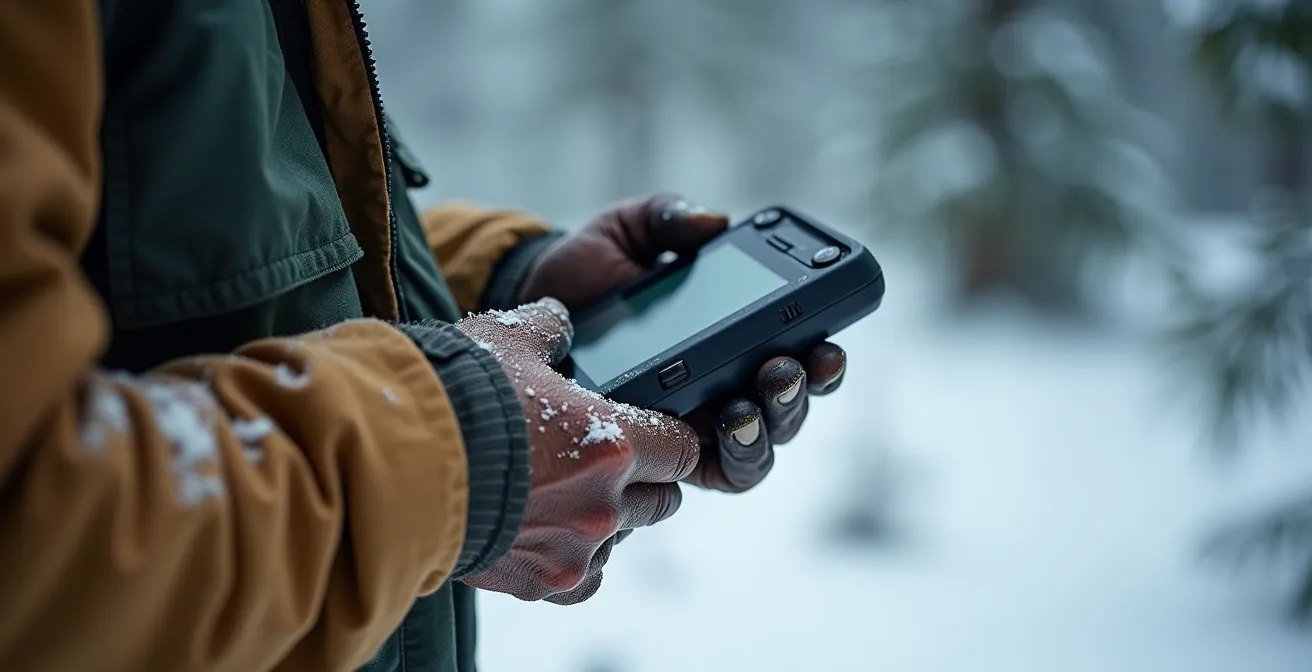
Choosing the right device depends on your needs and budget. Major providers like Garmin, ZOLEO, and SPOT offer robust coverage across Canada. Many can be rented from outdoor retailers like MEC in Montreal and Quebec City if you don’t want to purchase one. They provide peace of mind that is simply unattainable with a smartphone.
The table below provides a comparison of popular satellite messengers available to travelers in Quebec, helping you make an informed decision for your trip. This preparation is the foundation of what we call prepared solitude.
| Device | Features | Monthly Cost (CAD) | Coverage | Rental Availability |
|---|---|---|---|---|
| Garmin inReach | Two-way texting, GPS tracking, SOS | $20-100 | Global Iridium network | MEC stores in Montreal/Quebec City |
| ZOLEO | SMS, email, check-in messages | $25-50 | Iridium + cellular blend | Outdoor gear shops Quebec-wide |
| SPOT Gen4 | One-way messaging, tracking | $15-40 | Globalstar network | Canadian Tire, outdoor retailers |
Why Complete Silence in the Woods Can Be Terrifying at Night?
After a lifetime in an urban environment, your brain is tuned to a constant, low-level hum: traffic, sirens, neighbours. The absolute silence of the forest at night is not just quiet; it’s a sensory void. This lack of familiar background noise puts your auditory system on high alert. Suddenly, every snap of a twig, gust of wind, or distant call sounds amplified and potentially threatening. This is a primal, evolutionary response—in the absence of known sounds, our brains default to a state of vigilance for unknown dangers.
The key to overcoming this fear is sensory acclimatization: learning the new language of the forest. The hoot of a Barred Owl, the surprisingly loud gnawing of a porcupine, or the sound of a moose breaking branches can be startling if you don’t know what they are. The process of identifying these sounds transforms them from threats into simple facts of the environment. You’re not alone in the woods; you’re in a living ecosystem with its own nightly rhythm. Instead of letting your imagination run wild, arm yourself with knowledge. Before your trip, listen to recordings of common Quebec wildlife sounds.
This initial fear is a temporary phase in your brain’s adjustment. As one Quebec cabin owner notes about their guests, this is the process of achieving what neurologists call “cognitive quiet”:
Many first-time visitors to remote Quebec cabins report that after 2-3 nights, the initial fear transforms into appreciation for the natural soundscape, as the brain adjusts from urban noise patterns to forest rhythms.
– Experience from a Quebec cabin owner, Drift Travel
To help with this sensory acclimatization, here is a quick guide to some of the common sounds you might hear at night in the Quebec wilderness:
- Barred Owl: Listen for the distinctive ‘who-cooks-for-you’ call, most active at dusk and dawn.
- Moose: Breaking branches sound like gunshots; breathing creates deep huffing noises when nearby.
- Wind in Spruce Trees: Creates a constant whisper or rushing sound, intensifying with gusts.
- Black Bear: Rarely vocal except for huffing when startled; mostly silent movement through underbrush.
- Coyotes: Yipping and howling in groups, typically after sunset and before sunrise.
- Porcupines: Surprisingly loud gnawing sounds on wood structures at night.
Is It Safe for a Woman to Stay Alone in an Isolated Cabin?
For any solo traveler, and especially for women, safety is a primary concern. The idea of being alone in an isolated location can feel vulnerable. However, it’s important to separate perceived risk from statistical reality. The truth is, according to property market analysis, rural Quebec has among the lowest crime rates in North America. The greatest risks in the wilderness are not typically from other people, but from a lack of preparation for the environment itself.
True safety isn’t a passive state; it’s the result of proactive measures. Prepared solitude means empowering yourself with knowledge, tools, and a plan. It’s about building a fortress of confidence through competence. Before you even leave, share your detailed itinerary, including GPS coordinates and check-in times, with a trusted contact. Your satellite messenger is your link to this person and to emergency services. Upon arrival, conduct a security sweep of the cabin. Check that all doors and windows lock securely. Know your exits. Simple, low-tech items like a rubber door wedge and a personal keychain alarm can provide a powerful sense of security.
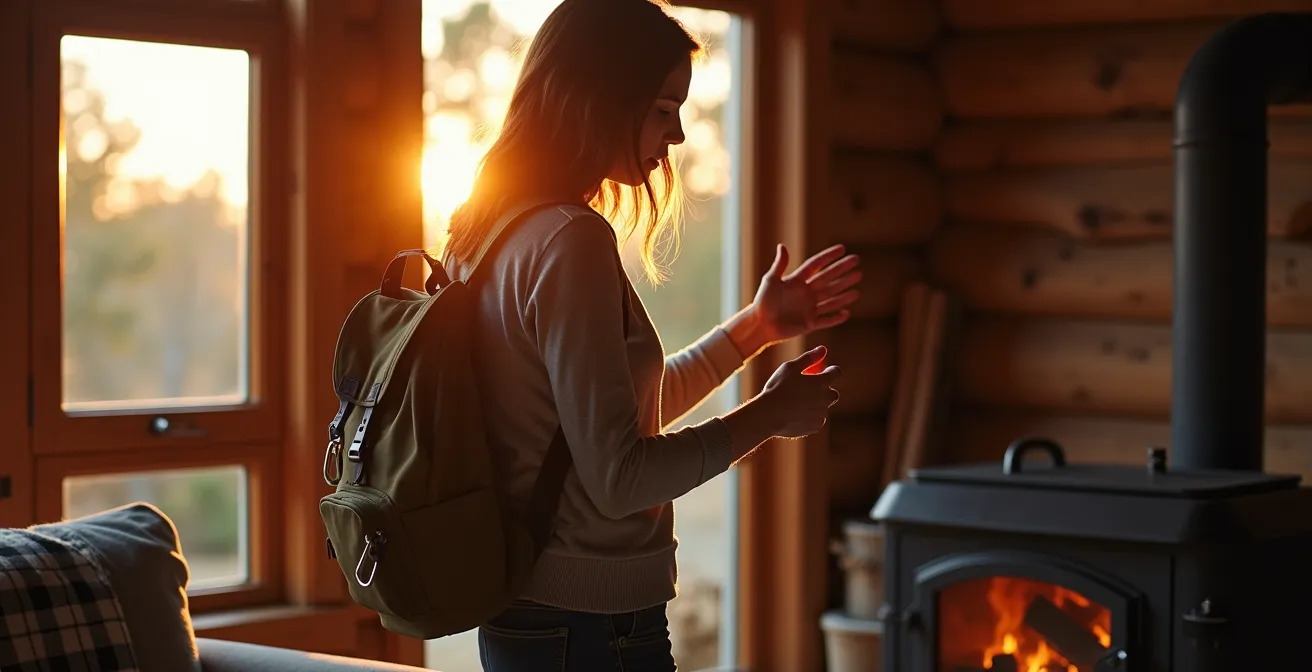
Ultimately, your greatest safety tool is your intuition. Urban life often forces us to suppress our instincts. The quiet of the woods is an opportunity to listen to that inner voice again. If a situation feels wrong, it is wrong for you. Trust that feeling. Having a plan—whether it’s leaving immediately or contacting the local Sûreté du Québec detachment (whose number you will have saved offline)—is what transforms potential fear into decisive action. Preparedness, not paranoia, is the key to a safe and empowering solo experience.
- Pack a rubber door wedge to secure doors from inside.
- Carry a keychain personal alarm (120+ decibels).
- Upon arrival, do a complete security sweep: check all window locks and identify exits.
- Establish check-in times with a trusted contact using your satellite messenger.
- Keep a powerful flashlight and whistle within arm’s reach at night.
- Trust your instincts—if something feels off, have a plan to leave or contact authorities.
Board Games or Books: What to Do When the Sun Goes Down?
The question of “what to do” after dark without screens reveals a deep-seated fear of boredom. We’re accustomed to having our evenings filled with endless streaming options. Bringing books, journals, or board games are excellent first steps, but the real opportunity goes much deeper. The absence of digital input allows your brain to shift into a different, more restorative mode of operation. This is where the magic of disconnection truly begins.
Without a constant stream of external prompts, the brain’s “default mode network” becomes more active. This is the part of your brain associated with creativity, daydreaming, and self-reflection. Instead of consuming content, you start creating your own. This isn’t just a philosophical idea; it’s a neurological fact. The “cognitive quiet” you achieve allows your mind to wander productively. This is the state where new ideas are formed and complex problems are solved in the background.
Research on the effects of nature immersion and disconnection supports this. One study found that after just three days of disconnection from technology, participants’ creativity increased by 50% and their emotional responses became more stable. The adrenaline and cortisol that fuel our constantly-connected lives begin to subside, replaced by a slower, more deliberate brainwave frequency. So, while a game of cards is a wonderful way to pass the time, don’t be afraid of the moments of pure, unstructured thought. Let your mind drift. This “structured mind-wandering” is one of the most powerful benefits of your detox.
The goal is to replace passive consumption with active engagement—with your thoughts, your surroundings, or a physical task. Stoking the fire, observing the stars, or simply sitting in silence aren’t “doing nothing.” They are active forms of mental and sensory engagement that are profoundly restorative for an overstimulated mind. Embrace the opportunity not just to be entertained, but to be present with yourself.
The Error of Relying on Cell Phones in Zones 15 Minutes Outside Towns
One of the most dangerous assumptions travelers make in Quebec is that “remote” means hours away from civilization. The reality is that robust cell service can disappear just minutes outside major towns and along primary highways. On Highway 40, the main artery between Montreal and Quebec City, the signal becomes unreliable after Trois-Rivières. In the popular Outaouais region, complete dead zones exist just a 35-minute drive north of Ottawa. This is not a failure of your device; it’s the geographical and infrastructural reality of a vast province. Even when providers like Bell and Telus offer wider rural coverage than Rogers or Videotron, that coverage is still patchy and should never be counted on for emergencies.
This “coverage illusion” is why pre-departure digital preparation is not optional; it is a fundamental safety requirement. Before you lose your last bar of signal, your phone should be transformed from a communication device into a self-sufficient navigation and information hub. This means downloading maps for offline use—not just for your final destination, but for the entire region. Apps like Avenza Maps allow you to download official, georeferenced Sépaq park maps, which are invaluable for hiking. Having physical, printed backups of key information is also a wise redundancy.
Think of your departure as a final “data harvest.” This is your last chance to download weather forecasts, confirm reservation details, and inform your emergency contacts of your final plans. Treating this last point of connectivity with intention is part of the mental shift required for a safe and relaxing detox. The following checklist is your essential guide to this process.
Your Pre-Departure Digital Safety Checklist
- Download Offline Maps: Save Google Maps for your entire route plus a 50km radius around the cabin. Add official park maps via an app like Avenza Maps.
- Archive Key Documents: Screenshot or print your cabin address, GPS coordinates, owner’s contact info, and reservation confirmation.
- Create an Offline Contact List: Save emergency contacts, the nearest hospital location, and the local Sûreté du Québec (SQ) detachment number directly on your device and on paper.
- Cache Essential Information: Download the detailed weather forecast for your entire stay period before you lose signal.
- Build a Physical Backup: Create a waterproof packet containing printed driving directions and all key phone numbers.
Where Does the Signal Die on the North Shore?
For those seeking the ultimate remote experience, Quebec’s North Shore (Côte-Nord) is an iconic destination. But here, the concept of a “dead zone” takes on a new meaning. The drive along Route 138 is a real-time map of disappearing connectivity. While you can expect reliable service up to Baie-Comeau, the landscape changes dramatically past this point. Between Baie-Comeau and Sept-Îles, coverage becomes a frustrating patchwork, with signal blackouts lasting for 30 to 60 minutes at a time.
Past Sept-Îles, on the way to Havre-Saint-Pierre and beyond, you must operate under the assumption that your phone has only two functions: a camera and a flashlight. Service exists almost exclusively within the town centers themselves, and even there it is not guaranteed. While Bell and Telus have established emergency-only towers for 911 calls every 50-80 kilometers, these are for life-threatening situations and do not provide data or standard call service. To rely on your phone here is to be dangerously unprepared.
This predictable loss of signal, however, presents a unique opportunity. Instead of seeing it as a negative, you can reframe it as a formal beginning of your detox. This is the “Digital Sunset.” It’s a conscious ritual where you acknowledge the final flicker of service and officially transition into a different state of being. You can create a ceremony around it: at a specific landmark like the town of Godbout, turn your phone to airplane mode. Use the rest of the drive not for anxious signal-checking, but for deliberate decompression. Notice the stunning, rugged coastline and the vastness of the boreal forest. This simple act transforms a moment of technological loss into a moment of personal gain—the beautiful, final step into true disconnection and presence.
Key Takeaways
- Acknowledge and manage withdrawal symptoms with grounding techniques; don’t just fight them.
- A satellite messenger is non-negotiable for safety in remote Quebec; cell service is an illusion.
- Reframe evening silence not as a void, but as an opportunity for deep cognitive rest and creativity.
How to Prepare for a Hike in the Boreal Forest Without Getting Lost?
Engaging with the boreal forest is a core part of the Quebec cabin experience, but venturing onto the trails requires respect and preparation. The forest is beautiful but indifferent. Getting lost is a real possibility if you rely solely on an electronic device whose battery can die or whose signal can fail. Your primary navigation tools should be a physical map—ideally a waterproof, official park map—and a compass. And, crucially, the knowledge of how to use them together. Before your trip, practice basic map and compass skills in a local park. This is a far more reliable system than any single app.
Safety in the boreal forest also means understanding its specific hazards. Quebec’s ecosystem has its own set of challenges that you must prepare for. During their peak season (typically May and June), black flies can swarm in thick clouds, and a simple bug head net can be the difference between a pleasant hike and a miserable one. Water from even the clearest streams can contain Giardia, so a water filter or purification tablets are mandatory. Weather can also shift with startling speed; what starts as a sunny morning can turn into a cold, rainy afternoon, so packing layers and rain gear is essential.
Wildlife encounters, while often magical, also require protocols. If you see a moose, especially a mother with a calf, give it a wide berth of at least 50 meters and back away slowly. When hiking, make noise—talk, sing, or attach a bear bell to your pack—to avoid surprising a black bear. Never run from a bear if you encounter one. Carrying bear spray and knowing how to use it is a standard safety measure for hikers in much of Quebec. Understanding the local trail marking system (e.g., orange for main trails, blue for secondary) is another layer of your safety net.
Your journey into the Quebec wilderness is an opportunity for profound reconnection—with nature, and more importantly, with yourself. Instead of fearing the quiet, prepare for it. The deep rest you’re seeking is on the other side of that preparation.