
The key to an affordable Fjord water tour is choosing your vessel based on an understanding of the environment, not just the price tag.
- The public ferry offers a 10-minute “mini-cruise” for free if you park and walk on, beating the cost of any tour boat.
- Kayaking provides ultimate immersion but is governed by the Fjord’s dangerously cold water and massive tides, requiring professional gear and knowledge.
Recommendation: For the best value, use the ferry for a quick view and dedicate your budget to a certified eco-tour that prioritizes wildlife safety over sheer proximity.
The sheer cliffs of the Saguenay Fjord plunge into dark, mysterious waters. It’s a landscape of immense power, a place where fresh water from Lac Saint-Jean meets the salty, frigid depths of the St. Lawrence Estuary. To truly grasp its scale, you feel an instinctual pull to get on the water, to crane your neck and feel small beneath its ancient rock walls. Many travelers assume this means choosing between an expensive zodiac tour or a crowded sightseeing boat. They might even dream of the silent glide of a sea kayak, an image often painted with romanticism.
But as a guide who has spent countless hours on these waters, I can tell you the Fjord demands more than just a ticket; it demands respect. The real secret to a successful and affordable trip isn’t found in a tour brochure. It lies in developing a bit of “water literacy”—understanding the forces at play. The water’s shocking cold, the relentless push and pull of the tides, and the presence of the magnificent whales that call this place home are not side notes; they are the main characters of your adventure. But what if the key wasn’t spending more for a “better” view, but choosing smarter based on these elements?
This guide is built on that principle. We will navigate the practical options, from the most thrilling to the most frugal. We will dissect the pros and cons of different vessels, share local secrets for avoiding crowds, and emphasize the safety and respect this mighty environment commands. By the end, you’ll be equipped to choose an experience that fits your budget and honours the wild spirit of the Saguenay Fjord.
To help you navigate your options, this article breaks down every critical aspect of planning your water-based exploration of the Fjord. The following summary outlines the key topics we’ll cover to ensure you make the smartest, safest choice.
Summary: Navigating the Saguenay Fjord’s Waters on a Budget
- Zodiac or Big Boat: Which Is Best for Observing the Fjord’s Cliffs?
- How to Use the Tadoussac-Baie-Ste-Catherine Ferry Without Waiting Hours?
- Why Kayaking the Fjord Requires a Wetsuit Even in August?
- The Tidal Mistake That Strands Kayakers on the Shore
- Where to See the Fjord’s Magnitude Without Getting on a Boat?
- Gravel or Tarmac: What Are the Road Conditions Around the Fjord?
- Zodiac vs. Kayak: Which Vessel Disturbs Whales Less?
- How to Choose an Eco-Responsible Whale Watching Tour on the St. Lawrence?
Zodiac or Big Boat: Which Is Best for Observing the Fjord’s Cliffs?
The most common entry point to the Fjord’s waters is a commercial tour, which typically presents two main choices: the high-speed, wave-skimming zodiac or the large, stable tour boat. The decision isn’t just about price; it’s a fundamental trade-off between thrill and comfort, and it directly impacts your ability to appreciate the scenery. A zodiac puts you at water level, offering a visceral sense of speed and closeness to the surface. However, this comes at the cost of stability, making photography a serious challenge amidst the bumps and spray. It’s an adventure, but one where your focus might be more on holding on than on framing the perfect shot.
This illustration starkly contrasts the experience for anyone hoping to capture the Fjord’s grandeur. The photographer on the zodiac is in a survival suit, battling the elements, while the one on the larger boat has a stable platform for a tripod and telephoto lens.
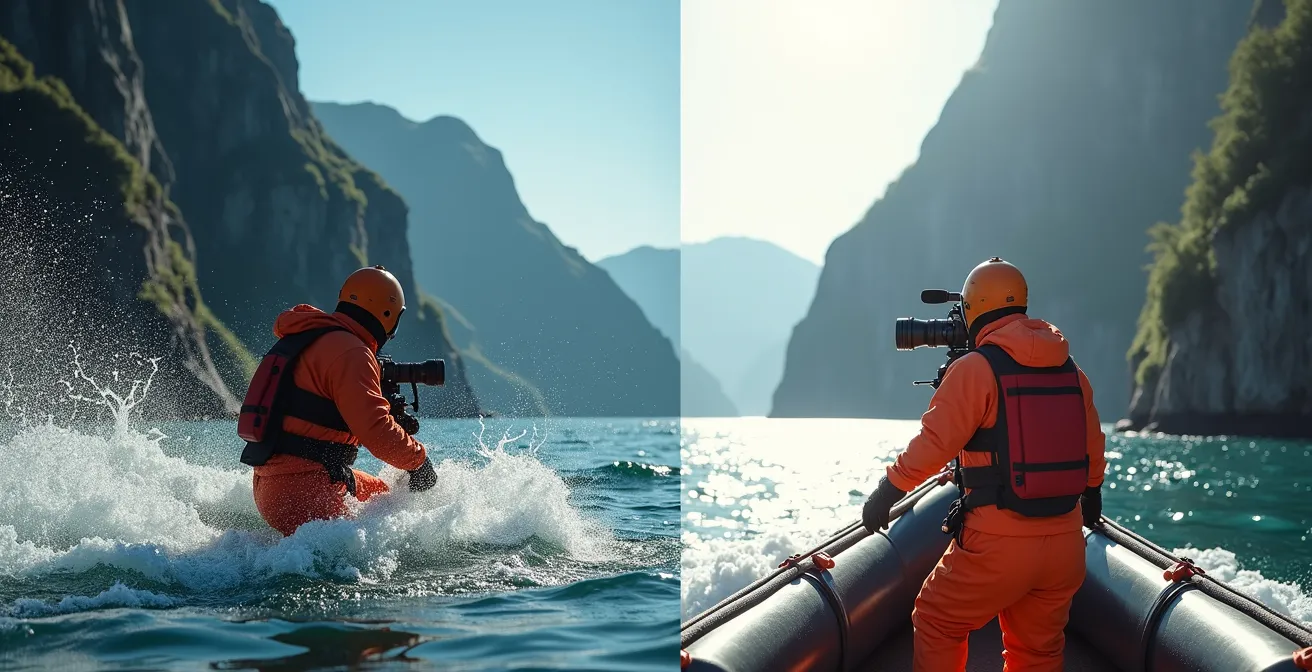
Conversely, the larger boats, while further from the cliffs, provide an elevated, panoramic perspective. Their stability is a massive advantage for photography and for those prone to seasickness. You sacrifice the water-level thrill for a calm, observational experience, often with the convenience of onboard amenities. The choice hinges on your priority: are you seeking an adrenaline rush or a steady platform for observation?
This table breaks down the key differences to help you align your choice with your budget and travel style. Note how the Fjord Marine Shuttle, often overlooked, presents a balanced middle ground in both price and experience.
| Feature | Zodiac (24-60 passengers) | Big Boat (200+ passengers) | Fjord Marine Shuttle |
|---|---|---|---|
| Proximity to Cliffs | Can approach within safe distance | Further from cliffs but elevated view | Mid-range proximity |
| Photography Stability | Challenging (movement/spray) | Excellent for telephoto lenses | Good compromise |
| Price Range | $85-100 CAD | $65-75 CAD | $45-55 CAD |
| Seasickness Risk | High (bumpy ride) | Low (stable platform) | Medium |
| Adventure Level | High thrill factor | Comfortable observation | Moderate adventure |
How to Use the Tadoussac-Baie-Ste-Catherine Ferry Without Waiting Hours?
For the truly budget-conscious traveler, the best cruise on the Fjord might be the one that’s free. The Tadoussac–Baie-Sainte-Catherine ferry is a public service, designed to transport vehicles across the mouth of the Saguenay. But for a savvy visitor, this 10-minute crossing is the cheapest tour available, offering breathtaking, cliff-level views as it navigates the confluence of the Fjord and the St. Lawrence. The catch? The legendary wait times, which can stretch for hours during peak season, turning a clever travel hack into a frustrating ordeal. The key is to think like a local, not a tourist.
The service is frequent, but demand is overwhelming in summer. According to the official operator, the ferry has departures every 13-20 minutes during peak periods, but this capacity is quickly swamped by the line of cars. The most powerful tool at your disposal is information. The single greatest mistake is arriving blind. By checking the Quebec 511 app before you even get in your car, you can see real-time wait estimates and even view live camera feeds of the queue. This allows you to time your arrival perfectly or change your plans if the wait is unbearable.
The ultimate strategy for a zero-cost, zero-wait experience is the “Park and Walk-On.” Designated parking areas in Baie-Sainte-Catherine allow you to leave your car and board the ferry as a pedestrian for free. You get the full multi-million-dollar view without spending a dime or waiting in the vehicle line. It’s the single best travel hack in the region for seeing the Fjord from the water on a budget.
Your Action Plan: The Ferry Crossing Playbook
- Check the Quebec 511 app for real-time wait times and live cameras before you leave.
- Avoid peak traffic between 10 AM and 4 PM on summer weekends. Never attempt a crossing during Québec’s construction holiday (last two weeks of July).
- Use the “Park and Walk-On” strategy: park in designated lots in Baie-Sainte-Catherine and board as a pedestrian for free.
- Consider a “Contrarian Crossing”: drive to Tadoussac early in the morning when traffic is light, explore the village, and return in the late afternoon against the main flow.
- Have a backup plan. If wait times are over 90 minutes, consider visiting a land-based viewpoint instead and trying the ferry another time.
Why Kayaking the Fjord Requires a Wetsuit Even in August?
Sea kayaking offers the most intimate connection with the Fjord. The silence, broken only by the dip of your paddle and the call of a gull, is a profound experience. It’s the ultimate way to feel the scale of the cliffs. But this immersion comes with a non-negotiable respect for the Fjord’s most dominant feature: its cold. Many visitors, seeing the summer sun, underestimate the water. This is a critical, potentially fatal mistake. The water in the Saguenay Fjord is not refreshing; it is dangerously cold, year-round.
The reason lies in its hydrology. A deep layer of frigid saltwater from the St. Lawrence Estuary flows into the Fjord and remains trapped below a thin, seasonal layer of warmer fresh water. This means that even on the hottest August day, the vast majority of the water column is icy. As a result, the fjord maintains frigid temperatures with an average of 4-6°C (39-43°F) in its deep-water layers. A capsize without proper thermal protection can lead to cold shock within a minute—an involuntary gasp that can cause you to inhale water—followed by rapid hypothermia.
This is why professional outfitters have strict rules. It’s not about comfort; it’s about survival. Responsible companies will not let you on the water without adequate gear, and you should not attempt it independently without it.
Case Study: Aventure Écotourisme Québec (AEQ) Safety Standards
Companies like Fjord en Kayak, which are certified by Aventure Écotourisme Québec (AEQ), enforce the mandatory use of a wetsuit or drysuit for all participants, regardless of the season or air temperature. This isn’t an arbitrary company policy but an industry-wide safety standard based on the known risks of the Fjord’s water. The AEQ certification guarantees that the outfitter provides professional-grade equipment and follows protocols designed to prevent and manage cold-water emergencies. Choosing an AEQ-certified operator means you are renting not just a kayak, but a system of safety built on deep respect for the Fjord’s power.
The Tidal Mistake That Strands Kayakers on the Shore
If the Fjord’s cold is its heart, the tide is its breath. Twice a day, the St. Lawrence Estuary pushes a massive volume of water into the Fjord and pulls it back out. For a kayaker, ignoring this rhythm—the “Tidal Clock”—is the second critical mistake. It’s not a gentle lapping at the shore. The tidal range here is immense. At certain times of the year, particularly the spring equinox, the dramatic tidal variations can reach up to 6 meters (20 feet). That’s the height of a two-story building.
What does this mean in practical terms? It means the beach where you launched your kayak in the morning might be 100 meters of thick, impassable mud by the afternoon. It means the charming cove you stopped in for lunch could become a rocky prison, with the water’s edge now a distant line you can’t reach. Every year, inexperienced paddlers get stranded, facing a long, cold wait for the tide to return or a difficult and dangerous trek over slippery terrain. They misjudged the shoreline’s horizontal movement, which can be far greater than the vertical drop.
This aerial view shows the stark reality of a miscalculated tide. The kayak is not peacefully beached; it’s trapped, with a long, arduous drag to the new low-tide waterline.
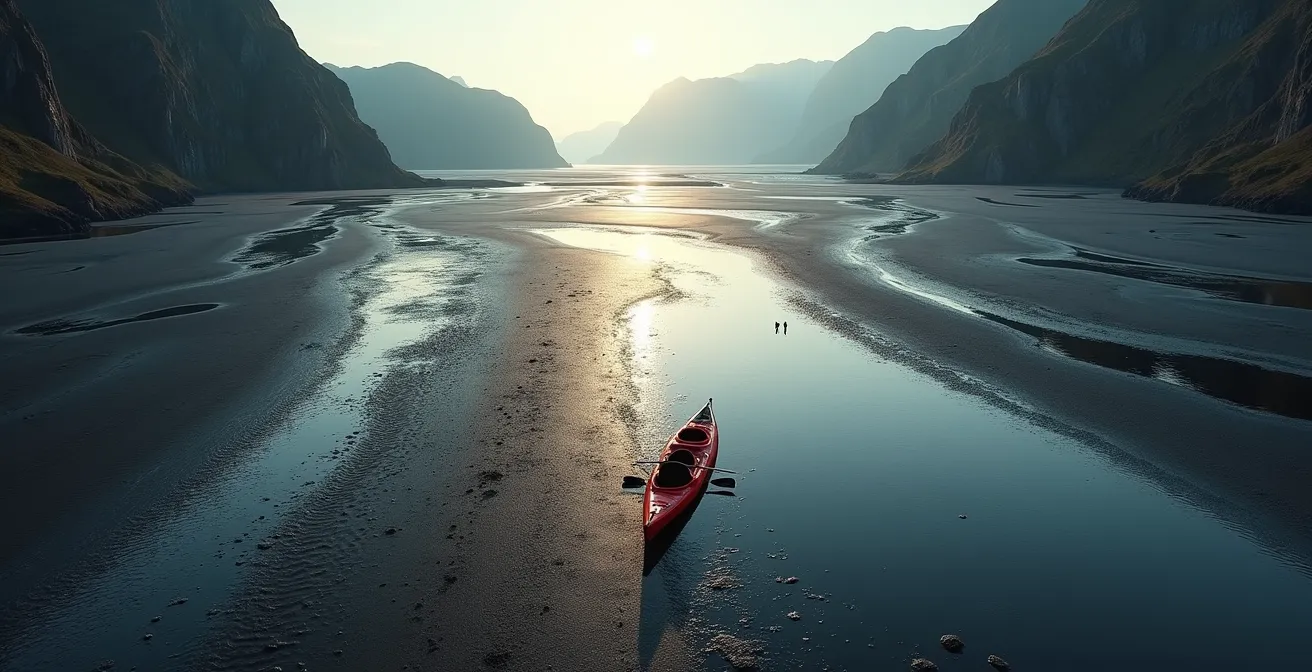
Planning is not optional. You must consult official tide charts from Fisheries and Oceans Canada for the specific area you plan to paddle—data for Tadoussac at the mouth is different from L’Anse-Saint-Jean further in. A successful trip is planned *with* the tide, using its flow to assist your travel out and back. Launching or landing near high tide is easiest, while low tide reveals the challenging, muddy reality of the Fjord’s intertidal zones. Forgetting to check the tide chart is like going for a hike without a map; you are inviting trouble.
Where to See the Fjord’s Magnitude Without Getting on a Boat?
While the allure of a water-level view is strong, it’s entirely possible to experience the Fjord’s breathtaking scale without spending a cent on a boat tour. For the budget-conscious traveler, a “land-based cruise” along the Fjord Route (Routes 172 and 170) offers a series of world-class viewpoints that are completely free. These aren’t just distant overlooks; many are perched right at the edge of the cliffs, providing the same sense of vertigo and grandeur you’d get from a boat.
The key is knowing where to stop. A tour of these viewpoints can be structured by effort, from simple roadside pull-offs to rewarding short hikes. This approach allows you to customize your day based on your energy and time, all while keeping your wallet in your pocket. These spots are also excellent for whale watching from shore, particularly near the mouth of the Fjord in the Tadoussac and Sacré-Coeur area.
- Low Effort / High Reward: The Halte Béluga viewpoint on Route 138 near Sacré-Coeur is a simple roadside pullout that offers a spectacular panoramic view of the Fjord’s mouth.
- Village Charm: The public pier in the picturesque village of Sainte-Rose-du-Nord is free to access and puts you right over the water, surrounded by cliffs.
- Epic Reward: For the price of a daily park pass ($10.10), the Le Géant trail in Parc national du Fjord-du-Saguenay leads to a staggering clifftop vista.
- The Drive Itself: Simply driving the loop of Route 172 (north shore) and 170 (south shore) reveals numerous free ‘haltes routières’ (roadside rest areas) with stunning, uncurated views.
Hidden Gem: The Anse-de-Tabatière Viewpoint
For those willing to invest a small park fee and a bit of hiking effort, the Point-de-vue de l’Anse-de-Tabatière in the national park offers the best of both worlds. This moderate 3.2km round-trip trail is unique because it descends to a secluded cove. Here, you stand at water level, surrounded by towering cliffs, experiencing the same immersive perspective as a kayaker but with your feet firmly on the ground. It delivers the Fjord’s immensity without the cost or risks of being on the water, making it one of the highest-value experiences in the region.
Gravel or Tarmac: What Are the Road Conditions Around the Fjord?
A common concern for visitors planning to drive the Fjord Route is the quality of the roads. Given the region’s rugged and wild reputation, it’s reasonable to wonder if you’ll be facing rough gravel paths or smooth highways. The good news is that the main tourist loop is exceptionally well-maintained. According to the official Saguenay-Lac-Saint-Jean tourism body, the main tourist routes around the fjord feature 100% paved two-lane highways. Routes 138, 170, and 172 are designed for year-round travel and are suitable for any standard vehicle, from a small sedan to an RV.
However, “paved” doesn’t mean without challenges. Driving in this part of Québec requires seasonal awareness. The biggest hazards aren’t the road surface itself but the conditions created by weather and wildlife. Being prepared for these local realities is key to a safe and enjoyable road trip.
- Spring (April-May): This is ‘nid-de-poule’ (pothole) season. The freeze-thaw cycle creates significant damage to the asphalt. Drive with caution and reduced speed, as some potholes can be deep enough to damage a tire.
- Winter (December 1 – March 15): Winter tires are mandatory by law in Québec during this period. The fine for non-compliance is steep ($200-$300), but more importantly, it’s a critical safety measure for handling icy and snowy conditions.
- Year-Round Wildlife: Moose and deer are very active, especially at dawn and dusk. Collisions can be extremely dangerous. Heed the warning signs and reduce your speed significantly during these times.
Gravel roads are generally only encountered when accessing very specific, remote locations, such as certain trailheads deep within the national parks (Parcs nationaux) or ZECs (controlled harvesting zones). For the average tourist exploring the main villages and viewpoints, you will remain on tarmac for your entire journey.
Zodiac vs. Kayak: Which Vessel Disturbs Whales Less?
For many, the ultimate goal of a Fjord trip is to see whales. This brings up an important ethical question: which method of observation is most respectful to these magnificent animals? It’s tempting to think a silent kayak is inherently less disturbing than a motorized zodiac. However, the reality is more complex. The key factor is not the vessel type, but the operator’s behavior and adherence to regulations.
The Saguenay–St. Lawrence Marine Park is a federally protected area with strict rules. To protect the animals from stress, federal regulations in the Saguenay-St. Lawrence Marine Park mandate a 200-meter minimum approach distance for most whale species. For the endangered St. Lawrence Beluga, that distance is doubled to a strict 400 meters. The problem with kayaks is not malice, but unpredictability. A silent vessel can appear suddenly to a whale, causing surprise and stress. Furthermore, a flotilla of independent kayakers can effectively “corral” an animal, cutting off its path. A zodiac, in the hands of a trained, certified captain, is loud but predictable. Its engine noise allows whales to track its location, and a responsible captain will follow established navigation patterns that minimize disturbance.
Case Study: The Eco-Whale Alliance Certification
Tour operators who are members of the Eco-Whale Alliance demonstrate that responsible behavior transcends vessel type. These certified companies, whether operating zodiacs or large boats, commit to maintaining strict approach distances and using predictable routes. Their captains and on-board naturalists are trained to read whale behavior and will adjust their course or even cut an observation short if they see signs of stress. When it comes to the highly protected belugas, both kayaks and zodiacs must respect the 400-meter buffer, which often makes land-based observation from sites like Pointe-Noire or Cap-de-Bon-Désir the most responsible choice for seeing this specific species.
Ultimately, a certified zodiac tour is often a more responsible choice than an unguided kayak trip in a high-density whale area. The certification ensures the operator is trained in low-impact observation and contributes to a regulated environment, which is always better for the whales.
Key Takeaways
- The best viewing choice depends on your priority: big boats for stable photography, zodiacs for thrills, and the ferry for the ultimate budget view.
- Respect for the Fjord’s environment is not optional. The water’s extreme cold and powerful tides are serious safety factors that must govern any kayaking plans.
- Responsible whale watching is determined by the tour operator’s training and adherence to regulations, not simply by whether the vessel is motorized or not.
How to Choose an Eco-Responsible Whale Watching Tour on the St. Lawrence?
Navigating the sea of tour operators in Tadoussac can be confusing, with everyone promising the “best” whale watching experience. However, a truly exceptional tour isn’t just about seeing whales; it’s about doing so in a way that contributes to their well-being and conservation. Making an eco-responsible choice requires you to look past the marketing and verify a company’s real-world commitments. Your power as a consumer lies in rewarding the operators who invest in sustainable practices.
The most significant indicator of a responsible operator is membership in the Eco-Whale Alliance (Alliance Éco-Baleine). This certification is not a simple marketing badge; it signifies a commitment to higher-than-required standards of practice, including slower speeds, predictable navigation, and participation in research. The presence of a trained naturalist or marine biologist on board is another critical sign. These experts transform a simple sightseeing trip into an educational experience, providing context about whale behaviors, the local ecosystem, and the conservation challenges these animals face.
Case Study: The Value of a GREMM Research Partnership
By choosing an operator that partners with the Group for Research and Education on Marine Mammals (GREMM), your tour fee directly supports vital science. These certified companies contribute sighting data and whale identification photos (a practice known as photo-ID) to GREMM’s long-term research projects, particularly those focused on the endangered St. Lawrence Beluga. To enhance your trip, visit the Marine Mammal Interpretation Centre (CIMM) in Tadoussac before your tour. The knowledge gained there will give you a much deeper appreciation for the animals you are about to see and the importance of choosing an operator who is a partner in their protection.
To ensure your money supports conservation, you need to become a discerning customer. This checklist provides a simple framework for auditing a potential tour operator before you book.
Your Eco-Tour Audit Checklist: 5 Points to Verify
- Certification: Look for the official Eco-Whale Alliance logo prominently displayed on the operator’s website and at their ticket kiosk.
- On-Board Expertise: Confirm that a certified naturalist or marine biologist will be on your specific tour to provide educational commentary.
- Regulation Compliance: The operator should explicitly mention their adherence to the Saguenay-St. Lawrence Marine Park regulations, especially approach distances (200m for most whales, 400m for belugas).
- Citizen Science Contribution: Check if the company mentions contributing data or photos to research organizations like GREMM or the CIMM. This demonstrates a long-term commitment.
- Pre-Booking Questions: Don’t be afraid to ask their staff directly: “What are your specific protocols when approaching whales?” A responsible operator will have a clear, confident answer.
The ultimate way to explore the Saguenay Fjord is not by choosing the fastest boat or the cheapest ticket, but by making an informed decision that aligns with your budget, your comfort level, and your respect for this powerful, living environment. Use these insights to plan an adventure that is both memorable for you and sustainable for the nature that makes this place so extraordinary.