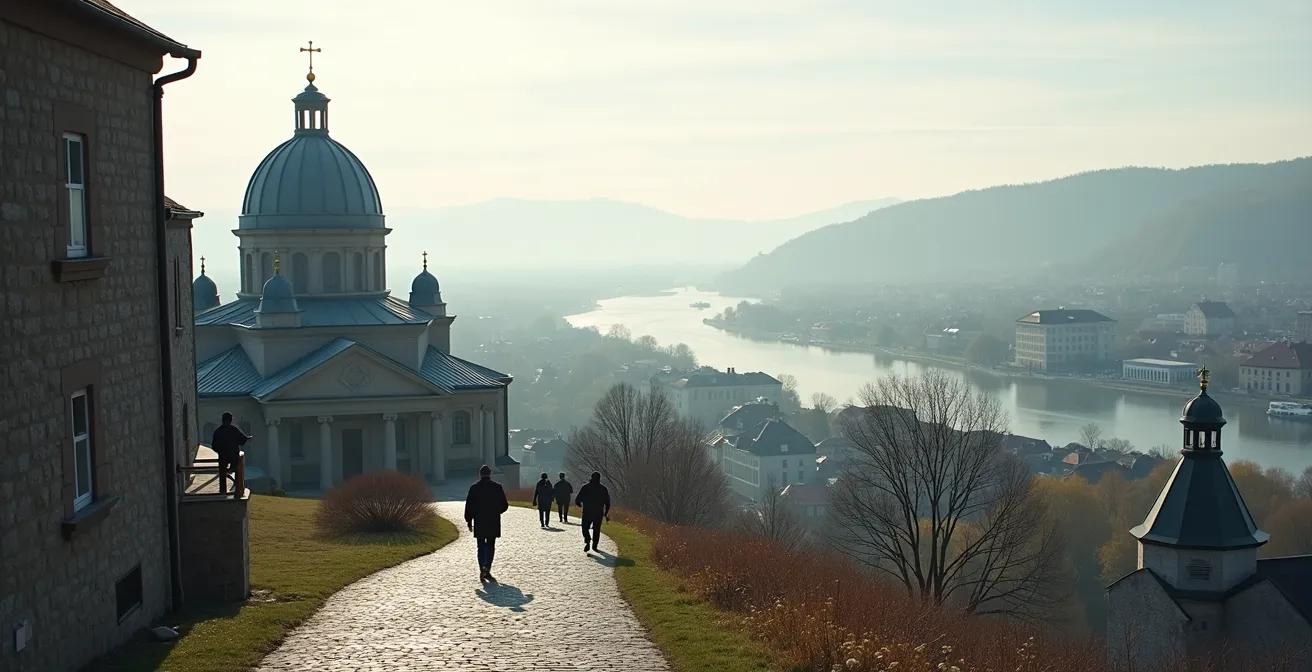
In summary:
- To truly connect with Quebec’s sacred sites, adopt a “pilgrim’s mindset” that prioritizes understanding over simple sightseeing.
- Respect for “living heritage” involves observing practical rules regarding silence, dress codes (especially in winter), and participation in services.
- Engage with the practical aspects of pilgrimage, like using a credential on the “Compostelle” route, even on short, comfortable trips.
- Learn to read the “symbolic language” of the sites, from votive offerings like crutches and ship models to the role of organ music.
- A deep experience involves seeing these sites not as museums, but as active places with their own sacred rhythms and history integrated into Quebec’s identity.
Stepping into a grand Quebec basilica for the first time is an exercise in awe. The soaring vaults, the glint of gold, the scent of old wood and cool stone—it’s an experience that hushes the soul. Yet, for many visitors, a question lingers beneath the surface: “Am I doing this right?” We know the basic advice is to be quiet and take pictures without flash. But this barely scratches the surface of a heritage that is not just built of stone, but woven from centuries of living faith, social history, and profound cultural identity.
A truly deep and respectful visit goes beyond admiring the architecture of Montreal’s Notre-Dame Basilica or the scale of Saint Joseph’s Oratory. It’s about understanding the difference between being a tourist and becoming, even for a moment, a pilgrim. It’s about recognizing that these are not merely historical attractions but often active places of worship and community. But what if the key to unlocking this deeper experience isn’t found in a typical travel guide, but in learning to read the unspoken rules, sacred rhythms, and symbolic language of these spaces?
This guide is designed to shift your perspective from that of a passive observer to an engaged participant. We will explore the practical etiquette of staying in a monastery, the specific clothing choices that signal respect, and how to interpret the powerful stories told by votive offerings. By embracing this approach, you will not only see Quebec’s religious heritage, but feel its enduring pulse.
To understand the profound and sometimes complex relationship between Quebec society and its religious roots, the following documentary on the Charter of Quebec Values offers essential cultural context. It provides a backdrop for why the themes of heritage and secularism are so potent in the province today, enriching a visitor’s perspective.
To help you navigate this rich landscape, this article is structured to provide both practical guidance and deeper historical insight. Each section addresses a key question that will transform your visit from a simple tour into a meaningful journey.
Summary: A Deeper Journey into Quebec’s Sacred Heritage
- Monastery Stays vs. Hotels: What Are the Rules for Guests?
- The Clothing Mistake That Might Bar You from Entering a Basilica
- How to Walk the ‘Compostelle’ of Quebec Without Camping?
- When to Hear the Great Organs of Quebec City for Free?
- Museum or Active Church: How to Interpret the Votive Offerings?
- The Citadel or the Ramparts: Which Tour Is Better for History Buffs?
- Basilica or Biosphere: Which Icon Defines Montreal’s Skyline Better?
- How to Trace Your Family Roots in Quebec During a Short Trip?
Monastery Stays vs. Hotels: What Are the Rules for Guests?
Choosing to stay in a monastery over a hotel is the first step in shifting from a tourist’s schedule to a pilgrim’s rhythm. Unlike a hotel, where the guest is the center, a monastery operates on its own sacred rhythm, dictated by prayer, community life, and silence. Understanding this distinction is key. Some establishments, like Le Monastère des Augustines in Quebec City, offer a hybrid experience focused on holistic healing and history in a non-confessional setting. Others, like traditional Benedictine abbeys, maintain a stricter contemplative life where the separation between the monastic community and guests is more defined.
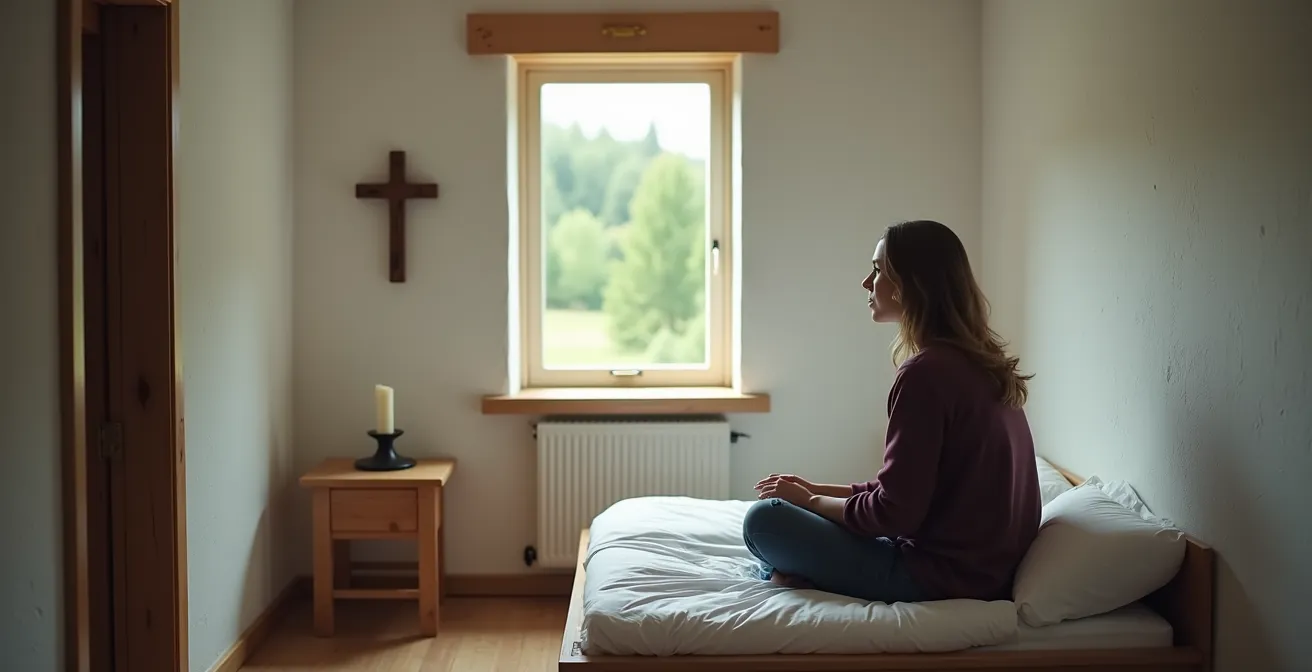
As the image suggests, the experience is one of simplicity and introspection, not luxury. The room is a space for contemplation, a stark contrast to the distraction-filled environment of a typical hotel. The rules for guests are not arbitrary; they are designed to protect this atmosphere of peace for both the community and its visitors. This includes observing designated periods of silence, respecting private areas, and often, participating in a “digital detox” due to limited or non-existent Wi-Fi.
Your Guide to Monastery Guest Etiquette
- Understand the levels of silence: Respect complete silence in the refectory (dining hall), use quiet voices in corridors, and engage in normal conversation only in designated common areas.
- Prepare for a digital detox: Most Quebec monasteries have limited or no Wi-Fi. Download any necessary maps or books beforehand and inform contacts of your unavailability.
- Learn the bell schedule: Bells signal prayer times, meals, and quiet hours. Guests are typically welcome but not obligated to attend religious services.
- Respect the cloister boundaries: Areas marked “clôture” are strictly off-limits to guests. Never photograph monks or nuns without their explicit permission.
- Participate respectfully in services: If you choose to attend, non-Catholics should follow the congregation’s lead for standing or kneeling but remain seated during communion.
By embracing these guidelines, a monastery stay transforms from mere accommodation into a profound immersion in a centuries-old way of life, offering a unique form of spiritual and mental rejuvenation.
The Clothing Mistake That Might Bar You from Entering a Basilica
Approaching a sacred space involves crossing a threshold of respect, and clothing is its most visible sign. While Quebec is a modern and secular society, its most important religious sites maintain a dress code rooted in tradition and reverence. The most common mistake visitors make is assuming that tourist comfort supersedes the sanctity of the space. For major basilicas like Notre-Dame in Montreal or Sainte-Anne-de-Beaupré, this generally means covering shoulders and knees. Tank tops, very short skirts or shorts, and clothing with offensive graphics will likely prevent your entry.
The Quebec climate presents a unique challenge. What about winter, when visitors are bundled in heavy layers? The expectation is that you remove outer winter coats, hats, and wet boots upon entering. Most major churches provide a coat check or designated area for this. The key is what you wear underneath; even in winter, athletic wear or casual t-shirts are discouraged if you wish to show full respect. It’s a matter of intention—dressing as if you are a welcome guest in a special home, not just passing through an attraction.
Beyond clothing, be mindful of your accessories. Large backpacks are often prohibited inside the main sanctuary to prevent accidental damage to fragile artworks and to enhance security. Both Saint Joseph’s Oratory and Notre-Dame Basilica offer lockers near the entrance for this purpose. Finally, always check for signs indicating a private service like a wedding or funeral. While visitors can sometimes observe quietly from the back, it’s a sign of profound respect to be dressed more formally—at a minimum, business casual—if you choose to stay.
How to Walk the ‘Compostelle’ of Quebec Without Camping?
The idea of a pilgrimage often conjures images of arduous, rustic journeys. However, walking Quebec’s “Compostelle”—the Chemin de Saint-Jacques—can be a comfortable and deeply moving experience without ever pitching a tent. The route is designed to be accessible, connecting historic towns and parishes with a network of inns, B&Bs, and monastery guesthouses. This allows for a focus on the spiritual and historical aspects of the journey, with the comfort of a good bed and meal at the end of each day. For instance, a popular 3-day, 30km pilgrimage from Quebec City to the renowned Sainte-Anne-de-Beaupré Shrine can be done by staying at places like the Monastère des Augustines and the historic Auberge Baker en route.
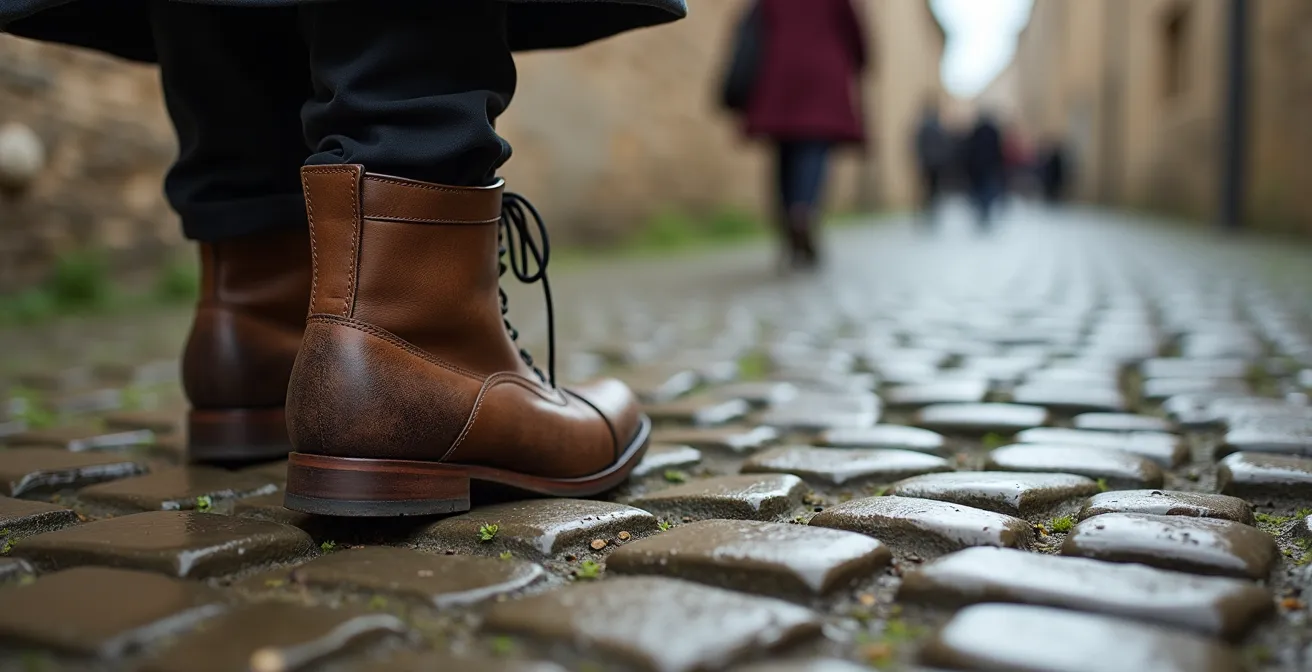
The key to this type of pilgrimage is the Pilgrim’s Credential (or “passeport”). More than just a souvenir, this booklet is your key to the pilgrim community. You collect stamps at churches, town halls, and even local dépanneurs (corner stores) along the way, creating a tangible record of your journey. Presenting a stamped credential often grants access to pilgrim rates at participating accommodations, typically a 15-20% discount. You can obtain the credential for about $10 at the starting point in Quebec City or by ordering it online in advance.
Walking the Chemin is to literally follow in the footsteps of centuries of faithful. The path winds along the historic Chemin du Roy, offering glimpses of the St. Lawrence River and connecting you to the very foundation of French Canada. The journey becomes a moving meditation on history, faith, and the stunning landscape of the province. Upon arrival at the Basilica of Sainte-Anne-de-Beaupré, presenting a credential with at least six stamps earns you a certificate of completion, a meaningful conclusion to a memorable journey.
When to Hear the Great Organs of Quebec City for Free?
The great organs of Quebec’s historic churches are not museum pieces; they are the powerful, living voices of these sacred spaces. Hearing them fill a basilica with sound is one of the most immersive ways to experience this living heritage, and fortunately, there are many opportunities to do so for free. The most reliable chance is by attending a regular Sunday Mass. At the Notre-Dame de Québec Basilica-Cathedral, for example, the 10 a.m. service is preceded by a 15-minute organ prelude starting at 9:45 a.m., offering a moment of pure musical contemplation.
Beyond weekly services, the liturgical calendar offers special moments for organ enthusiasts. The Christmas and Easter services feature the most elaborate performances of the year. The Easter Vigil on Saturday evening, in particular, often showcases the organ’s full repertoire and power. While these are religious services, all respectful visitors are welcome to attend and listen from the pews. In Montreal, a similar experience awaits at Saint Joseph’s Oratory, where the carillon has been enchanting visitors for over 70 years of carillon concerts with 56 bells, adding another layer of sound to the city’s sacred soundscape.
For those seeking a purely concert-like experience, two seasons are ideal. During the summer (June-August), many historic churches in Quebec City host a free Tuesday evening recital series, often featuring acclaimed international organists. In the fall, usually in September, the “Doors Open Days” (Journées de la culture) event can provide a unique opportunity for behind-the-scenes tours of organ lofts, though this may require advance contact with the church’s “organiste titulaire” (titular organist). These events transform the musical instrument into a bridge connecting history, art, and the public.
Museum or Active Church: How to Interpret the Votive Offerings?
When you see walls covered in crutches or model ships hanging from a church ceiling, you are witnessing one of the most powerful forms of religious expression: the votive offering. These objects are the tangible symbolic language of faith, gratitude, and hope. They are not museum artifacts; they are public testimonies to prayers answered. Understanding their meaning is crucial to grasping the difference between a historic site and a living shrine. Quebec’s major shrines are not relics; over 2 million visitors annually to Saint Joseph’s Oratory alone proves their ongoing relevance in people’s lives.
Two of Quebec’s most famous shrines offer a clear lesson in decoding these symbols. At the Basilica of Sainte-Anne-de-Beaupré, two prominent types of votives tell the story of its patrons. The pillars near the entrance, piled high with crutches, canes, and braces, represent centuries of physical healings attributed to Saint Anne, the patron saint of Quebec, dating back to the 1650s. Hanging from the ceiling, you’ll see intricate wooden ship models. These are “ex-votos” left by sailors who, facing deadly storms on the St. Lawrence River, prayed to Saint Anne for deliverance and survived.
At Saint Joseph’s Oratory in Montreal, the thousands of crutches lining the walls of the Votive Chapel are directly linked to the ministry of Saint Brother André, who was known for his healing touch. They are a testament to the countless individuals who came to him seeking relief. Beside them, the glow of 10,000 continuously burning candles represents a different kind of offering: ongoing prayers and intentions left by pilgrims from around the world. These are not historical displays; they are active, ongoing conversations between the faithful and the divine.
The Citadel or the Ramparts: Which Tour Is Better for History Buffs?
For a history buff in Quebec City, the choice between touring the Citadel or walking the ramparts seems straightforward. The Citadel offers military history, while the ramparts offer scenic views. However, for those interested in religious heritage, the ramparts provide a far more unique and integrated perspective. A walk along the city’s fortified walls reveals how Quebec’s foundational religious institutions were not separate from but central to the colony’s defensive design and survival. These were not just places of prayer; they were strategic assets.
From the ramparts, you gain a strategic vantage point overlooking the sites of the Ursulines’ Monastery (founded in 1639) and the Hôtel-Dieu hospital, the first hospital north of Mexico. The placement of these institutions within the protective walls was a deliberate choice. As a study of the city’s design confirms, the colonial authorities understood that essential services—education, healthcare, and spiritual guidance—provided by these religious orders were critical to the colony’s morale and resilience. Protecting them was as important as protecting the garrison.
Therefore, a tour of the ramparts becomes a lesson in urban and social history, showing a society where the sacred and the secular, the military and the missionary, were inextricably linked. You see the city as its founders did: a fragile outpost where the church steeple was as much a symbol of enduring presence as the cannon on the wall. The Citadel tells the story of how Quebec was defended, but the ramparts tell the story of what, and who, was being defended, offering a much deeper insight into the role of religious heritage in the city’s very foundation.
Basilica or Biosphere: Which Icon Defines Montreal’s Skyline Better?
Montreal’s skyline tells a story of two souls. On one hand, you have the illuminated cross on Mount Royal and the magnificent dome of Saint Joseph’s Oratory. On the other, the futuristic geodesic dome of the Biosphere, a remnant of Expo 67. Deciding which better defines the city is to ask what defines Montreal itself: its deep Catholic roots or its innovative, secular modernity? For the visitor seeking to understand the city’s heritage, the answer is that you cannot understand one without acknowledging the other. The city’s identity lies in this very tension.
Montreal has long been recognized as the “City of a hundred bell towers”, a nickname that speaks to a time when religious life dominated the urban landscape and social fabric. The spires and domes were the original skyscrapers, orienting the populace both geographically and spiritually. The Oratory and the cross on the mountain are powerful, enduring symbols of this foundational identity. They represent the city’s origins and a heritage that continues to shape its culture, even in an increasingly secular age.
As historian Mathieu Drouin eloquently states in an article for *Canada’s History*, the two icons represent a clear duality:
The illuminated cross on Mount Royal and the massive dome of Saint Joseph’s Oratory represent Montreal’s founding Catholic soul, while the Biosphere embodies its innovative, secular future from Expo 67.
– Mathieu Drouin, Canada’s History – Transforming Religious Heritage
For a visitor, the Biosphere represents the Montreal of global festivals, technology, and multiculturalism. But looking up at the Oratory’s dome from its base reminds you that this modern city was built on a foundation of faith. The true icon of Montreal is not one or the other, but the dynamic, ever-present dialogue between them.
Key takeaways
- Adopt a Pilgrim’s Mindset: The most profound experiences come from prioritizing understanding, silence, and respect over a tourist’s checklist.
- Engage with Living Heritage: These sites are not just museums. Participate respectfully by attending a free organ recital, observing a service, or simply lighting a candle.
- Read the Symbolic Language: The architecture, votive offerings, and even the layout of the city tell a deep story of faith, survival, and community.
How to Trace Your Family Roots in Quebec During a Short Trip?
For those with French-Canadian ancestry, a trip to Quebec can be the ultimate pilgrimage: a journey to trace your own family’s story. Thanks to the Catholic Church’s meticulous record-keeping, it is entirely possible to make significant genealogical discoveries even on a short trip. The key is the “Parish-Cemetery-Archive Triangle” strategy, which leverages the fact that for centuries, life in Quebec revolved around the local parish church. The extensive religious heritage of Quebec includes over 2,755 places of worship documented in its official inventory, many holding the keys to your past.
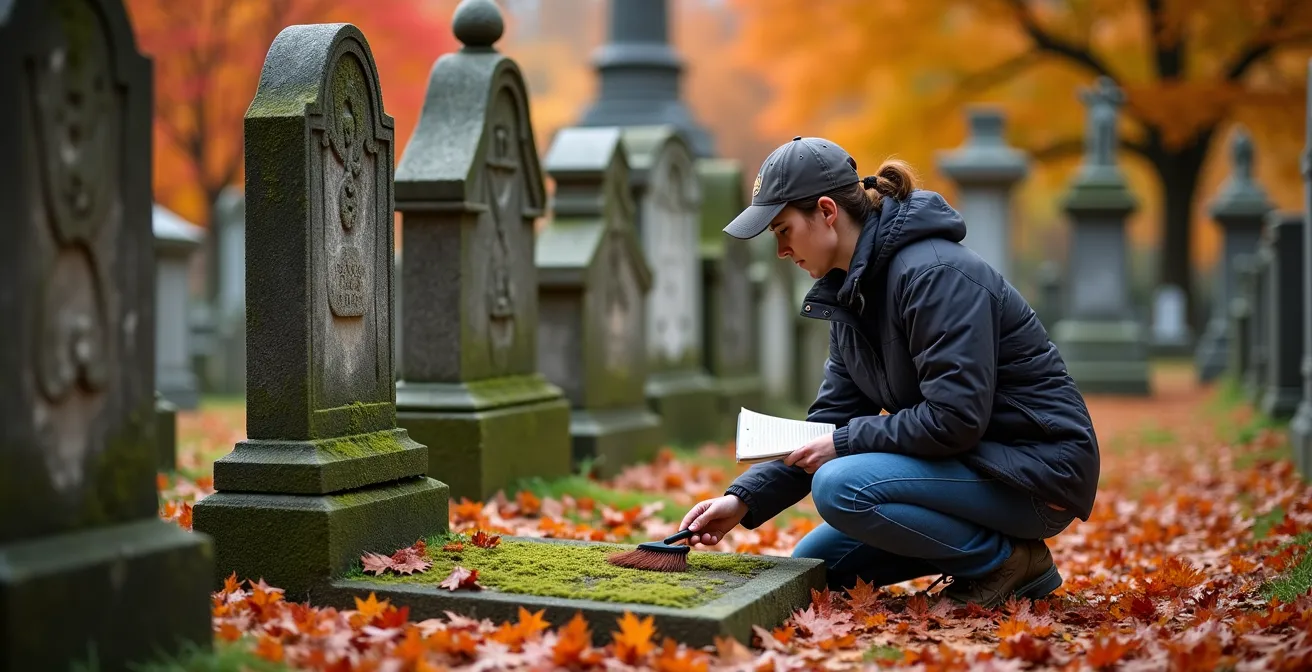
The first and most critical step happens before you leave home. Using online databases like Généalogie Québec (Drouin Institute) or BMS2000, you can identify your ancestral parish. With this information, your trip becomes a targeted mission. Once in Quebec, you can visit the parish church itself. Many still hold their original registers (baptisms, marriages, burials) dating back to the 1600s. It’s best to contact the parish office in advance, as they often have limited hours (e.g., Tuesday-Thursday mornings).
Next, explore the adjacent cemetery. This is where history comes to life. Look for family plots, paying attention to location—prestigious families were often buried near the church entrance. Photographing tombstones and noting their location is crucial. Be sure to look for “dit” names (e.g., Hébert *dit* Jolicoeur), which were common nicknames that became official family branches. If parish records have been moved, the final point of the triangle is the regional branch of the BAnQ (Bibliothèque et Archives nationales du Québec), which centralizes these precious documents. This focused strategy can turn a simple vacation into a powerful connection with your ancestors.
Embarking on this journey of discovery, armed with both historical context and practical knowledge, is the most meaningful way to honour Quebec’s heritage. The next step is to begin planning your own route, whether it leads to a quiet monastery, a resounding organ loft, or a simple tombstone bearing your family name.