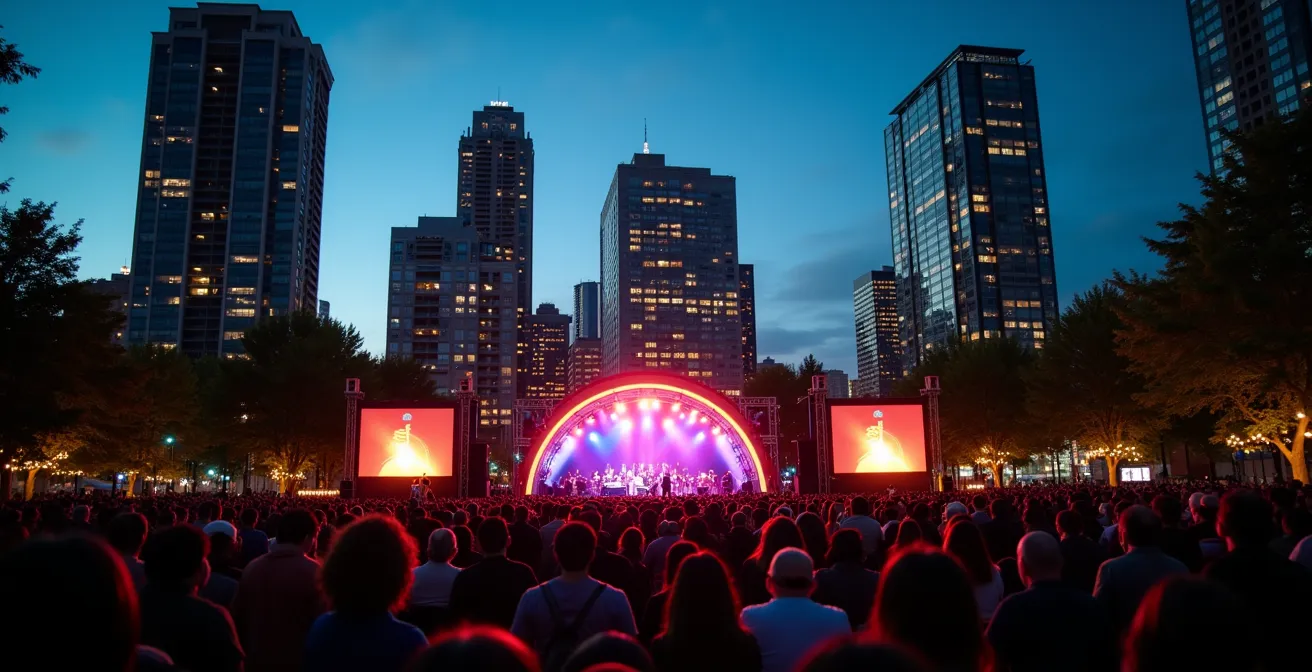
The key to discovering great new music at the Montreal Jazz Fest isn’t knowing the artists, but strategically choosing your venues.
- Free outdoor stages offer serendipity, but paid indoor venues provide superior acoustic quality for genuine discovery.
- Navigating the festival “ecosystem”—from transport like BIXI to pre-show dining—is as important as picking a show.
Recommendation: Shift your focus from who to see to where to see them for a more curated and rewarding festival experience.
The Montreal International Jazz Festival is a magnificent beast. The air in the Quartier des Spectacles thrums with energy, a city-wide celebration of sound and summer. With over two million visitors descending on the city for hundreds of performances, the sheer scale can be overwhelming for even seasoned festival-goers. The common advice is to simply “wander the free stages” and let serendipity be your guide. But this often leads to aimless drifting, catching fragments of sets from the back of a massive crowd, and feeling like you’ve missed the real magic.
What if the secret to truly discovering incredible new music wasn’t about luck, prior knowledge, or endlessly scrolling through the program? What if it was about strategy? The real pros, the music journalists and locals, don’t just wander—they curate their experience. They understand the festival as a living ecosystem, where the choice of venue is more critical than the choice of artist. This is the core of a better strategy: focusing on “venue curation” to dictate the quality of your musical discovery.
This guide will show you how to navigate the Montreal Jazz Fest like an insider. We’ll decode the value of different stages, reveal the best spots for acoustics, and cover the practical logistics that make for a seamless experience. It’s time to stop wandering and start discovering.
This article breaks down a strategic approach to the festival, from choosing your discovery environment to mastering the logistics of a perfect festival day. Explore the sections below to build your insider’s guide.
Summary: How to Strategically Discover Music at the Montreal Jazz Festival
- Is It Worth Paying for Indoor Shows When Outdoor Stages Are Free?
- Where to Stand at the Main Stage for the Best Acoustics?
- Outdoor Stages vs. Indoor Halls: Where is the Real Vibe?
- How to Navigate Montreal’s Summer Festivals Like a Local?
- How to Navigate the Place des Festivals in a Wheelchair?
- The Security Check Mistake That Costs You Your Water Bottle
- Where to Eat Quickly Before a 7 PM Show?
- When to Capture the Jacques-Cartier Bridge Illumination Perfectly?
Is It Worth Paying for Indoor Shows When Outdoor Stages Are Free?
The central dilemma for any festival-goer is how to allocate time and money. With over 450 free outdoor performances, the temptation to spend your entire festival experience on the main site is strong. However, this approach overlooks a key strategic concept: Acoustic Value. Free outdoor stages are fantastic for high-volume, low-risk discovery—you can sample many artists quickly. But for a truly immersive and high-fidelity listening experience, nothing beats an indoor venue.
Indoor halls like the Gesù or L’Astral are designed for sound. They offer a controlled environment where you can appreciate the nuance and complexity of an unfamiliar artist’s work. Think of it as an investment in the quality of your discovery. While the outdoor stages provide the sprawling party, the indoor venues offer intimacy and connection. This is where you’ll find curated series like ‘Carte Blanche’, where an artist presents a unique program, or late-night shows that often spill into legendary jam sessions at nearby clubs.
To truly discover new music, a hybrid approach is best. Use the free stages for serendipitous encounters and to soak up the communal energy. But when an artist’s description intrigues you, consider investing in a ticket for an indoor show. The sonic clarity will allow you to connect with the music on a much deeper level.
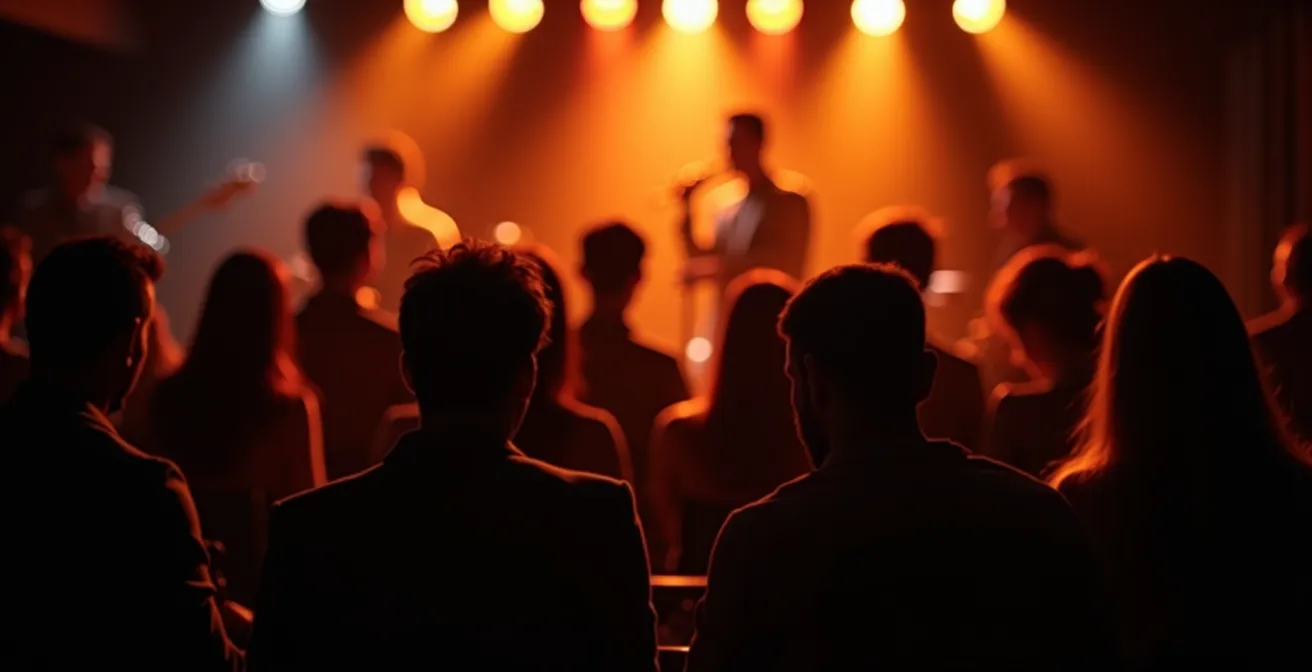
As you can see, the atmosphere of an indoor club provides a completely different kind of engagement. The proximity to the musicians and the focused energy of the crowd create a listening environment that a massive outdoor stage simply cannot replicate. This is where you move from being a spectator to a participant in the musical moment.
Where to Stand at the Main Stage for the Best Acoustics?
Even when you opt for the free outdoor stages, a little strategy goes a long way. The Place des Festivals isn’t just a random open space; it’s a carefully designed urban amphitheater with specific acoustic properties. Simply planting yourself anywhere in the crowd is a gamble. The biggest mistake is standing too close to the stage, where the sound can be unbalanced and overwhelmingly loud, or too far back, where it becomes muddy and lost in the chatter of the crowd.
The secret lies in finding the audio engineers’ “sweet spot.” The main soundboard is typically positioned about 30 meters from the center of the stage. This is where the engineers mix the sound for the entire venue, making it the theoretical point of optimal audio balance. However, this spot is often crowded and noisy. The insider’s trick is to position yourself slightly off-center from the soundboard, but at a similar distance from the stage. This gets you away from the main thoroughfare of people while keeping you in the prime acoustic zone.
Experienced festival-goers recommend a target zone between 25 and 40 meters from the stage. It’s also wise to avoid standing directly beside the large buildings flanking the square, as these can create “bass traps” where low frequencies accumulate and distort the sound. By applying this simple positioning strategy, you can dramatically improve your listening experience at the free shows, turning a chaotic crowd experience into a focused musical one, even amidst the 350 concerts that happen across 20 stages.
Outdoor Stages vs. Indoor Halls: Where is the Real Vibe?
Beyond pure acoustics, the choice between an outdoor stage and an indoor hall is a choice between two fundamentally different festival “vibes.” Your decision should be guided by the kind of experience you’re seeking at that moment. Neither is inherently better, but they serve very different purposes in your discovery strategy. Understanding this distinction is central to curating your perfect festival journey.
The outdoor stages, particularly the main stage at Place des Festivals, cultivate a ‘fête de quartier’ atmosphere—a massive, communal block party. The energy is social, celebratory, and diffuse. It’s the perfect environment for a relaxed evening with friends, soaking in the city’s energy, and stumbling upon music serendipitously. The focus is as much on the collective experience as it is on the performance itself.
In stark contrast, indoor venues like the Maison Symphonique or a smaller jazz club like Dièse Onze offer a more reverent, focused atmosphere. The vibe is one of ‘cérémonie’ or intimate intensity. Here, the music is the undisputed center of attention. The audience is there for critical listening and to forge a closer connection with the artist. As the Latin Jazz Network aptly puts it, the festival “reflects Montreal’s nightlife through its movement, its intensity and, of course, its community.” This intensity is most palpable in the smaller, dedicated venues.
The following table breaks down these atmospheric differences, helping you choose your venue based on your desired experience.
| Venue Type | Atmosphere | Best For | Capacity |
|---|---|---|---|
| Outdoor Stages (Place des Festivals) | ‘Fête de Quartier’ – communal block party energy | Serendipitous discoveries, social experience | Up to 100,000 |
| Indoor Halls (Maison Symphonique) | ‘Cérémonie’ – reverent, focused listening | Critical listening, acoustic appreciation | 2,000 seats |
| Jazz Clubs (Dièse Onze) | Intimate intensity | Close artist connection | 100-300 |
| Quartier Latin Bars | Hybrid casual atmosphere | Relaxed discovery with drinks | 50-200 |
How to Navigate Montreal’s Summer Festivals Like a Local?
Thinking like a local means mastering the festival ecosystem beyond the stages. How you get to the site, move between venues, and time your arrivals can transform a stressful trek into a seamless part of the experience. Ditch the car and the crowded metro lines during peak hours; the real Montrealer’s tool for festival navigation is the BIXI bike.
With a network of over 11,000 bikes, including 2,600 electric ones, BIXI stations are strategically placed all around the Quartier des Spectacles. It allows you to bypass traffic and enjoy the city’s energy en route. The most common frustration for BIXI users during festivals is finding a full docking station. However, BIXI Montreal has implemented a brilliant solution: a valet service specifically for major events. These valet stations guarantee you can drop off your bike even when the docks are full, removing the biggest pain point of the system.
This service integrates perfectly with Montreal’s cherished ‘5 à 7’ culture. Locals will often use a BIXI to enjoy happy hour drinks or a quick bite in a neighbourhood slightly outside the main festival zone (like the Quartier Latin or Plateau) before biking to the site just as the evening headliners begin. This allows you to avoid the biggest crowds and highest prices while still arriving in time for the main event. It’s a rhythm that makes you feel part of the city, not just a visitor to it.
How to Navigate the Place des Festivals in a Wheelchair?
Montreal’s commitment to accessibility is a point of pride, and the Jazz Festival is a shining example of this in action. The entire festival site is designed to be inclusive, a fact certified by Kéroul, Quebec’s leading organization for promoting tourism for people with disabilities. Their full accessibility rating, updated in 2024, confirms that navigating the festival in a wheelchair is not an afterthought, but a core part of its design.
The festival implements comprehensive measures across all its venues. This includes dedicated viewing areas at outdoor stages with wide circulation corridors of at least 92 cm, ensuring easy movement. These areas are often covered and situated near accessible restrooms for convenience. Ramps with gentle slopes are integrated throughout the site, and the pathways are smooth and spacious. The key is to know the layout in advance.
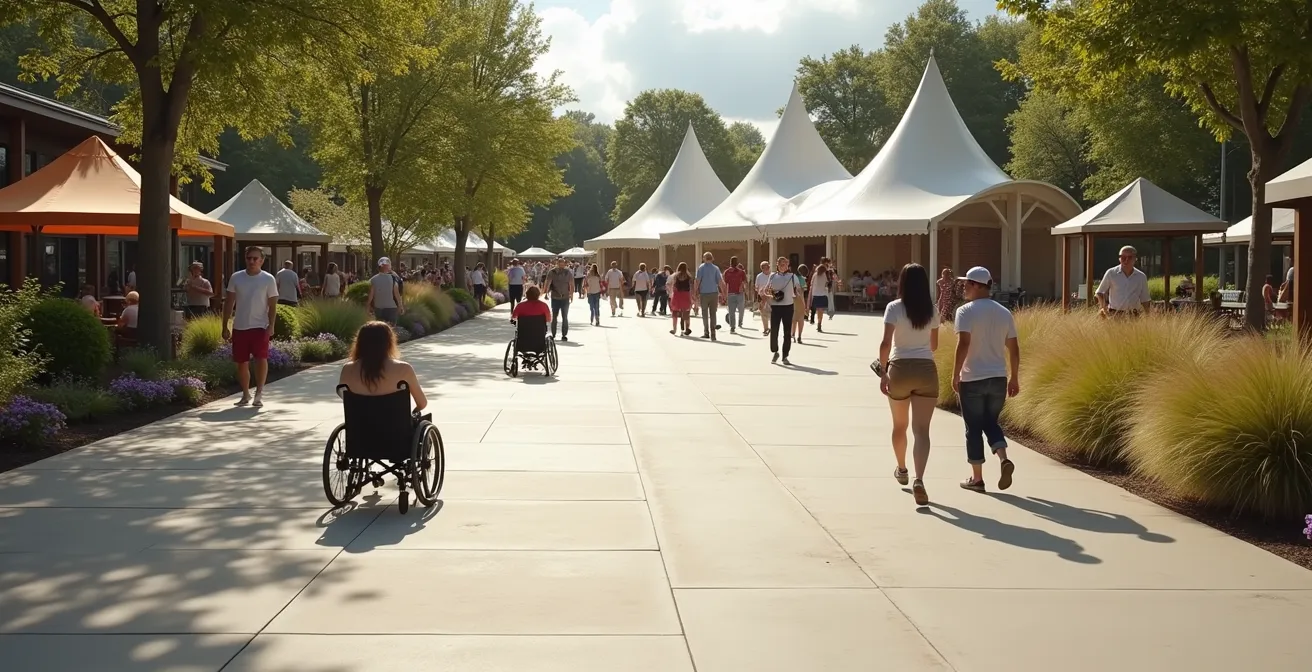
One of the most valuable local tips is to use the Place-des-Arts metro station. It features specific elevators that provide direct access to the heart of the festival, allowing you to bypass the densest street-level crowds entirely. The festival website provides detailed maps highlighting these accessible routes, viewing platforms, and facilities. Planning your path beforehand ensures a comfortable and enjoyable experience, allowing you to focus on the music, not the logistics.
The Security Check Mistake That Costs You Your Water Bottle
Nothing sours the start of a festival evening like having to throw out your brand-new insulated water bottle at the security check. It’s a small but incredibly common frustration that is easily avoidable with a bit of insider knowledge. The festival’s rules are clear but often misunderstood by first-timers. The goal of security is not to prevent you from staying hydrated, but to ensure safety. This means they need to see that your container is empty upon entry.
The single biggest mistake is bringing a pre-filled, opaque bottle. It will be confiscated. The solution is simple: bring a clear, empty water bottle. Once you’re inside the festival grounds, numerous refill stations are available. For maximum efficiency, consider a high-capacity insulated bottle (as long as it’s brought in empty) to minimize trips to the refill station during a show. This small tweak in your preparation can save you money and frustration.
This principle of preparation extends to other items as well. A little planning can make your entry and re-entry significantly smoother, letting you get to the music faster. Following a simple checklist ensures you’re prepared for the security process.
Your Pre-Entry Security Checklist
- Bring an empty, reusable water bottle, preferably clear, to show security it’s empty.
- Use a high-capacity insulated bottle (brought empty) to reduce refill trips during peak heat.
- Pack small, factory-sealed energy bars or snacks if you have dietary needs; these are generally tolerated.
- Prepare a small “express bag” with only your essentials for faster processing at re-entry points.
- Look for “no bag” express lanes at some entry points if you’re traveling light for the quickest access.
Where to Eat Quickly Before a 7 PM Show?
The “what’s for dinner?” question can quickly become a stressful scramble when you have a 7 PM show to catch. The restaurants immediately surrounding the Place des Festivals are often packed and can be pricey. A strategic dining plan is another component of mastering the festival ecosystem. Your goals are speed, value, and location. Luckily, the area offers several excellent options if you know where to look.
For maximum speed and air-conditioned comfort, the underground city (RÉSO) is your best friend. A short walk through the Place-des-Arts metro station connects you to the Complexe Desjardins food court. It offers a wide variety of quick, affordable options, allowing you to eat and be back on the festival site in under 30 minutes. Another fantastic option is the adjacent Chinatown. Just a five-minute walk east on De la Gauchetière Street, it’s packed with places serving quick and delicious meals like dumplings or banh mi, especially if you go between 5 and 6 PM before the main dinner rush.
For a more uniquely Québécois experience, consider creating a picnic. Nearby grocery stores like Provigo or IGA are a 10-minute walk away and offer a great selection of local cheeses, charcuterie, and bread. It’s an affordable and delightful way to dine al fresco before the music starts. Save the sit-down restaurants in the Quartier Latin for a more relaxed post-show meal.
This table summarizes your best bets for a quick pre-show meal, helping you make a fast, informed decision.
| Option | Distance from Festival | Speed | Price Range |
|---|---|---|---|
| Underground City Food Courts (Complexe Desjardins) | Connected via metro | 10-15 min | $10-15 |
| Chinatown (St-Laurent area) | 5 min walk | 15-20 min | $12-20 |
| Quartier Latin restaurants | Adjacent to festival | 30-45 min | $20-35 |
| Grocery stores (Provigo/IGA) | 10 min walk | Picnic prep: 15 min | $10-15 |
Key Takeaways
- Prioritize Venue Curation: Choose where you go based on the *type* of listening experience you want, not just the artist’s name.
- Master the Festival Ecosystem: A great night involves more than music—plan your transport (BIXI), food, and security passage like a local.
- Embrace the Hybrid Approach: Balance the social energy and serendipity of free outdoor stages with the superior acoustic quality of paid indoor shows for deep discovery.
When to Capture the Jacques-Cartier Bridge Illumination Perfectly?
A truly magical Montreal summer evening during the festival isn’t just about the music. It’s about capturing the city’s full ambiance. One of the most iconic sights is the “Living Connections” illumination of the Jacques-Cartier Bridge, which reflects the city’s data-driven heartbeat in light. Getting the perfect photo of this spectacle with the festival in the foreground is an art form, a final flourish to your insider experience.
Timing is everything. The best light occurs during the “blue hour,” the period just after sunset when the sky takes on a deep blue hue before turning completely black. You should plan to be in position about 30 minutes after the official sunset time. A prime vantage point is the Clock Tower Pier (Quai de l’Horloge) in the Old Port, which offers an unobstructed view of the bridge and the St. Lawrence River.
To create a truly stunning photograph, use a long exposure setting on your camera or phone. This will smooth out the water’s surface, creating beautiful reflections, and transform the bridge’s pulsing lights into dynamic streaks of colour. For the ultimate festival shot, try to align your composition so that the vibrant lights of the main stage are visible as a foreground element, with the illuminated bridge glowing in the background. It’s the perfect way to encapsulate the energy of the festival and the beauty of the city in a single frame.
By shifting your perspective from chasing names to curating experiences, you unlock a deeper, more rewarding way to enjoy the festival. You’re no longer just a spectator in a crowd, but an active participant in your own musical discovery. Start planning your venue strategy today to transform your next visit to the Montreal Jazz Festival.