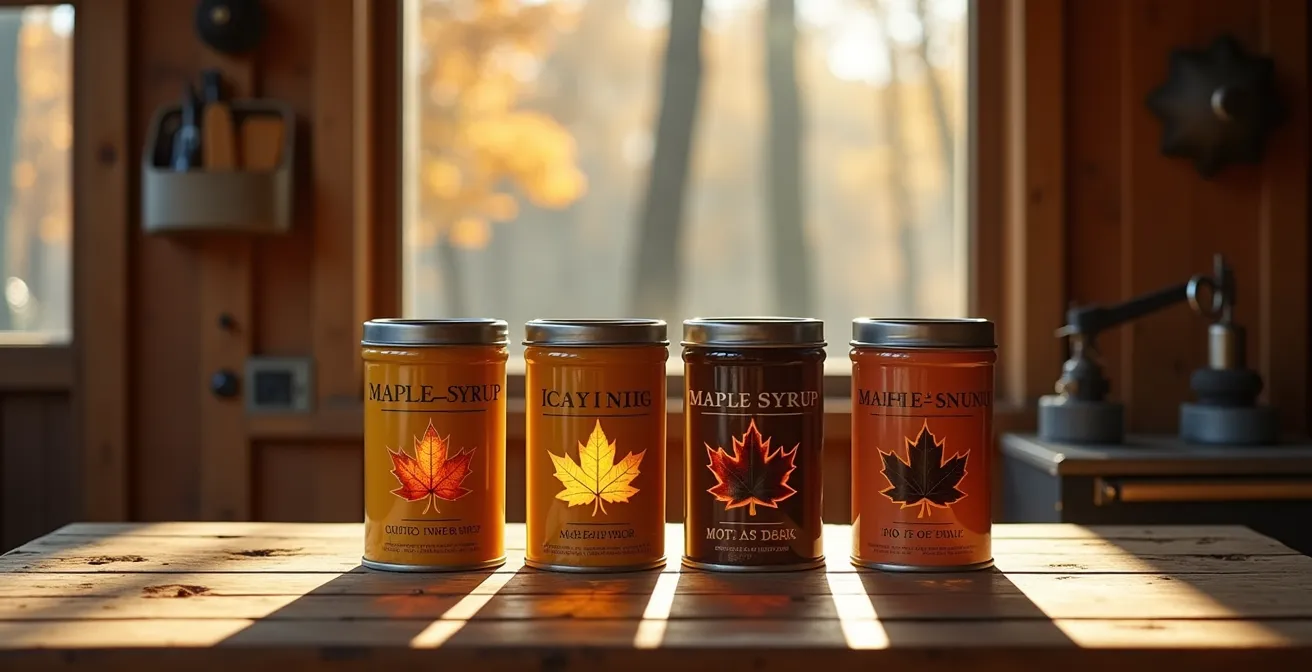
Choosing the right maple syrup is about matching its flavour profile to the dish, not just picking a colour.
- Golden and Amber syrups are best for delicate toppings and classic pancakes, while Dark and Very Dark are built for cooking and glazes where the flavour must stand out.
- Always check for “100% pure maple syrup” on the label and, for true Quebec authenticity and flavour, choose the traditional tin can (“la canne”).
Recommendation: Start with an Amber Rich Taste for your pancakes—it’s the Quebec household classic for a reason and the perfect all-rounder.
Standing in the grocery aisle, looking at a wall of maple syrup, can be surprisingly confusing. You see the iconic tin cans—”la canne,” as we call them here in Quebec—and glass bottles, all labeled with words like “Golden,” “Amber,” and “Dark.” You just want something for your pancakes, but which one is right? Many guides will just tell you that one is lighter and one is stronger, but that doesn’t really help you make a choice. As a maple syrup producer, I can tell you the secret isn’t about which one is “best,” because they are all of identical quality. The real art is in understanding the soul of each syrup.
The difference in colour and flavour comes from when the sap is harvested. Early in the season, the sap is clear and sugary, producing a light, delicate syrup. As the season progresses and the trees awaken, the chemistry of the sap changes, yielding syrups that are darker and more robust in flavour. It’s a beautiful, natural process. This guide is built on that producer’s perspective. We’re not just going to look at a colour chart; we’re going to think about the “culinary job” you’re hiring the syrup for. From a subtle kiss of sweetness on your yogurt to a powerful, caramelized glaze on ham, there’s a perfect syrup for every task.
This article will walk you through the four distinct grades of Quebec maple syrup, helping you understand their unique personalities. We’ll explore how to spot imposters, how to properly store your syrup, and even touch on advanced concepts like “syrup terroir.” By the end, you’ll be able to choose a can of maple syrup with the confidence of a true Quebecer.
Summary: A Producer’s Guide to Quebec Maple Syrup
- Golden or Dark: Which Syrup Is Best for Pancakes vs. Cooking?
- Ingredients List: How to Spot “Table Syrup” Disguised as Maple?
- Mold on Top: Is Your Maple Syrup Still Safe to Eat?
- Can vs. Glass Bottle: Which Preserves Flavor Better?
- Why Is Maple Syrup So Expensive This Year?
- Grand Cru vs. Industrial: How to Spot Real Charlevoix Lamb?
- The Packing Trick to Stop Maple Syrup Jars from Breaking in Luggage?
- How to Make Perfect Taffy on Snow at Home?
Golden or Dark: Which Syrup Is Best for Pancakes vs. Cooking?
The first thing to understand is a crucial point of pride for us in Quebec: every grade of pure maple syrup is of the same high quality. In fact, an independent third party inspects and grades our syrup, a process involving the tasting and certification of over 300,000 barrels of Québec maple syrup every year. The difference between Golden and Dark is not one of quality, but of flavour profile and intensity. Think of it like olive oil; you have delicate extra virgin oils for dressing and more robust oils for cooking. The same logic applies here.
Golden, Delicate Taste is the product of the first sap runs. It’s light and mild, perfect for when you want a gentle sweetness that won’t overpower other flavours. Drizzle it on yogurt, vanilla ice cream, or delicate crêpes. Amber, Rich Taste is the quintessential pancake syrup. It’s the most popular grade in Quebec households for a reason—it has the perfect, balanced, and classic maple flavour. It’s also incredibly versatile for things like salad vinaigrettes.
When you get to Dark, Robust Taste, you’re entering the world of cooking. Its more pronounced, caramelized flavour is designed to hold its own against other ingredients and heat. This is your go-to for glazing salmon, baking maple pecan pies, or making a traditional “jambon à l’érable” (maple-glazed ham). Finally, Very Dark, Strong Taste, from the very end of the season, is a flavour powerhouse. Its intensity is best used as an ingredient in complex BBQ sauces or even as a unique sweetener in a strong cup of coffee. The key is to match the syrup’s intensity to its culinary job.
To make this simple, here is a guide we producers use to explain the different culinary roles of each grade. It shows how what we call “flavour profile” translates directly to the best use in your kitchen.
| Grade | Color | Flavor Profile | Best Uses | Quebec Household Preference |
|---|---|---|---|---|
| Golden | Light golden | Delicate, subtle | Crepes, yogurt, ice cream | 10% |
| Amber Rich Taste | Amber | Versatile, balanced | Classic pancakes, vinaigrettes | 60% |
| Dark | Dark brown | Robust, caramelized | Glazes, baking, jambon à l’érable | 25% |
| Very Dark | Very dark | Strong, intense | BBQ sauces, coffee sweetener | 5% |
Ingredients List: How to Spot “Table Syrup” Disguised as Maple?
Here in Quebec, we have a name for the fake stuff: “sirop de poteau” (pole syrup), a joke suggesting it was made by tapping a telephone pole. These breakfast or table syrups are imposters, and learning to spot them is the most important lesson in buying maple syrup. These products are mostly corn syrup (glucose-fructose), water, artificial colouring, and artificial flavouring. They lack the complex flavour, minerals, and antioxidants of the real thing.
Fortunately, spotting real maple syrup is easy if you know the one golden rule: check the ingredients list. Under Canadian law, for a product to be called “maple syrup,” it must be made from a single ingredient. The Canadian Food Inspection Agency regulations mandate that it must be 100% pure maple sap and nothing else. If you see glucose, fructose, corn syrup, flavouring, or any other word on that list, put the bottle down. It’s not maple syrup.
Beyond the ingredients, there are other clues. Look for the official Quebec grading system on the label (Golden, Amber, Dark, Very Dark). Real producers are proud of their product and will often list their name or “érablière” (sugar bush) on the can or bottle. This transparency is a sign of authenticity. Be especially wary in two places: at a restaurant table for breakfast, and at a tourist-trap flea market. In a restaurant, don’t be shy to ask, “Is this 100% pure maple syrup from Quebec?” At a market, avoid unlabeled bottles, as their purity and safety cannot be guaranteed.
- Look for the official Quebec grade on the label: Golden, Amber, Dark, or Very Dark.
- Verify the ingredient list contains only one thing: “pure maple syrup.”
- Check for producer information or a certification from the Québec Maple Syrup Producers (QMSP).
- In restaurants, always ask if the syrup served is 100% pure maple.
- Avoid unlabeled or unsealed bottles from non-official vendors.
Mold on Top: Is Your Maple Syrup Still Safe to Eat?
You’ve opened a can of pure maple syrup, used it a few times, and left it in the cupboard. A few weeks later, you see a fuzzy layer of mold on top. Your heart sinks. Do you have to throw the whole precious thing out? The answer is complex and touches on both official safety guidelines and traditional household practices here in Quebec. First, let’s talk prevention, which is the best strategy. The biggest mistake people make is storing opened syrup in its original tin can.
Once a can is opened and exposed to air, it’s no longer a sterile environment. You must immediately transfer the syrup to an airtight glass jar or bottle and, most importantly, always refrigerate it after opening. Pure maple syrup contains no preservatives, and the cool temperature of the fridge is crucial to inhibit the growth of xerophilic molds, which are specific fungi that can grow in high-sugar environments. For very long-term storage (a year or more), you can even freeze maple syrup. It’s so dense with sugar that it won’t solidify completely, remaining viscous and ready to use while preserving its quality indefinitely.
This image shows the single most important step for preserving your syrup after opening it.

But what if the mold has already appeared? The official recommendation from food safety agencies like MAPAQ (Quebec’s Ministry of Agriculture, Fisheries and Food) is unequivocal: discard the syrup. However, there is a long-standing traditional method used in many Quebec homes (which you would use at your own risk). This involves carefully skimming off every trace of the mold from the surface, then bringing the remaining syrup to a rolling boil for a few minutes to kill any remaining spores, before transferring it to a newly sterilized container. While common, this method doesn’t guarantee the elimination of all potential toxins, so the safest bet remains prevention.
Can vs. Glass Bottle: Which Preserves Flavor Better?
In the syrup aisle, the elegant glass bottles shaped like maple leaves often catch the eye. They look beautiful and make for great gifts. But if you look at what a Quebecer is putting in their own shopping cart, you’ll almost always see them reach for the humble tin can, or “la canne.” There’s a very good reason for this: for preserving the delicate and complex flavour of pure maple syrup, the tin can is superior.
The primary enemy of maple syrup’s flavour is light. Light exposure, over time, can degrade the syrup, causing its colour to darken and its taste to change, becoming almost a bit metallic or ‘off’. Glass bottles, even tinted ones, let some light through. The tin can, however, offers 100% protection from light. This is why producers and connoisseurs who value the truest expression of the syrup’s original flavour profile will always choose the can for their own use. It’s the same reason high-quality olive oil often comes in tins.
There’s also a strong cultural and practical component. The can is an iconic symbol of the Quebec “cabane à sucre” (sugar shack) experience. It’s lightweight, unbreakable, and stacks efficiently, which is practical for both producers and consumers. Glass bottles certainly have their place; they are aesthetically pleasing and are heavily marketed towards tourists and for special gift-giving occasions. But if your top priority is the authenticity and preservation of flavor, you should embrace the tradition of “la canne.” It’s a sign that you’re buying syrup the way the locals do.
Why Is Maple Syrup So Expensive This Year?
It’s a common perception that maple syrup is a costly luxury, and headlines about poor harvests often lead people to believe prices are always on the rise due to scarcity. However, the reality of maple syrup pricing is far more complex and fascinating, tied to an incredible system of market stabilization. In fact, fears of scarcity are often misplaced. For instance, Quebec’s 2024 harvest reached a record-breaking 239 million pounds, a massive increase over the previous year. So, if production is up, why does the price feel high?
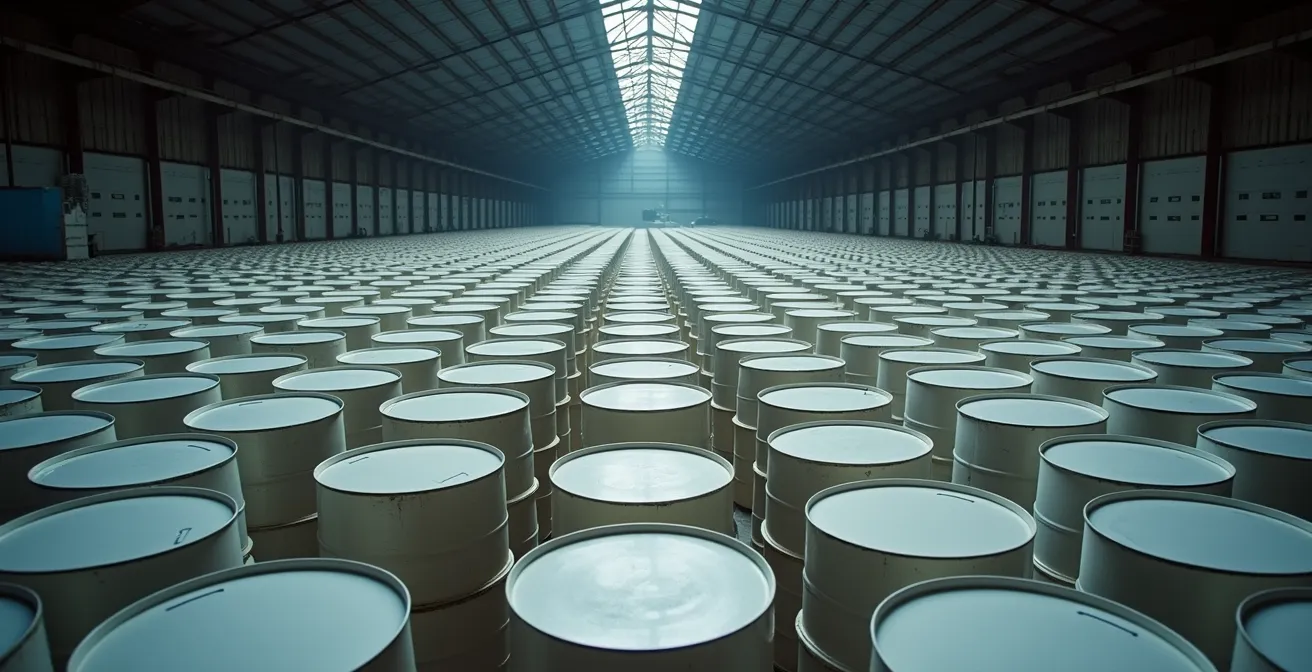
The price stability of maple syrup is largely thanks to the Global Strategic Reserve, managed by the Québec Maple Syrup Producers (QMSP). This is a massive reserve of millions of pounds of syrup stored in barrels in secure warehouses across the province. Its purpose is to act as a buffer. In years with a bad harvest (due to poor weather), QMSP releases syrup from the reserve to ensure supply meets global demand, preventing massive price spikes. In bumper-crop years like 2024, the excess syrup is purchased and added to the reserve, preventing a market crash that would hurt thousands of producers.
This system ensures a stable price for consumers and a predictable income for producers. The value of this reserve is immense, which was highlighted by the infamous “Great Canadian Maple Syrup Heist,” where thieves stole nearly 3,000 tonnes of syrup valued at over $18 million between 2011 and 2012. So, while maple syrup is an expensive product to produce—it takes 40 litres of sap to make just 1 litre of syrup—its price on the shelf is a carefully managed figure, not one that wildly fluctuates with each harvest.
Grand Cru vs. Industrial: How to Spot Real Charlevoix Lamb?
This might seem like an odd question in an article about maple syrup, but it holds a powerful analogy for taking your appreciation to the next level. In the world of Quebec fine foods, Charlevoix lamb is famous for its unique, delicate flavour, which comes from the specific seaside meadows where the lambs graze. This is the essence of “terroir”—the idea that a product’s flavour is shaped by its specific environment. The same principle applies to maple syrup.
Most of the syrup you buy in a large grocery store is a blend. It’s high-quality syrup, but it’s blended from many different producers and forests to create a consistent product, much like a blended whisky. However, there is a growing world of “Grand Cru” or single-origin maple syrup. As noted in a Canadian agricultural overview, this concept is gaining traction. In a report, experts highlight this parallel perfectly:
Like with Charlevoix’s famous lamb, maple syrup also has its ‘terroir’ – factors like soil minerals, forest biodiversity, and producer techniques create unique flavor profiles.
– Agriculture Canada Research, Statistical Overview of Canadian Maple Industry 2024
A syrup from the Appalachian terroir of the Eastern Townships, with its unique soil, might have different mineral notes than one from a forest in the Bas-Saint-Laurent. A small-batch producer who taps only ancient maple trees might achieve a flavour that is impossible to replicate on an industrial scale. Finding these “Grand Cru” syrups is about looking for the story behind the syrup. Instead of a generic brand, you’re looking for a family name or a specific “érablière” on the label. This is how you find the “Charlevoix lamb” of maple syrup.
- Look for a family name or a specific sugar bush (‘érablière’) on the label.
- Visit farmers’ markets like Montreal’s Marché Jean-Talon for artisanal, single-origin selections.
- Go directly to a sugar shack during the spring maple season to buy “estate-bottled” syrup.
- Ask for “single forest” or “small batch” products to taste the difference from industrial blends.
The Packing Trick to Stop Maple Syrup Jars from Breaking in Luggage?
Bringing back pure Quebec maple syrup is the best kind of souvenir, but the fear of a sticky disaster in your suitcase is real. Whether you’ve chosen a classic can or a decorative glass bottle, getting it home safely requires a bit of strategy. Over the years, travelers and locals have perfected a few methods to ensure your liquid gold arrives intact. The most famous, and surprisingly effective, is a low-tech solution known as the “diaper trick.”
The method is exactly what it sounds like: you wrap the can or bottle securely in a clean, disposable diaper. The diaper provides excellent padding against bumps and shocks during transit. More importantly, its absorbent core acts as a failsafe. In the unlikely event of a leak or crack, the diaper will absorb the sticky syrup, containing the mess and saving the rest of the contents of your luggage. It’s a cheap, brilliant, and field-tested solution.
Of course, there are other options. Padded wine sleeves or bottle protector skins, available at travel or liquor stores, are a more “professional” option that works just as well. Regardless of your padding method, the placement in your suitcase is also key. Always place the wrapped syrup in the very center of your checked luggage, cushioned on all sides by soft clothing. For carry-on, you’re restricted to containers under 100ml (3.4oz), but you can often find small, gift-sized bottles in specialty shops that meet this requirement. The ultimate worry-free option is to buy your syrup at the airport duty-free shop after you’ve passed through security, though the price will likely be higher.
Action Plan: Your Maple Syrup Pre-Flight Checklist
- Choose your weapon: Use the “Diaper Trick” (wrap in a clean diaper) for padding and leak absorption or use professional padded wine skins.
- Secure placement: Position the wrapped syrup in the center of your checked suitcase, cushioned on all sides by soft clothing.
- Consider carry-on: If taking syrup in your carry-on, ensure all containers are under the 100ml / 3.4oz liquid limit.
- Final check: Double-check that all can seams and bottle caps are secure before wrapping.
- Risk-free alternative: If in doubt, purchase your syrup at the airport duty-free shop after security to bypass all packing risks.
Key Takeaways
- Syrup grades (Golden, Amber, Dark) denote flavour profile, not quality. Use light syrups for toppings and dark syrups for cooking.
- Always check the label for a single ingredient—”100% pure maple syrup”—to avoid artificial “table syrups.”
- Store opened syrup in a sealed glass jar in the refrigerator to prevent mold. For long-term, freeze it.
How to Make Perfect Taffy on Snow at Home?
Now that you’ve chosen the perfect syrup, protected it, and brought it home, it’s time to celebrate with one of Quebec’s most joyful traditions: “tire d’érable sur la neige,” or maple taffy on snow. This is the quintessential sugar shack treat, and it’s surprisingly easy to make at home, even if you don’t have a Canadian winter outside your window. It’s the perfect way to experience the pure, concentrated flavour of your chosen syrup.
The process is a simple act of food science. You’re heating the syrup to a specific temperature to evaporate some of the water and concentrate the sugars, then rapidly cooling it on a cold surface to create a soft, chewy candy. Following the steps precisely is the key to success. One of the most important factors is using the right syrup. For the best flavour balance, a Golden or Amber grade syrup is recommended. The intense flavours of a Dark syrup can become a bit overwhelming when concentrated into taffy.
Here is the traditional method to create this perfect Quebec treat:
- Pour about one cup of Golden or Amber maple syrup into a saucepan.
- Using a candy thermometer clipped to the side of the pan, heat the syrup over medium heat until it reaches exactly 112-115°C (234-239°F). This is the “soft ball” stage in candy making. Do not stir.
- While the syrup is heating, prepare your “snow.” If you have fresh, clean snow, pack it tightly onto a baking sheet. If not, create an alternative by filling a baking sheet with finely crushed or shaved ice.
- Once the syrup reaches temperature, carefully pour it in thin ribbons or lines over the packed snow or ice.
- Wait a few seconds for the syrup to cool and set slightly, then use a popsicle stick or wooden skewer to roll it up. The hot syrup will grab onto the stick and form a perfect, chewy lollipop.
By understanding the journey from the tree to your table, you not only make better choices but also deepen your appreciation for this incredible natural product. Now, go forth and enjoy your maple syrup with the confidence of an expert.