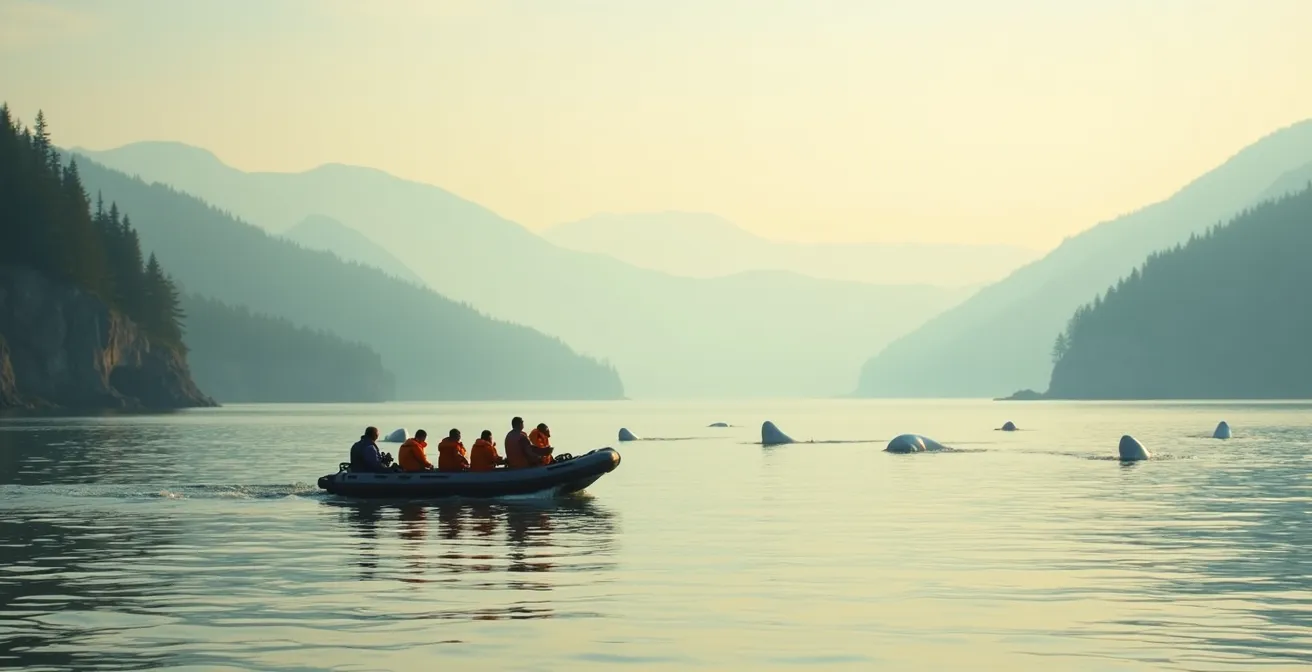
True ethical whale watching prioritizes the animal’s biological needs over the tourist’s spectacle; many tours marketed as “eco” still cause significant stress to marine life.
- A vessel’s acoustic footprint—the underwater noise it generates—is a primary source of disturbance, interfering with whale communication and navigation.
- Land-based observation offers a profound, zero-impact alternative that completely removes the risk of harassment.
Recommendation: Choose operators who demonstrably follow all Marine Park regulations, contribute to research, and always consider land-based viewing as the most ethical first choice.
The desire to witness the immense power and grace of a whale is a powerful one. Each year, travelers flock to the St. Lawrence Estuary, one of the world’s premier whale-watching destinations, hoping for that breathtaking moment when a fin whale surfaces or a humpback breaches. The peak season, generally from June to October, offers frequent sightings. In the rush to book the “best” tour, the question of responsibility often gets simplified to choosing an operator with an “eco” label. But from a marine biologist’s perspective, the issue is far more complex than a simple certification.
Many conventional approaches to whale watching, even when following basic distance guidelines, can impose a significant biological cost on the animals. Constant vessel traffic creates a non-stop acoustic fog that can mask communication between mothers and calves. The energy whales expend avoiding boats is energy they cannot use for feeding, migrating, or nursing their young. This cumulative stress, known as the energy budget deficit, can have long-term consequences for the health of individuals and the population as a whole, especially for endangered species like the St. Lawrence beluga.
But what if the goal wasn’t just to “see” a whale, but to observe it in a way that respects its existence and contributes to its protection? This guide reframes the selection process. Instead of asking which tour gets you closest, we will ask which method causes the least disturbance. We will explore how understanding a whale’s biology and the physics of sound in water can lead to a more profound and truly ethical encounter. This is about shifting our mindset from consumption to conservation, ensuring these magnificent animals continue to thrive in the St. Lawrence for generations to come.
This article delves into the critical factors that define a responsible tour, from the type of vessel you choose to the very way you use your camera. By understanding these nuances, you can make an informed choice that aligns with a genuine respect for marine life.
Summary : A Biologist’s Framework for Ethical Whale Encounters in Quebec
- Zodiac vs. Kayak: Which Vessel Disturbs Whales Less?
- Tadoussac or Percé: Where Are You Guaranteed to See Whales?
- How to Prevent Seasickness on Choppy Waters?
- Telephoto or Wide Angle: How to Photograph Whales from a Moving Boat?
- Blow or Breach: How to Spot Whales Before the Guide Does?
- Zodiac or Big Boat: Which Is Best for Observing the Fjord’s Cliffs?
- Why Drones Stress Belugas and Moose More Than You Think?
- How to Explore the Saguenay Fjord by Water Without Breaking the Bank?
Zodiac vs. Kayak: Which Vessel Disturbs Whales Less?
The choice of vessel is the single most important decision you will make regarding your impact on the whales. It’s not a simple question of size, but of the specific type of disturbance each craft creates. A vessel’s acoustic footprint is the critical factor. Whales live in a world of sound; they use it to navigate, find food, and communicate over vast distances. High-frequency noise from small outboard motors, like those on Zodiacs, directly interferes with the echolocation clicks of toothed whales like belugas. Conversely, the low-frequency rumble of a large tour boat can mask the communication calls of baleen whales like fins and humpbacks.
Kayaks may seem like the silent, perfect option, but they present a different challenge. Their stealthy approach can lead to a surprise encounter, startling a whale that didn’t detect the vessel’s presence. A sudden appearance can be just as stressful as a loud engine. Therefore, paddlers must move predictably and avoid cutting off a whale’s path. Ultimately, no motorized or human-powered vessel is free of impact. The key is to minimize it by adhering strictly to the Saguenay–St. Lawrence Marine Park regulations, which mandate minimum approach distances of 100-200 metres for most whales and a crucial 400 metres for the endangered St. Lawrence beluga population.
The following table breaks down the specific impacts of common vessel types, showing that the “best” choice is not always the most obvious one.
| Vessel Type | Acoustic Impact | Visual Disturbance | Approach Regulations |
|---|---|---|---|
| Zodiac | High-frequency motor noise interferes with echolocation | Predictable presence, visible from distance | 100-200m minimum distance |
| Kayak | Silent approach, minimal acoustic signature | Sudden appearance can startle whales | 100-200m, must move predictably |
| Large Tour Boat | Low-frequency rumble affects baleen whale communication | Large profile, highly visible | 100-200m standard distance |
Your Action Plan for Minimizing Whale Disturbance
- Operator Selection: Choose only operators certified by the Eco-Whale Alliance, ensuring they are trained and committed to following all Marine Park regulations.
- Distance Adherence: Actively monitor and respect minimum approach distances: 100-200m for most species and a strict 400m for endangered belugas.
- Predictable Movement: If kayaking, avoid sudden changes in direction or speed and never approach a whale head-on or from behind. Paddle parallel to its course.
- Time Limitation: Support operators who limit observation time to a maximum of 30 minutes per group of whales to reduce cumulative stress.
- Land-Based Priority: For a guaranteed zero-impact experience, prioritize land-based observation at designated sites like Cap-de-Bon-Désir.
Tadoussac or Percé: Where Are You Guaranteed to See Whales?
While whales can be seen along the Gaspé Peninsula near Percé, no location offers the same predictability and density of marine life as the mouth of the Saguenay Fjord near Tadoussac. This isn’t just luck; it’s a result of a powerful oceanographic phenomenon. The area is the heart of the Saguenay–St. Lawrence Marine Park, a federally and provincially protected area recognized as one of the best places in the world for whale watching. The unique underwater topography here creates a massive submarine valley where cold, dense, salt water from the Atlantic pushes up against the lighter, warmer fresh water from the Saguenay and St. Lawrence rivers.
This meeting of waters drives a massive upwelling of nutrients from the deep, creating an incredibly rich, all-you-can-eat buffet of krill, capelin, and other small fish. The estuary becomes a well-stocked pantry that attracts at least 13 different species of cetaceans, from the small harbour porpoise to the colossal blue whale, the largest animal on Earth. This reliable food source is why sightings are so consistent in this specific area.
However, the most ethical “guarantee” of a sighting comes not from a boat, but from the shore. The sheer concentration of activity means that land-based observation is not a compromise but a premier experience. Sites like Cap-de-Bon-Désir offer spectacular, panoramic views of the St. Lawrence, where you can watch minke and fin whales feed just a few hundred metres from the rocks, all with zero acoustic footprint or disturbance.
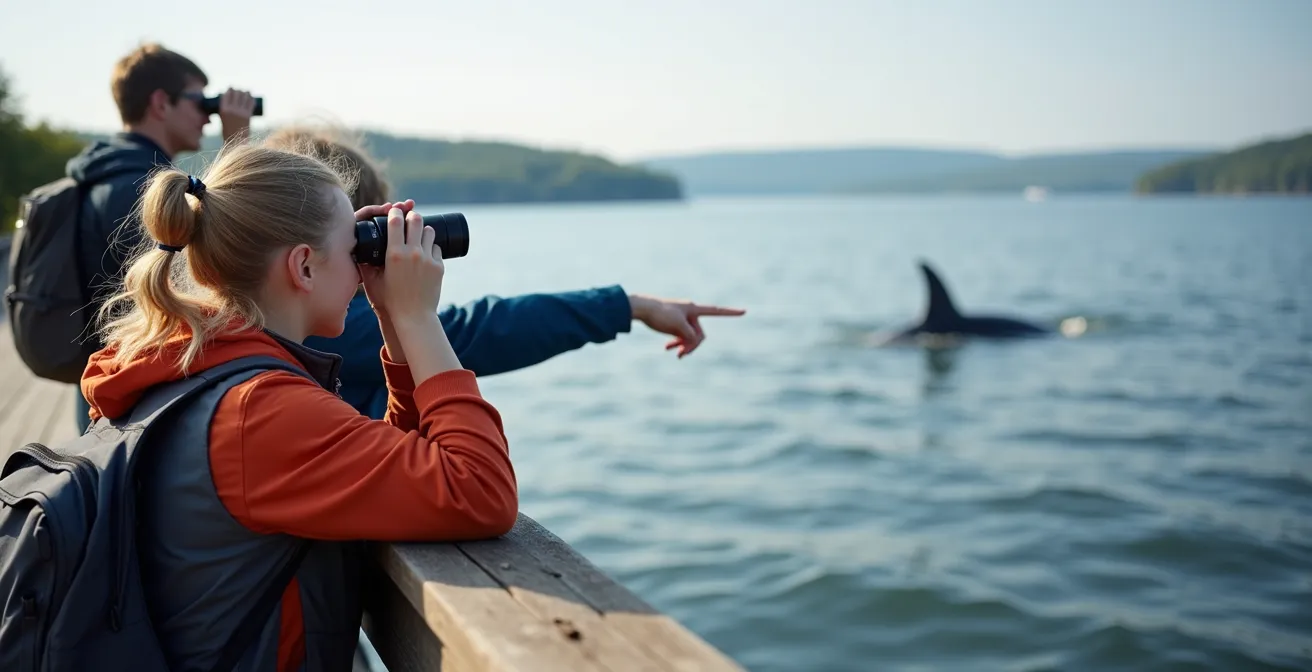
As you can see, choosing a land-based observation point allows for an intimate connection with the whales in their natural habitat, without adding to the vessel traffic in this critical feeding ground. It transforms the experience from a tourist activity into a respectful act of bearing witness.
How to Prevent Seasickness on Choppy Waters?
From a biologist’s standpoint, a seasick passenger is a distracted one, unable to fully engage with the observation and learn about the animals. Ensuring your comfort is therefore a practical step towards a more meaningful experience. The St. Lawrence is a vast and powerful body of water, and conditions can change rapidly. The first step is choosing the right vessel for the likely conditions: large, heavy tour boats generally offer more stability against the long, rolling swells of the Gulf near Percé, while Zodiacs can feel more jarring in the short, choppy waves of the Estuary.
Beyond vessel choice, several practical measures can be taken. Remember to dress appropriately; the wind on the water is always colder than on land. Wear layers, including a windproof and waterproof outer jacket. It’s also crucial to manage your internal equilibrium with these locally-relevant tips:
- Take Gravol (dimenhydrinate), an over-the-counter medication available at any Quebec pharmacy, 30 to 60 minutes before departure.
- Pack crystallized ginger, a natural remedy often found in local épiceries fines in Tadoussac or Baie-Saint-Paul.
- Eat a light, non-greasy meal about an hour before boarding. An empty stomach can make nausea worse.
- Position yourself in the middle of the boat, on the lowest deck possible, where the rocking motion is least pronounced.
- Actively use the whale-spotting technique of scanning the horizon. Fixing your gaze on a stable point in the distance is the single most effective natural way to prevent motion sickness.
Experienced local captains are invaluable. They possess an innate understanding of the St. Lawrence’s complex wave patterns and currents. They can navigate their vessel to minimize rolling and pitching, not only for passenger comfort but also to ensure their approach to the whales is as stable and predictable as possible, further reducing stress on the animals.
Telephoto or Wide Angle: How to Photograph Whales from a Moving Boat?
A camera in the hands of a tourist can be either a tool of disturbance or an instrument of conservation. The choice depends entirely on your technique and ethics. The temptation to get the “perfect shot” can lead to pressure on captains to get closer, violating regulations and stressing the animals. True ethical wildlife photography respects distance. This means a wide-angle lens is largely useless for whales; a telephoto lens of at least 300mm is not just recommended, it is essential to comply with Canada’s Marine Mammal Regulations while still capturing detailed images from a respectful distance of 100 metres or more.
Beyond the lens, your camera settings are crucial for capturing sharp images from an unstable platform. A fast shutter speed of 1/1000s or higher is necessary to freeze the motion of both the whale and the boat. A polarizing filter is also a key piece of gear for cutting through the intense glare off the water’s surface, revealing more detail on the whales themselves. Most importantly, never use a flash. The sudden burst of light can startle and stress marine mammals, especially in the low-light conditions of an early morning or evening tour.
Case Study: The Citizen Scientist Photographer
Your camera can be a powerful scientific tool. Organizations like the Mingan Island Cetacean Study (MICS) and the Group for Research and Education on Marine Mammals ( GREMM) rely on photographs from the public to track individual whales. The unique patterns on a humpback’s fluke or the nicks and scars on a fin whale’s dorsal fin are like fingerprints. By submitting your clear, side-profile shots of flukes and fins, you contribute directly to long-term monitoring programs. This transforms your trip from a simple holiday into a contribution to conservation, making every photo a valuable piece of observational data.
By following these ethical guidelines, you reframe your role from a simple tourist to a potential contributor to science. Your photographs become a record, not just a souvenir.
Blow or Breach: How to Spot Whales Before the Guide Does?
Learning to spot whales yourself deepens the experience immeasurably. It shifts your role from a passive passenger to an active observer, attuned to the subtle signs of the ecosystem. Guides are experts, but with thousands of square kilometres of water, more eyes on the horizon always help. The most obvious sign is the “blow” or spout—the cloud of water vapor a whale exhales when it surfaces. Each species has a distinct blow pattern, which can help with identification from a distance.
Beyond the blow, there are other, more subtle clues to watch for. One of the most useful is to look for bio-indicators, other species whose behaviour signals the presence of whales. The Northern Gannet, or fou de Bassan in Quebec, is a key ally. These large seabirds are spectacular divers, plunging into the water from great heights to catch fish. A large group of diving gannets is a clear sign of a dense school of fish near the surface—the very thing that attracts feeding fin, minke, and humpback whales.
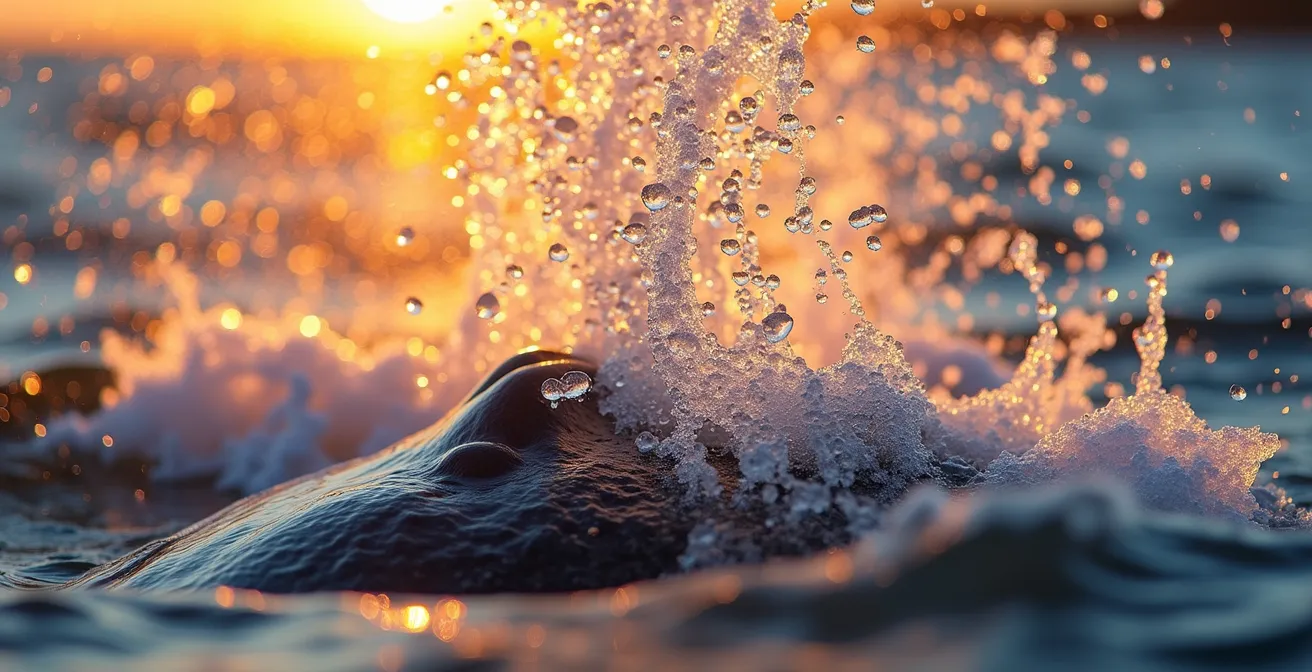
Another expert technique is to look for “footprints.” After a large whale takes a breath and dives deep, its powerful fluke movement creates a calm, glassy, circular patch on the water’s surface. This “flukeprint” is a footprint that tells you exactly where a whale just was. Since many species, like humpbacks, can stay down for 5 to 15 minutes, spotting a footprint gives you a clear area to watch for the whale to resurface. Learning these signs allows you to participate in the search, making any eventual sighting that much more rewarding.
Zodiac or Big Boat: Which Is Best for Observing the Fjord’s Cliffs?
While whale watching is the main draw, the Saguenay Fjord itself is a geological marvel worthy of exploration. Here, the choice between a Zodiac and a large boat is less about acoustic impact and more about the type of experience you seek. The Fjord is a drowned glacial valley with cliffs plunging hundreds of metres below the water’s surface. It’s a unique environment where two distinct water layers barely mix.
As one Parks Canada guide explains, the Fjord’s water is a fascinating paradox:
The fjord is at once a sea and a river, as cold salt water from the St. Lawrence estuary invades its depths, while warmer fresh waters flow on the surface
– Parks Canada Marine Park Guide, Saguenay-St. Lawrence Marine Park Official Documentation
Your choice of vessel determines how you experience this phenomenon and the towering cliffs. A Zodiac offers an intimate, water-level adventure. You can get close enough to see the geological details in the rock face, spot seals basking on low-lying rocks, and even witness small waterfalls that appear to bounce off the surface—a visual clue to the two-layer water system. A large tour boat, in contrast, provides a more comfortable, “floating classroom” experience. Its elevated decks offer sweeping, panoramic views of the U-shaped valley, giving you a better sense of the immense scale of the glacier’s passage. A naturalist on board can explain the complex ecology and geology, putting the landscape into context.
The following table summarizes the different experiences offered by each vessel type for fjord exploration.
| Aspect | Zodiac | Big Boat |
|---|---|---|
| Cliff Viewing | Close-up geological details, seals on rocks | Panoramic view of glacial U-shaped valley |
| Water Stratification | Visual evidence at water level (waterfalls on surface) | Educational explanation of two-layer system |
| Experience Type | Intimate, visceral adventure | Comfortable ‘floating classroom’ with naturalist narration |
| Wildlife Distance | Must maintain mandatory approach distances | Elevated platform provides overview perspective |
Why Drones Stress Belugas and Moose More Than You Think?
In the age of social media, the temptation to capture spectacular aerial footage with a drone is strong. However, from a wildlife welfare perspective, the use of recreational drones near marine mammals is unequivocally harmful and, in Canada, illegal. It is illegal to fly a drone within a half nautical mile (approximately 926 metres) of a marine mammal. The high-pitched buzz of a consumer drone’s propellers is particularly stressful for cetaceans. To a beluga, this sound can mimic the signature of a predator like a killer whale, triggering a flight response that burns precious energy reserves.
While some scientific studies use drones for research under special permits with strict protocols (e.g., high altitude, specific flight paths), this is not comparable to recreational use. The potential for disturbance is so significant that Canadian authorities take it very seriously. Flying a drone too close to a marine mammal can result in severe penalties. According to Fisheries and Oceans Canada, disrupting marine mammals with a vessel or drone can lead to fines of up to $100,000 under the Fisheries Act. This regulation applies not only to belugas in the St. Lawrence but also to moose swimming between islands or other wildlife along the coast.
The core issue is the animal’s perception. While a drone may seem small and non-threatening to us, it is an Unidentified Flying Object to an animal, producing a high-frequency sound in a register associated with danger. It forces the animal to divert its attention from critical activities like feeding or resting to assess a potential threat. For the critically endangered St. Lawrence beluga population, already facing numerous threats from pollution and ship traffic, this added stress is something they simply cannot afford. The only responsible choice is to leave the drone packed away.
Key Takeaways
- Prioritize operators in the Eco-Whale Alliance and respect all approach distances, especially the 400m rule for belugas.
- Land-based observation from sites like Cap-de-Bon-Désir offers a world-class, zero-impact whale watching experience.
- Your camera is a scientific tool; use a telephoto lens to respect distance and contribute your photos to research groups like GREMM.
How to Explore the Saguenay Fjord by Water Without Breaking the Bank?
An ethical encounter with the Saguenay-Fjord’s ecosystem doesn’t have to involve an expensive, multi-hour cruise. Several budget-friendly and lower-impact options allow you to experience the majesty of the landscape and its wildlife, including frequent sightings of belugas and minke whales at the fjord’s mouth. These alternatives empower you to explore on your own terms while minimizing your financial and ecological footprint.
One of the best-kept secrets is the public water shuttle system, the Navettes Maritimes du Fjord. This service functions like a public bus on the water, connecting villages like Tadoussac and L’Anse-Saint-Jean. It offers the same stunning views as a tour cruise for a fraction of the price. Another fantastic option is the completely free Tadoussac–Baie-Sainte-Catherine ferry. This ferry runs 24/7, crossing the mouth of the Saguenay right where belugas often congregate. Countless visitors have had incredible sightings from its decks, proving you don’t need a ticket to see the whales.
This morning, as we arrived for the ferry to take us from Baie-Sainte-Catherine to Tadoussac, the dazzling white backs of belugas were visible from the free ferry crossing, proving you don’t need expensive tours to experience the magic of St. Lawrence whales.
– A visitor’s report
For more active exploration, consider these options:
- Kayak Rental: For experienced paddlers, renting a kayak from local co-ops in villages like L’Anse-Saint-Jean or Petit-Saguenay offers an unparalleled, intimate experience.
- Ferry & Hike: Combine a ferry crossing with hiking one of the many trails in the Parc national du Fjord-du-Saguenay for stunning land-and-water perspectives.
- Cycling: The Véloroute du Fjord du Saguenay is a cycling path that winds along the fjord, offering access to numerous lookouts, beaches, and villages.
Ultimately, choosing a truly eco-responsible tour is an active process. It requires you to look beyond marketing claims and ask critical questions about a tour’s real-world impact on the animals’ well-being. By prioritizing distance, choosing lower-impact observation methods, and supporting operators who contribute to conservation, you become part of the solution, ensuring the whales of the St. Lawrence continue to inspire awe for generations to come.
Frequently Asked Questions About St. Lawrence Whale Watching
What are the distinct blow patterns of St. Lawrence whale species?
Fin and blue whales produce tall, powerful columns up to 6-12 meters high. Minke whales create small, often inconspicuous puffs barely visible at distance. Belugas have subtle, low blows close to the water surface. The North Atlantic right whale shows a distinctive bushy ‘V’ shaped blow.
How can seabirds help spot whales?
Watch for diving Northern Gannets (fous de Bassan) – concentrations of these diving birds indicate schools of fish near the surface, which attracts feeding whales. This is a technique used by local guides.
What is a ‘footprint’ and how does it help locate whales?
Footprints or flukeprints are calm, circular patterns left on the water’s surface after a whale has dived. These glassy patches indicate where a whale just was and suggest where it might resurface in 5-15 minutes.