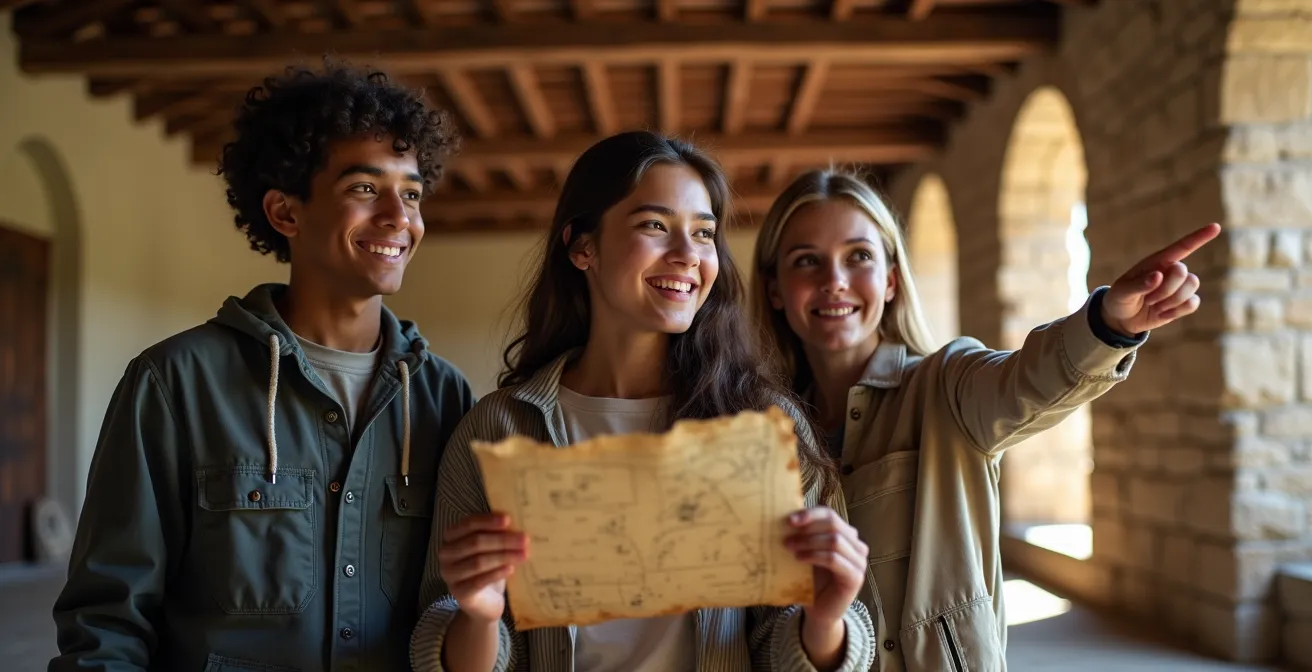
The secret to engaging a teen with New France history isn’t more facts or dates—it’s shifting them from a passive observer to the main character of their own discovery story.
- Focus on tangible, sensory experiences like hands-on workshops over passive tours to create lasting memories.
- Frame historical accuracy not as a lecture, but as an exciting detective game of spotting clues and uncovering hidden stories.
Recommendation: Invest in interactive activities and, if possible, frame the entire trip as a personal quest to trace your own family’s roots back to a specific Quebec village.
You’ve seen it before: the glazed-over eyes, the slow scroll through a phone, the palpable boredom of a teenager standing before a historical plaque. As a parent, you want to share the rich history of places like Quebec City or Upper Canada Village, but you’re competing with a world of instant digital gratification. The usual advice—turn it into a scavenger hunt or focus on the battles—often feels like putting a cheap sticker on a profound subject. It’s a temporary fix that rarely sparks genuine curiosity.
These common tactics fail because they still position the teenager as a passive student in an outdoor classroom. They are being told what to find, what to look at, and what was important centuries ago. But what if the entire approach was flipped? As a museum educator, I can tell you the key isn’t to try and *teach* history more effectively. The secret is to create the conditions for a personal and sensory connection to the past. It’s about empowering them to become the protagonist of their own historical adventure, not just a spectator.
This guide abandons the generic tips. Instead, we’ll explore how to reframe your visit entirely. You will learn to prioritize interactive experiences over observation, transform the question of historical accuracy into an engaging puzzle, and even connect the grand story of New France to the most personal story of all: your own family’s. It’s time to stop showing them history and start letting them feel it.
This article provides a complete roadmap for transforming your family’s historical outing from a mandatory lesson into a captivating journey. Below, you will find a summary of the key strategies we will cover to help you plan an experience your teenager won’t forget.
Summary: Your Blueprint for a Captivating Historical Journey
- Reenactment or Reality: How Much of the “New France” Site is Accurate?
- Is the Admission Price for Historical Villages Worth It for a 4-Hour Visit?
- Watching vs. Doing: Why Paying Extra for the Bread Workshop Matters?
- Why Visiting Historical Sites in October Is Often Impossible?
- Do the Actors Speak English During the Historical Reenactments?
- Why Visiting Your Ancestors’ Village Changes Your Trip Perspective?
- The Citadel or the Ramparts: Which Tour Is Better for History Buffs?
- How to Trace Your Family Roots in Quebec During a Short Trip?
Reenactment or Reality: How Much of the “New France” Site is Accurate?
The question of authenticity can either be a dry, academic exercise or an exciting detective game. For a teenager, framing it as the latter is key. Instead of telling them “this is accurate,” empower them to ask, “What clues tell me if this is real?” This turns a passive visit into an active investigation. The world of New France was both vast and intimate; historical records show that New France’s population grew to 69,000 people by 1754, a tiny number by modern standards, making each recreated detail significant.
Authenticity isn’t just about buildings and costumes; it’s about perspective. Many historical sites now offer a more nuanced story. For instance, the narrative of New France is incomplete without understanding its profound and often devastating impact on First Nations. The fur trade that sustained the colony simultaneously ravaged Indigenous ways of life. Highlighting these multiple, sometimes conflicting, viewpoints makes history more complex and far more interesting than a simple “colonists vs. nature” tale. It becomes a story of real people with competing interests.
Encourage your teen to be a critical observer. Are the materials used in the buildings consistent with the 17th or 18th century? Do the actors’ stories align with what you know, or do they feel dramatized? This approach transforms them from a tourist into a historical critic, a much more engaging role.
Your Authenticity Audit Checklist: New France Sites
- Architectural Clues: Compare building features like window sizes and roof styles against historical records from the 1600s-1700s.
- Costume Check: Evaluate the materials and styles of reenactors’ clothing. Do they match museum references or look like modern costumes?
- Storytelling vs. Drama: In guided tours, listen for nuanced historical storytelling versus overly dramatized, simplified narratives.
- Multiple Perspectives: Cross-reference the site’s story with information from nearby First Nations interpretive centers. Does the story change?
- Spot the Anachronism: Look for out-of-place items in recreated scenes—a fun game that sharpens observation skills.
Is the Admission Price for Historical Villages Worth It for a 4-Hour Visit?
The sticker shock of a family admission ticket can make any parent question the value of a visit. But the calculation shouldn’t just be about cost per hour; it’s about the return on experience. The good news for families visiting Quebec is that many premier historical sites are incredibly accessible. For instance, at National Historic Sites across the country, Parks Canada offers admission that is free for youth 17 and under. This single policy dramatically changes the value equation for families.
A four-hour visit can feel rushed and expensive if you’re just passively walking around. But if that time includes one deeply engaging, hands-on activity, its value skyrockets. The price of admission isn’t just for seeing things; it’s for the curated atmosphere, the access to knowledgeable interpreters, and the safety of a well-maintained environment. Think of it as the price for a time machine portal. What matters is what you *do* once you step through it.
To maximize your investment, plan your short visit around a central “mission.” This could be mastering the bread workshop, completing the “authenticity audit” from the previous section, or finding a specific location tied to your family’s history. By focusing your time, you ensure the visit has a climax and a sense of accomplishment, making the cost feel entirely justified.
| Site Type | Adult Price | Youth Price | Family Value |
|---|---|---|---|
| Parks Canada Sites | $15-20 | Free (17 & under) | Excellent |
| Morrin Centre | $18.50 | $16.50 (students) | Good |
| Museums (McCord) | Regular price | Free (12 & under) | Very Good |
Watching vs. Doing: Why Paying Extra for the Bread Workshop Matters?
The difference between a trip your teen remembers for a week and one they talk about for years often comes down to one thing: moving from watching to doing. History learned through a textbook or a guided tour is abstract. But history learned through the hands—the heat of a forge, the smell of baking bread, the weight of a blacksmith’s hammer—is sensory history. It creates a physical memory that is profoundly more powerful than a mental one.
This is why paying extra for that hands-on workshop is rarely a gimmick; it’s an investment in memory. Watching a blacksmith shape iron is interesting. But feeling the shock travel up your arm as you strike the hot metal yourself connects you to centuries of craftsmanship in an instant. It’s no longer a demonstration; it’s your experience.
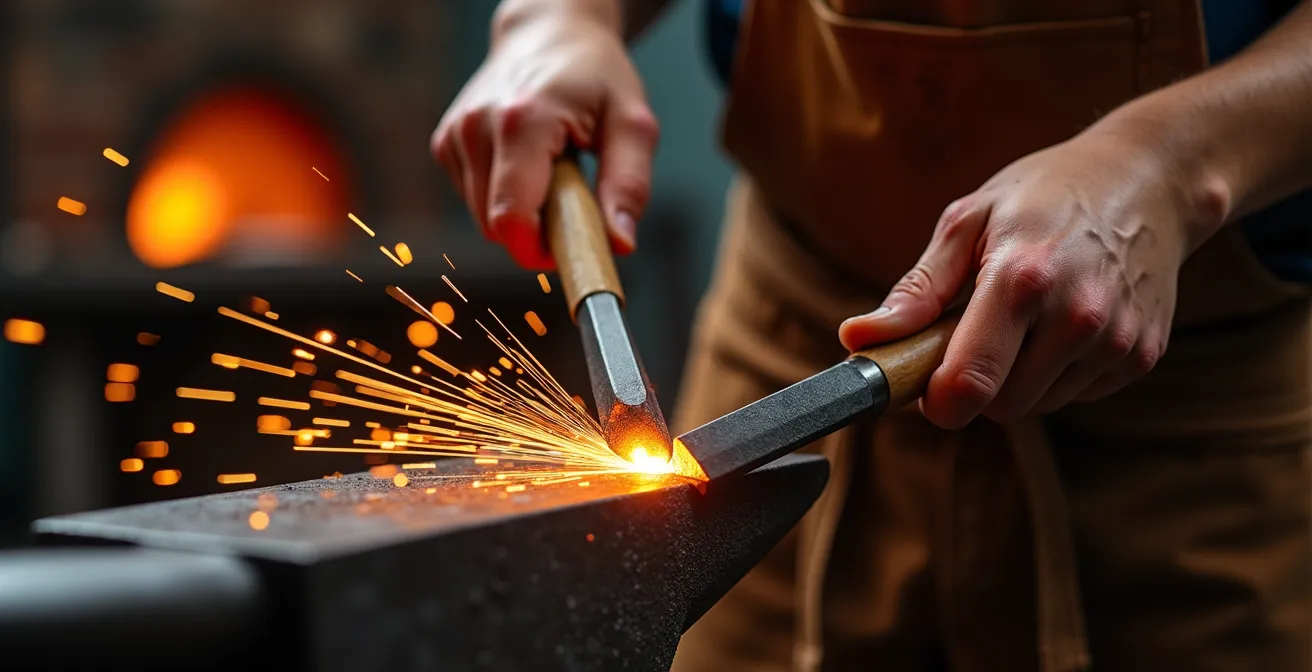
As you can see, the focus and engagement in such an activity are total. While guided tours of places like the Citadelle are informative, allowing visitors to see impressive architecture, they remain an observational experience. A workshop, by contrast, gives a teenager agency and a tangible outcome. They don’t just leave with facts; they leave with a loaf of bread they kneaded themselves or a small iron hook they forged. This souvenir is a powerful storytelling token that anchors the entire trip in their memory.
Why Visiting Historical Sites in October Is Often Impossible?
Planning a trip to a historical village in Quebec for an autumn weekend seems perfect—crisp air, beautiful foliage, fewer crowds. But many families arrive in October only to find the gates locked. The reason is simple: most large-scale reenactment villages are seasonal operations. They rely heavily on student interpreters who return to school in September and on outdoor activities that are unpredictable in colder weather. Their business model is built for the summer tourist season, and operations often wind down after Labour Day.
However, a closed village doesn’t mean your historical journey is over. It’s an opportunity to get creative and explore a different side of New France history that thrives in the off-season. Autumn is the perfect time for atmospheric ghost tours through the cobblestone streets of Old Quebec, where history is told through spooky legends. It’s also an ideal time to visit indoor museums with world-class, climate-controlled exhibits on New France that are open year-round.
Think outside the “village” box. A visit to an apple orchard on the Île d’Orléans can become a fascinating discussion about 18th-century food preservation and self-sufficiency. The off-season forces you away from the curated experience and into a more authentic, living landscape where the echoes of history can still be found.
- Visit Pointe-à-Callière Museum in Montreal – open year-round with fantastic indoor exhibits on the city’s origins.
- Explore Quebec City’s Musée de la civilisation, which houses extensive collections related to New France in a comfortable setting.
- Prepare for your next trip by exploring the Virtual Museum of New France online for a rich, multimedia experience.
- Book one of Old Quebec’s famous ghost tours, which use the autumn atmosphere to their advantage.
- Visit an apple orchard on Île d’Orléans to discuss 18th-century food preservation and agricultural life.
Do the Actors Speak English During the Historical Reenactments?
This is a critical and practical question for many families visiting Quebec. The answer depends entirely on the site. As a general rule, sites operated by Parks Canada, such as the Fortifications of Quebec or the Citadel, are fully bilingual. They offer guided tours and have interpreters who can switch seamlessly between French and English, ensuring no visitor is left out.
However, in many of the historical villages or regional sites, the experience is designed to be immersive, and that immersion often means that French is the primary, and sometimes only, language spoken by reenactors. This isn’t meant to be exclusionary; rather, it’s a commitment to authenticity. New France was, after all, a French-speaking colony. For a teen learning French in school, this can be an incredible, real-world practice opportunity. For an English-only speaker, it can be a barrier.
The best strategy is to check the website of each specific site before you go. Most will clearly state their language policy. If a site is primarily French, don’t write it off. Focus on the visual and sensory aspects of the experience—the craft demonstrations, the smells from the kitchen, the architecture. History is communicated in many ways beyond spoken language.
| Site | Language Options | Best for English Speakers |
|---|---|---|
| Citadelle Tours | Offered in French and English | Fully Bilingual |
| Fortifications | Tours in both languages | English Tours at Set Times |
| Village Sites | Primarily French | French-Dominant for Immersion |
Why Visiting Your Ancestors’ Village Changes Your Trip Perspective?
Here is where a history trip transforms into a personal pilgrimage. Visiting a historical site is interesting. But visiting the actual village where your great-great-great-grandparents lived, standing in the church where they were married, or finding their name on a tombstone—that is a profoundly different experience. It instantly makes your teenager the protagonist in the story. History is no longer about anonymous “settlers”; it’s about *their* family, *their* roots.
This personal connection is the most powerful tool for engagement. The abstract timeline of New France suddenly has a human face that looks like theirs. This isn’t just a fantasy; it’s a highly achievable goal in Quebec, which has some of the most complete and accessible genealogical records in the world. With databases like Genealogy Quebec providing access to over 50 million documents and images, tracing your family to a specific parish or village is often possible with just a few hours of online research before your trip.
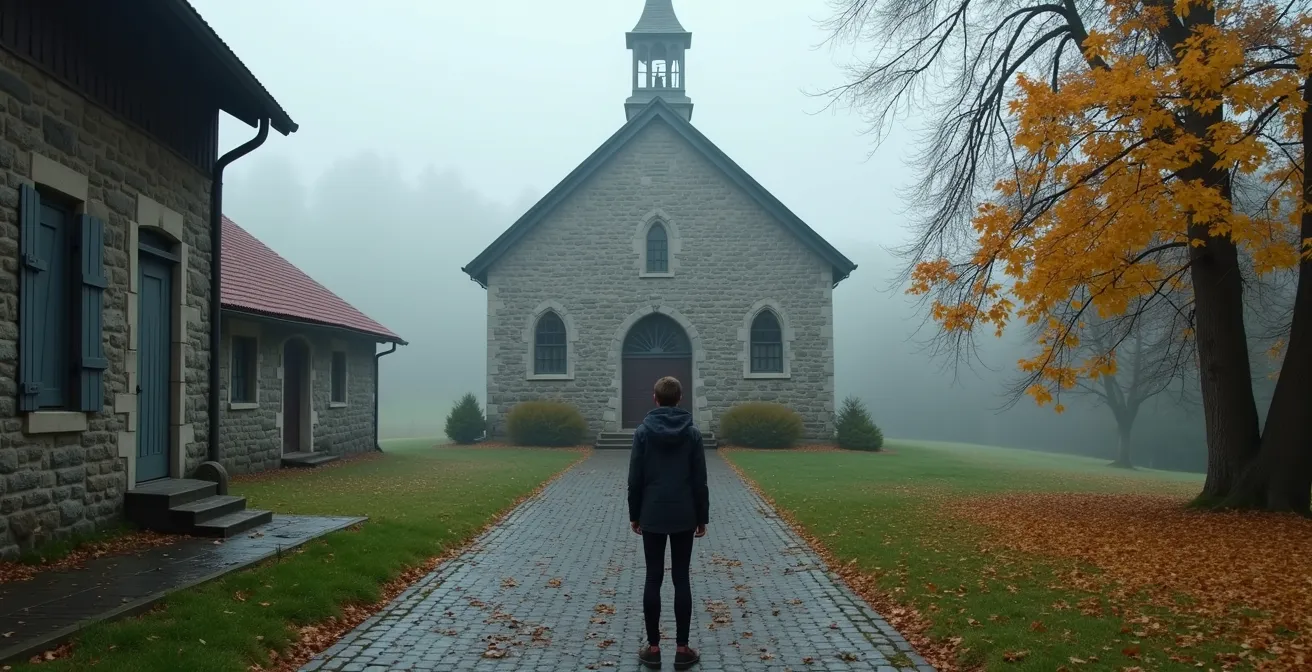
Imagine your teen standing before a small stone church, not just as a tourist, but as a descendant. Suddenly, the architecture isn’t just “old”; it’s a part of their story. The small details of the village—the river, the layout of the fields, the view from the hill—become clues to understanding their ancestors’ lives. This perspective shift is transformative and creates a connection no museum exhibit can replicate.
The Citadel or the Ramparts: Which Tour Is Better for History Buffs?
For a family with a budding history buff, this choice isn’t just about what to see; it’s about what kind of story you want to uncover. Instead of asking “which is better,” reframe the question as “What’s our mission today?” Are you on a mission to understand the grand strategic layout of the most fortified city in North America, or are you on a mission to dive deep into its military heart?
The Ramparts offer the strategic overview. A walk along the 4.6 km of walls surrounding Old Quebec is a lesson in urban defense. It allows you to see how the city was protected, where its vulnerabilities were, and why certain locations were chosen for cannons and gates. This is the “big picture” mission, perfect for understanding the city as a complete defensive system. It’s also a great opportunity for fantastic photos and a less structured, self-guided experience.
The Citadel, on the other hand, is the deep dive. As an active military garrison, it offers a concentrated look at over 300 years of military history, from French colonial tactics to the traditions of the Royal 22e Régiment today. This is the “boots on the ground” mission, where you get up close with cannons, tactics, and the life of a soldier. The guided tour is structured and packed with detailed information. For the teen who loves military history, this is the main event.
For the ultimate experience, combine them into a single “Defense of Quebec” mission.
- Start with a self-guided tour of the Ramparts to understand the city’s layout (2 hours).
- Take photos from strategic vantage points along the walls to map out the defensive lines.
- Join a guided tour of the Citadel to explore military tactics up close (90 minutes).
- Visit the Saint-Louis Forts and Châteaux National Historic Site to understand the colonial governance that directed the military.
- End your day on the Plains of Abraham to see the famous battlefield that decided the city’s fate.
Key Takeaways
- True engagement comes from making a teen the protagonist of a personal discovery, not a passive student.
- Invest in hands-on, sensory experiences (like workshops) over observation to create powerful, lasting memories.
- Leverage Quebec’s exceptional genealogical records to connect your family’s personal story directly to the history of New France.
How to Trace Your Family Roots in Quebec During a Short Trip?
The idea of tracing your ancestry might sound like a project for a lifetime, but in Quebec, a remarkable amount of progress can be made even before a short trip. The key is targeted online research before you ever leave home. This front-loading of effort turns your time in Quebec into the exciting “discovery” phase, rather than the tedious “research” phase.
Your goal is to identify one or two key pieces of information: the name of the ancestral village or parish, and the approximate dates your family lived there. Start with powerful online databases like the Drouin Collection (available through Genealogy Quebec and other sites) to find marriage records, which are the cornerstone of French-Canadian genealogy. These records often name the parents of both the bride and groom, allowing you to jump back a generation with each document found.
Once you have a village name, the trip’s focus sharpens dramatically. You can now plan a day trip—a pilgrimage—to that specific place. Use online tools like Find a Grave to see if you can locate family tombstones in the local cemetery before you even arrive. With this preparation, your short trip becomes an efficient and emotionally resonant treasure hunt.
Your Quebec Ancestry 3-Day Sprint Plan
- Day 1 (At Home): Access the Drouin Collection online to search for key marriage records and identify ancestral village names.
- Day 1 (Evening): Cross-reference names in the Fichier Origine database to find potential immigration records from France.
- Day 2 (In Quebec): With your targeted research, visit the BAnQ (Bibliothèque et Archives nationales du Québec) or a local genealogy society for specific documents.
- Day 2 (Afternoon): Use a cemetery app on your phone to efficiently locate family tombstones in the village cemetery.
- Day 3: Make the pilgrimage to the ancestral village and church, taking photos and soaking in the environment where your family’s Canadian story began.
Now that you have the tools to reframe the sites, choose the right experiences, and connect it all to a personal story, the next step is to start planning. Begin by exploring your family’s potential Quebec roots online. This single thread of personal connection can be woven through your entire itinerary, turning what could have been a boring history lesson into your family’s unique and unforgettable historical adventure.