Thinking your standard travel insurance has your back for a Quebec backcountry adventure is a potentially bankrupting assumption.
- Most policies contain “out-of-bounds” or “backcountry” exclusion clauses that void your coverage the moment you leave patrolled trails.
- Unlike in many parts of the world, wilderness rescue costs in Quebec are often billed directly to the person being rescued, and these are not covered by provincial health plans.
Recommendation: Before you even book your flight, find the “Exclusions” section of your travel insurance policy. If you see terms like “off-piste,” “unpatrolled,” or “backcountry,” you need to purchase a specific rider or a specialized sports policy that explicitly covers these activities and medical evacuation.
For the adrenaline seeker, the promise of untouched powder in Quebec’s glades or the thrill of an off-trail snowmobile expedition is magnetic. You’ve packed your best gear, you’ve watched the weather, and you’ve bought travel insurance. You feel prepared. But this is where the most dangerous assumption is made: the belief that your standard, one-click-purchase travel insurance is a reliable safety net. As an insurance broker specializing in high-risk sports, I see the financial fallout when this assumption collides with the harsh reality of a policy’s fine print.
Most adventurers are told to “read their policy,” but few know what to look for. They scan for medical limits and trip cancellation, missing the critical exclusion clauses that are the insurer’s escape hatch. Terms like “backcountry,” “out-of-bounds,” “unpatrolled terrain,” or participation in “extreme sports” can instantly render your multi-million dollar medical coverage void. In Quebec, where the wilderness is vast and the conditions are severe, this isn’t a minor detail; it’s a financial time bomb. The real danger isn’t just the fall or the frostbite; it’s the life-altering bill that arrives after the rescue helicopter has flown away.
This article isn’t another generic checklist. We are going to dissect the specific, localized perils of Quebec’s winter wilderness through the cold, hard lens of an insurance contract. We will move beyond the platitudes and expose the coverage gaps in standard policies. We will explore why a rescue can cost thousands, what gear choices matter from a liability standpoint, and what specific insurance add-ons are non-negotiable. By the end, you will understand how to build a layered protection strategy of gear, knowledge, and—most importantly—the right insurance, ensuring your quest for adventure doesn’t end in financial ruin.
This guide will break down the essential risk factors you must consider. We will examine the real costs, the necessary preparations, and the insurance details that truly matter when you venture beyond the groomed trails in Quebec.
Summary : Decoding Your Insurance Policy for Quebec’s Backcountry
- Why a Helicopter Rescue at Massif de Charlevoix Costs $5,000?
- Rental vs. Purchase: Which Gear Protects Best Against -30°C Winds?
- How to Detect Early Signs of Frostbite on Exposed Skin?
- The Chic-Chocs Danger: Do You Really Need an Avalanche Beacon?
- When to Book Your Trip for the Best Powder Snow?
- The Medical Cost Risk for Non-Residents Without Travel Insurance
- What to Pack for the Tundra Where Summer Can Mean Snow?
- Classic or Skate Skiing: Which Technique Is Best for Quebec Conditions?
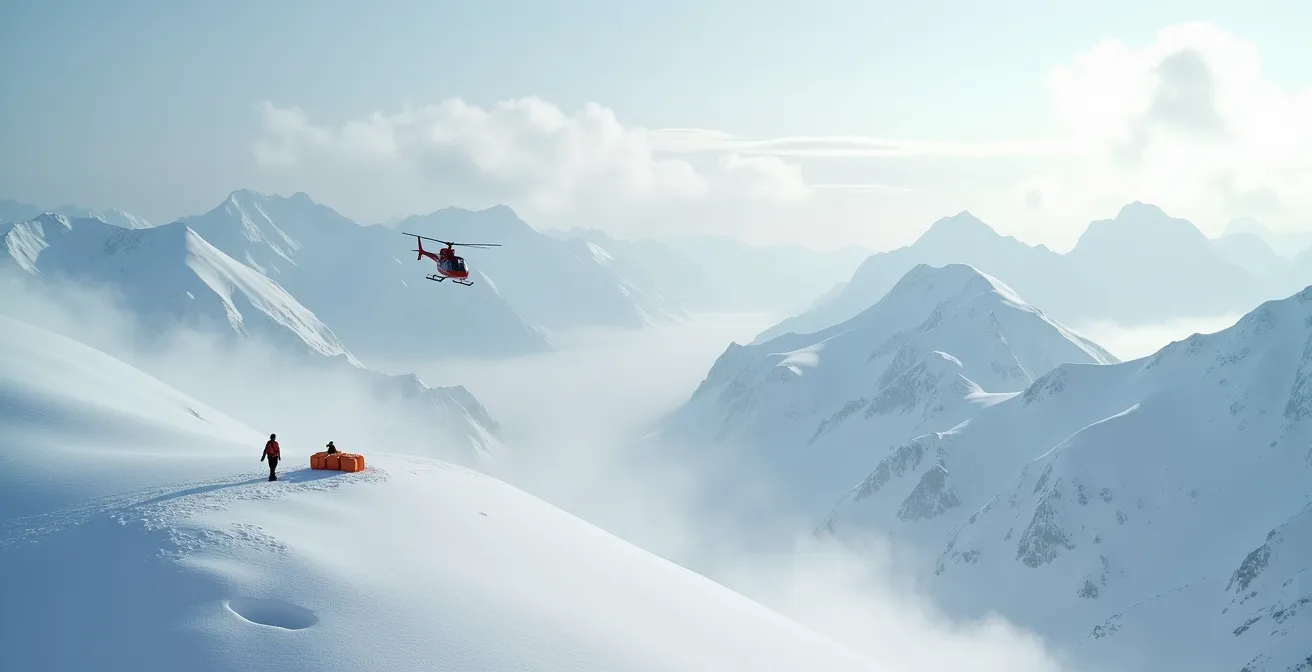
Why a Helicopter Rescue at Massif de Charlevooix Costs $5,000?
The first and most brutal financial lesson in the backcountry is that rescue isn’t free. In many parts of the world, search and rescue is a public service. In Quebec, the framework is different. The moment you require evacuation from an unpatrolled area, you are often entering a private, user-pay system. Organizations like Sépaq, which manage many of Quebec’s parks, are clear in their policies: rescue operations are at the expense of the person rescued. That “minor” ankle twist three kilometres from the nearest trail is no longer just a medical issue; it’s a logistical and financial problem that you are now responsible for solving.
The cost escalates dramatically based on method. A ground rescue with a stretcher by ski patrol might be a few hundred dollars. But when terrain is inaccessible or time is critical—a common scenario in the vast expanse of Charlevoix—an air ambulance is dispatched. These services are not part of the provincial health plan. As a broker, I can tell you that a standard policy will look for any reason to deny this claim, often citing that you willingly engaged in a high-risk activity outside the resort’s operational domain. The bill for that helicopter ride, which can easily top $5,000, will be addressed to you. It’s a stark example of a coverage gap; you thought you were insured for medical emergencies, but you weren’t insured for the *transport* required to get you to the hospital.
Specialized services exist to fill this gap. A company like Airmedic offers annual plans providing helicopter rescue and in-flight medical care, a crucial layer of protection. Without this specific coverage, you are personally liable. This is the fine print in action: your policy covers the hospital, but not the five-figure journey to get there.
Your Action Plan if Injured in the Quebec Backcountry
- Call 911 immediately. Even without cell service, this call can sometimes connect to any available network for emergencies.
- Provide your exact location using resort trail markers, GPS coordinates from a phone or dedicated device, or detailed descriptions of landmarks.
- Have your travel insurance and any supplemental rescue membership information ready. First responders need to know who will be coordinating and paying.
- Understand that parks and outdoor centres bill users for rescue costs, and the ambulance ride from the park entrance to the hospital is also at your expense.
- Before your trip, seriously consider a dedicated accident insurance policy or a subscription to an emergency medical rescue service to cover these specific costs.
Rental vs. Purchase: Which Gear Protects Best Against -30°C Winds?
From an insurer’s perspective, your gear is a key part of your risk management strategy. While we don’t insure the gear itself against failure, we absolutely scrutinize whether an incident was caused by negligence or inadequate preparation. Facing Quebec’s notorious -30°C wind chills with subpar equipment is a clear sign of the latter. The debate between renting and purchasing isn’t about cost; it’s about guaranteed performance and suitability for localized perils.
Renting gear at a top-tier resort like Le Massif ensures you get modern, well-maintained equipment suitable for current conditions. Their rental centers offer beginner-friendly setups that ease the learning curve and even specialized gear like powder skis. This is a good option for casual visitors. However, for the serious adventurer, purchasing your own gear is superior. It allows you to create a personalized, layered protection system you know and trust. This includes a moisture-wicking merino wool base layer (cotton is a liability as it holds sweat and freezes), a high-quality down or synthetic mid-layer, and a Gore-Tex or equivalent waterproof/breathable shell. This system is your first line of defense against hypothermia and frostbite, two conditions that can lead to very serious medical claims.

The most critical items are those protecting your extremities. High-quality insulated mittens (not gloves), a balaclava, and thermal socks are non-negotiable. Renting these items is often not possible or hygienic. If an incident occurs and it’s found you were wearing inadequate clothing for the forecasted -30°C, your insurer may argue you did not take reasonable precautions to protect yourself, potentially complicating your claim. Owning and understanding your gear isn’t just about comfort; it’s a demonstration of responsibility that strengthens your position in any potential claim scenario.
How to Detect Early Signs of Frostbite on Exposed Skin?
In the extreme cold of a Quebec winter, frostbite is not a remote possibility; it’s a constant and insidious threat. For an adrenaline seeker focused on the next turn, the early signs are easy to miss. As an insurance broker, I see frostbite not just as a medical condition, but as the start of a claims process that can become incredibly complex if it leads to long-term injury. Understanding how to spot it early is a critical self-preservation skill that also functions as a form of personal liability management.
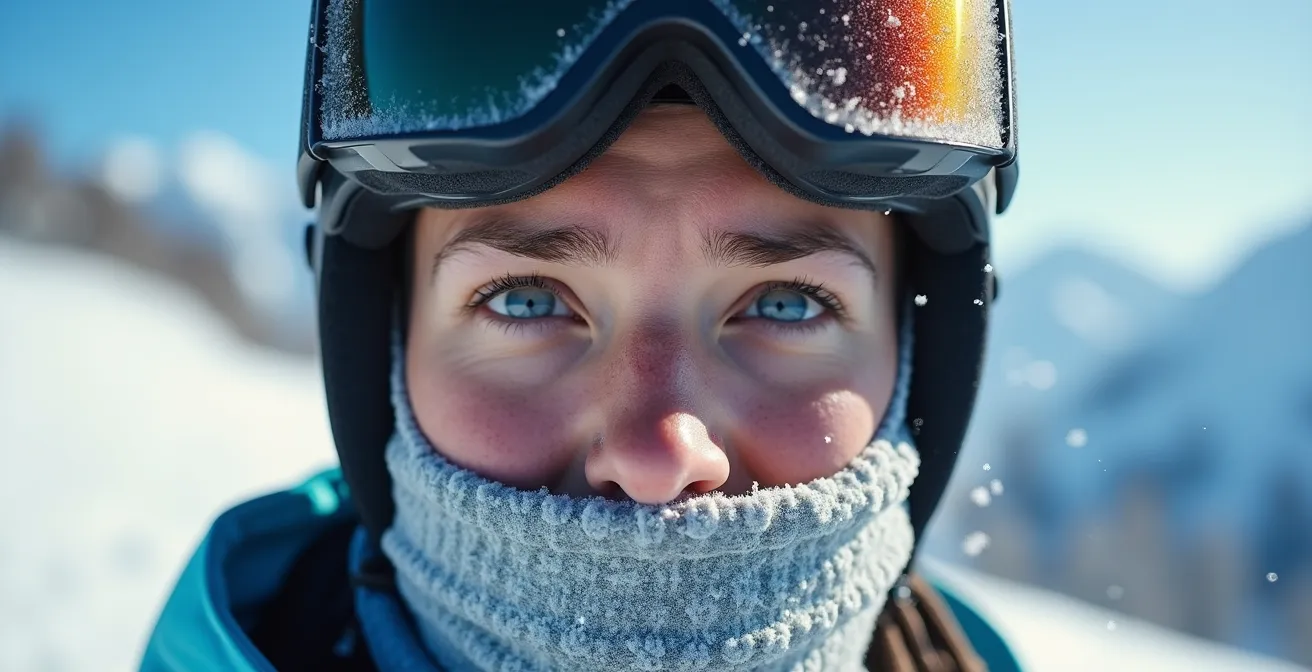
The first stage of frostbite is often called “frostnip.” It’s deceptive because it can feel like simple numbness. The key indicators to watch for on any exposed skin—typically the nose, ears, cheeks, and chin—are:
- A change in skin color to a pale, greyish, or waxy white appearance.
- A feeling of coldness on the skin’s surface, followed by a complete loss of feeling or a “pins and needles” sensation.
- The skin may feel hard or rubbery to the touch.
It is crucial to act on these signs immediately. This is not the time to “push through for one more run.” The first step is to get out of the cold and begin gentle rewarming. Never rub the affected area or use direct, high heat like a fire or heating pad, as this can cause severe tissue damage. The skin is extremely delicate at this stage.
From an insurance standpoint, ignoring these early warnings could be viewed as negligence. If frostnip progresses to more severe frostbite, requiring hospitalization and specialized treatment, the insurer will investigate the circumstances. Were you appropriately dressed for the conditions? Did you heed weather warnings? Did you act promptly when symptoms appeared? Your ability to recognize and react to the first signs of frostbite is a testament to your preparedness and can be a factor in ensuring your medical claim is handled smoothly.
The Chic-Chocs Danger: Do You Really Need an Avalanche Beacon?
When you venture into the Chic-Choc Mountains, you are entering some of the most serious and wild backcountry terrain in Eastern North America. This isn’t glade skiing next to a resort boundary; this is true avalanche country. The question is not whether you need an avalanche beacon, but rather, why you would ever consider going without one. From an insurance perspective, the answer is simple and brutal: entering avalanche terrain without proper safety gear (beacon, shovel, probe) and the knowledge to use it is a material breach of your duty of care. It’s one of the clearest fine print traps there is.
Many specialized sports insurance policies that cover backcountry skiing will have explicit clauses requiring you to carry—and know how to use—this “holy trinity” of avalanche safety gear. Some may even require you to have completed a recognized avalanche safety training course, such as an AST 1 (Avalanche Skills Training) from Avalanche Canada or its equivalent. If a slide occurs and you or a member of your party is not equipped, your insurer has grounds to deny all related claims, from rescue to medical to repatriation. The argument is that you knowingly took on an extreme risk without taking the industry-standard minimum precautions. You voluntarily opted out of safety.
The beacon is not a talisman; it’s a component of a system. It does nothing if your partners don’t have one or don’t know how to perform a search. This is why insurers value training so highly. It proves you understand the system and your role within it. Forgoing a beacon in the Chic-Chocs is like driving a car without brakes and expecting your auto insurance to cover the inevitable crash. It fundamentally misunderstands the principle of assumption of risk. The moment you step into that terrain unprepared, you are signalling to your insurer and the world that you are accepting all consequences, financial and otherwise, on your own.
When to Book Your Trip for the Best Powder Snow?
Timing your Quebec backcountry trip is a balance of chasing optimal snow conditions and managing financial risk. The best powder is often found when the weather is most volatile. According to local experts, the prime window for deep, reliable snowpack in many Quebec backcountry areas is generally between January and mid-March, as resorts wait for a significant base to open their touring terrain.
However, booking a trip during this peak winter period exposes you to risks of cancellation due to extreme weather events, closed access roads, or even personal injury before you depart. This is where your insurance strategy becomes critical. Standard Trip Cancellation & Trip Interruption insurance is essential if you have pre-paid for expensive flights, vehicle rentals, or remote accommodations. This coverage can help you recoup non-refundable costs if you or a member of your party has to cancel for a covered reason, like a sudden illness or injury.
But what if the issue is a lack of snow, or an avalanche forecast so high that it makes your planned trip unsafe? These are typically not covered reasons under a standard policy. This is where an optional upgrade, “Cancel for Any Reason” (CFAR), becomes invaluable. As noted by travel experts, this type of specialized coverage has a strict purchase window. According to Pacific Alpine Guides, you often need to buy a CFAR policy within 14-21 days of your initial trip deposit. It won’t reimburse 100% of your costs (typically 50-75%), but it provides an exit strategy if conditions simply aren’t what you hoped for. For frequent travelers, a multi-trip annual emergency medical plan can also save time and money, but you must ensure it includes the specific winter sports and backcountry riders you need for each trip.
The Medical Cost Risk for Non-Residents Without Travel Insurance
For visitors to Quebec, the belief that Canadian healthcare is “free” is a dangerous and widespread misunderstanding. While Quebec residents are covered by the provincial plan (RAMQ), non-residents—including Canadians from other provinces and international visitors—are not. If you have an accident while skiing off-piste and do not have adequate private travel insurance, you are personally responsible for 100% of your medical costs. And these costs are staggering.
Provincial healthcare plans from your home province will not cover many of the costs incurred outside its borders. As the insurer TuGo points out, they won’t cover ground or air ambulances, hospital transfers (critical if you’re taken to a small rural clinic first), emergency dental services, or prescription drugs. These are all out-of-pocket expenses. The most shocking bill is often for air evacuation. While costs vary, a medical helicopter flight in the Canadian backcountry can be devastating. For instance, in British Columbia, an air ambulance evacuation costs non-residents about $2,800 per hour of helicopter time, plus other fees. The costs in Quebec are comparable.
Consider the real-world case of an Alpine Club of Canada member who fractured her ankle and wrist in a remote location. Her TuGo Travel Insurance covered over $16,000 in expenses. Without that policy, she would have faced that bill herself. These are not exaggerated scare tactics; they are the standard costs for emergency medical logistics in remote areas. For an adrenaline seeker, a broken leg is a temporary inconvenience; an uninsured $20,000 medical bill is a long-term financial disaster. This is the ultimate, and most avoidable, localized peril for any visitor skiing in Quebec.
Key Takeaways
- Standard travel insurance policies often contain explicit exclusions for “off-piste” or “backcountry” activities, rendering your coverage void.
- In Quebec, wilderness rescue costs are frequently billed to the individual and are not covered by provincial health plans or standard insurance.
- Adequate gear for extreme cold is not just for comfort; insurers may view inadequate preparation as negligence, potentially complicating a claim.
- For visitors to Canada, provincial health plans from their home province do not cover major expenses like ambulance services or air evacuation.
What to Pack for the Tundra Where Summer Can Mean Snow?
While Quebec’s winter playground may not be the Arctic tundra, the saying “summer can mean snow” is a potent metaphor for its volatility. Conditions can change in an instant. From an insurance perspective, what you pack is a direct reflection of your preparedness to handle foreseeable risks. Your “kit” must extend beyond just ski gear into a holistic survival and administrative package. Forgetting a key piece of paper can be as disastrous as forgetting a warm layer.
Your physical kit must anticipate a worst-case scenario: an unplanned night in the cold. This means packing items beyond your immediate ski needs. This includes:
- A high-energy food supply (more than just one lunch bar).
- A small first-aid kit with blister treatment and pain-relief medication.
- A fully charged phone and a separate power bank.
- A headlamp, even if you plan to be back by noon.
- A signaling device, such as a whistle or mirror.
This isn’t about being paranoid; it’s about demonstrating to an insurer that you took every reasonable step to mitigate a bad situation. If you require rescue because you were caught by darkness without a light, that is a mark against you.
Equally important is your administrative kit. This is the paperwork that can make or break a claim. You should have digital and, ideally, waterproofed physical copies of:
- Your travel insurance policy document, with the emergency contact number highlighted.
- Your specialized rescue service membership card (e.g., Airmedic).
- Government-issued ID and provincial health card (if applicable).
- A list of emergency contacts.
In a stressful post-accident situation, fumbling for a policy number is the last thing you want to do. Having this information immediately available for first responders and hospital administrators streamlines the entire process. Your pack should protect you from the elements and from administrative chaos.
Classic or Skate Skiing: Which Technique Is Best for Quebec Conditions?
To the uninitiated, “skiing” is a single category. To an insurance underwriter, the distinction between classic cross-country, skate skiing, and backcountry touring is enormous. Each carries a vastly different risk profile, and your policy must reflect the specific activity you intend to pursue. Choosing a technique isn’t just about personal preference; it’s about selecting a risk category, and you need to be insured for the highest one you might attempt.
Classic cross-country skiing is most often done on groomed, patrolled tracks within a park or resort. The risks are relatively low: falls, muscle strains, or exposure to cold on a well-marked loop. Most standard travel insurance policies that include winter sports will comfortably cover this activity. The chances of needing a helicopter rescue are virtually zero. This is the baseline, lowest-risk category.
Skate skiing often involves higher speeds and can take place on wider, multi-use trails that may be less controlled than classic tracks. The potential for higher-impact collisions or falls at speed increases the injury risk slightly. While still generally considered a low-risk activity by insurers, it’s a step up from classic skiing. It remains well within the bounds of what a standard winter sports policy should cover.
The moment you step off these groomed trails to ski in the trees or on un-marked paths, you enter the world of backcountry or off-piste skiing. This is a completely different universe of risk. Here, you are exposed to changing snowpack, hidden obstacles, navigational challenges, and potentially avalanches. This is the activity that triggers the “backcountry” exclusions in standard policies. Insuring this requires a specialized policy or rider. If you buy a policy that covers “skiing” but you get injured in the backcountry, you will likely find your claim denied because you were not participating in the activity they agreed to insure.
Before your next trip, don’t just pack your bags; audit your insurance. Your first step is to locate the “Exclusions” or “General Exclusions” section of your policy document. Search for keywords like ‘backcountry,’ ‘off-piste,’ ‘out-of-bounds,’ or ‘unpatrolled terrain.’ If these terms are present, assume you are not covered. The next logical step is to contact your broker or a specialized provider and ask for a policy that explicitly covers these activities and includes medical evacuation and repatriation.
Frequently Asked Questions about Winter Sports Insurance in Quebec
What emergency resources are available for non-residents in Quebec?
For any emergency, non-residents should call 911. For insurance purposes, you should secure coverage before you travel. You can find visitor-to-Canada insurance plans that cover the whole country; you simply need to select the province you will be arriving in first when purchasing the policy. It is recommended to choose an Emergency Medical Insurance plan and select a broker to finalize the details.
Do I need separate insurance for each Canadian province?
No, you do not need a separate policy for each province. A Visitor to Canada plan provides coverage for travel anywhere within Canada. When purchasing online, you typically just need to specify which province you will be travelling to first.
What medical costs should I expect without insurance?
The costs can be shocking. An air ambulance from a Search and Rescue operation to a major hospital can be thousands of dollars. Furthermore, many small, remote hospitals near ski areas do not offer a full range of medical care, which means you may also be billed for a secondary transfer to a larger urban hospital.