In summary:
- Your choice depends less on the technique and more on understanding Quebec’s specific trail culture and variable weather.
- Mastering layering and choosing the right ski base (like skins) for near-freezing temperatures is more critical than picking a style.
- Trail etiquette is non-negotiable; respecting the groomed tracks and fellow skiers is the most important skill to learn.
- Classic skiing is the recommended starting point for beginners to build a solid foundation in balance and glide on Quebec’s diverse terrain.
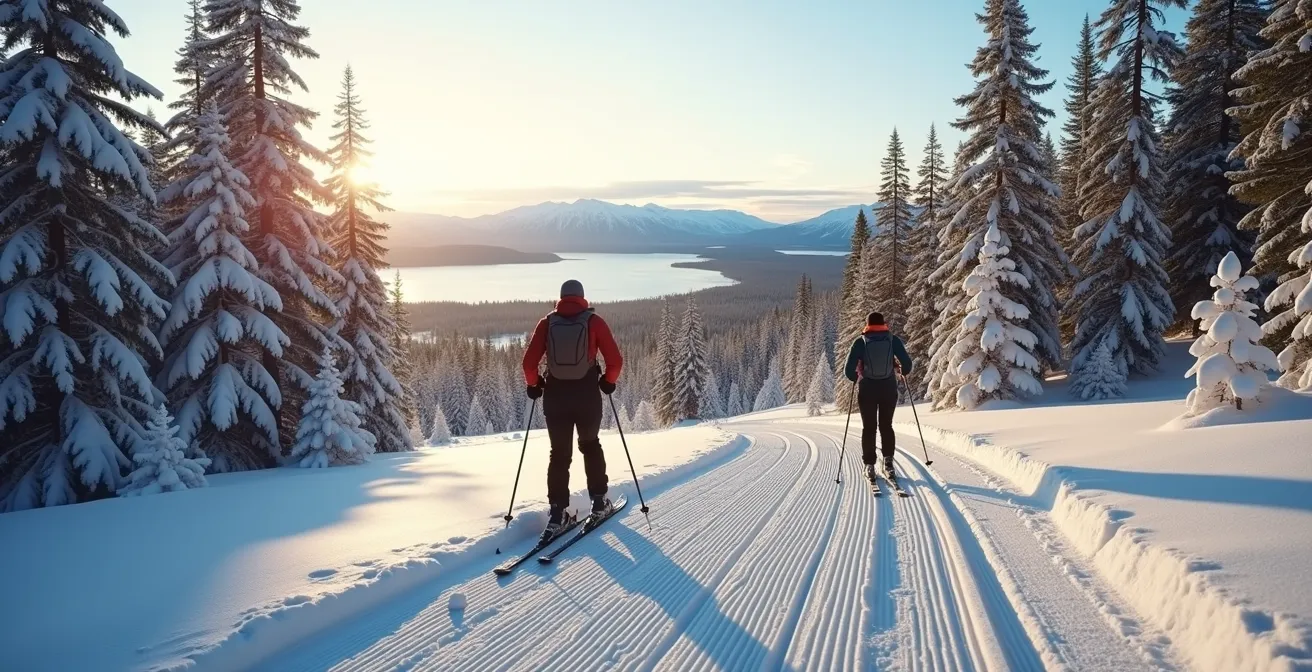
The scene is perfect: fresh snow blankets the Laurentian forest, the air is crisp, and a perfectly groomed trail disappears between the birch and fir trees. You’re ready to embrace a Quebec winter, but a fundamental question stops you at the rental shop: classic or skate skiing? The common advice is simple: classic is slower and easier for beginners, while skate is a faster, more athletic workout. Many will tell you to choose based on your fitness goals.
But this advice misses the point entirely, especially in Quebec. The most significant factor isn’t your athletic ambition; it’s your ability to navigate the province’s unique conditions and unwritten rules. Choosing your technique is not just about glide and kick; it’s about understanding how to dress for humid cold, what gear truly works when the temperature hovers around freezing, and how to share the trail without earning the silent scorn of local skiers.
This guide approaches the question from an instructor’s perspective. The real key isn’t deciding if you’re a “classic” or “skate” person. It’s about learning to think like a Quebec skier. We will focus on the practical realities: the crucial layering strategies, the gear that handles unpredictable weather, the trail etiquette that ensures safety and respect, and how to read your environment to have a great day on the snow, no matter which skis you strap on.
To help you make the right choices before you even hit the snow, this article breaks down the essential knowledge every new cross-country skier in Quebec needs. From what not to wear to understanding why trails close, you’ll gain the confidence to ski correctly and respectfully.
Summary: Classic or Skate Skiing: An Instructor’s Guide to Trails & Etiquette
- Why Down Jackets Are the Worst Choice for Cross-Country Skiing?
- The Track Mistake That Enrages Local Skiers
- Scales or Wax: What Works Best for Variable Quebec Temperatures?
- How to Read Trail Maps to Avoid Dangerous Descents?
- Headlamp or Lighted Trails: Where to Ski After Work Hours?
- Why the “Onion Strategy” Is Crucial for Quebec Weather?
- Why Are Trails Closed During the Thaw Period?
- How to Prepare for a Hike in the Boreal Forest Without Getting Lost?
Why Down Jackets Are the Worst Choice for Cross-Country Skiing?
A beginner’s first instinct for a cold day is to grab the warmest coat they own: the puffy down jacket. For cross-country skiing, this is the single biggest clothing mistake you can make. Skiing is an intense aerobic activity that generates a surprising amount of body heat. A down jacket, designed to trap heat with maximum efficiency, quickly turns into a personal sauna. You’ll start sweating profusely within ten minutes, soaking your base layers.
Once you stop or ski a long downhill section, that trapped moisture will chill rapidly, leaving you cold, clammy, and at risk of hypothermia. The goal is not to stay warm; it’s to manage moisture and regulate temperature. Down feathers lose all insulating properties when wet and are not breathable. This makes them fundamentally unsuited for high-output winter sports. In fact, your performance is directly tied to staying in the right temperature zone. Research published in 2012 demonstrates that the optimal range for endurance performance is between -4°C and 1°C. Overheating by wearing a down jacket pushes you far outside this window, leading to premature fatigue.
Instead of one bulky, non-breathable layer, the solution is a system of thinner, technical layers you can add or remove. Think a moisture-wicking base layer, a light fleece mid-layer, and a breathable, wind-resistant softshell jacket. This “onion strategy” allows you to vent heat on the climbs and stay protected from wind on the descents, keeping you dry and comfortable throughout your ski.
The Track Mistake That Enrages Local Skiers
In Quebec, cross-country ski trails are a shared, almost sacred space maintained by hard-working groomers. The most egregious breach of etiquette—the one that will instantly identify you as a clueless tourist—is disrespecting the classic tracks. These two parallel grooves are painstakingly set for classic skiers. Walking, snowshoeing, or skate skiing over them damages their structure, making them useless for the people they are intended for. When you need to stop, herringbone up a steep hill, or let someone pass, you must step completely out of the tracks.
This is the cardinal rule of a broader “trail culture” that prioritizes safety and mutual respect. On groomed trails with both a classic track and a wide skate lane, slower skiers (of either style) should keep to the right. Faster skiers should politely announce their intention to pass by calling out “Passing on your left!” or “Track!”. The slower skier is then obligated to yield by moving to the right. On narrow, one-way trails common in Quebec’s parks, this is a critical safety protocol.
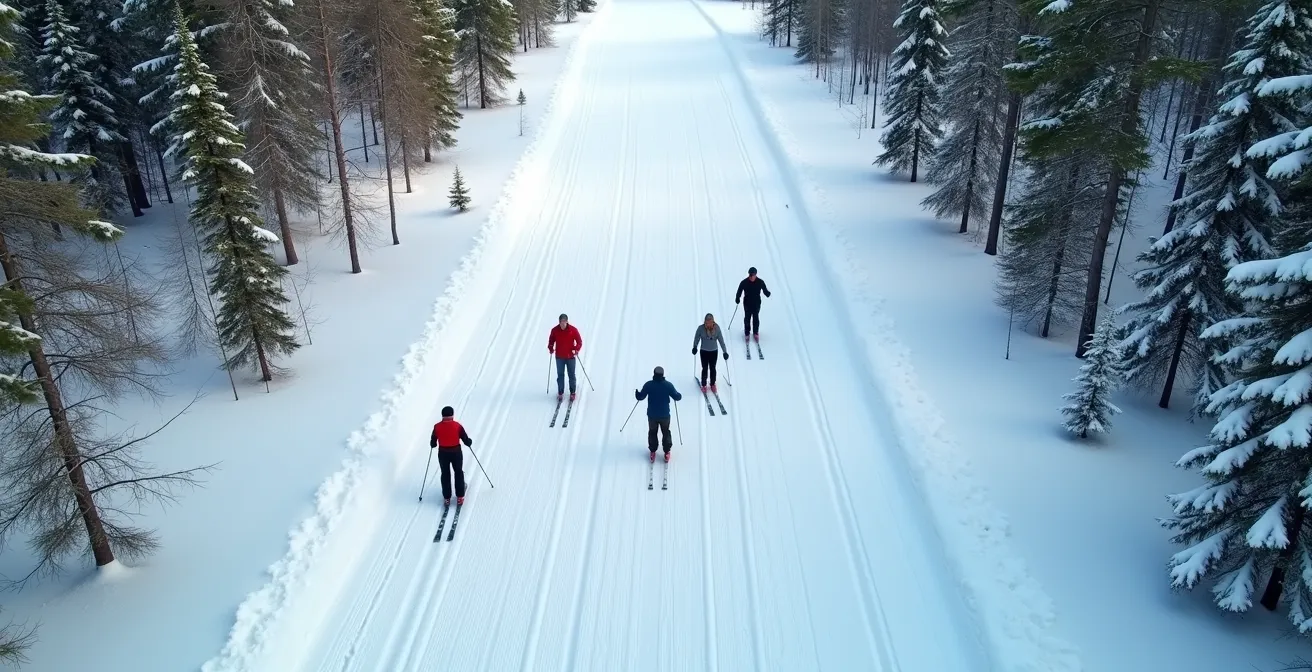
Other key rules include always following the marked direction of the trail, as many are one-way to prevent collisions on hills. Speaking of hills, the descending skier always has the right-of-way. If you are climbing, it is your responsibility to step aside and yield the trail to someone coming down, as they have more speed and less control. Mastering this etiquette is just as important as mastering your kick and glide; it shows respect for the trails and the community that uses them.
Scales or Wax: What Works Best for Variable Quebec Temperatures?
For classic skiing, getting “grip” to propel yourself forward is key. Historically, this was achieved with temperature-specific grip waxes. However, Quebec’s weather presents a unique challenge that makes traditional waxing a nightmare for beginners: the dreaded zero-degree problem. When temperatures hover around 0°C (32°F) with fresh, humid snow, a common occurrence, waxable skis become nearly unusable. The snow clumps into heavy, sticky balls on the ski base, turning your skis into unwieldy snowshoes. As cross-country ski experts confirm that at 0°C with fresh snow, no grip wax works effectively.
This is where modern “waxless” technologies shine. While cheap, entry-level “fish scale” skis exist, they often have poor glide and can still suffer from clumping. The superior solution for Quebec’s variable conditions is the skin ski. These skis have a strip of mohair or synthetic skin in the kick zone that provides excellent grip in all conditions but glides smoothly forward. They are the ultimate “grab and go” option, offering reliable performance without the daily guesswork of waxing.
As the experts at Cross Country Ski Headquarters note in their analysis of the technology:
On warm (+30F/-1°C) snow or days with fresh high-humidity snow, mechanical base skis suffer from snow clumping in the kick zone, making skis feel like snowshoes. Skin skis avoid this problem using sophisticated materials like Teflon that repel snow build-up effectively.
– Cross Country Ski Headquarters, Analysis of skin ski technology benefits
For a beginner looking for a hassle-free experience with reliable performance across the wide range of Quebec temperatures, skin skis are the unequivocal best choice. The slight premium in cost is more than offset by the convenience and effectiveness, especially on those challenging near-freezing days.
This comparative table breaks down the key differences for typical Quebec conditions, clearly showing why skin skis have become the local favourite.
| Feature | Skin Skis | Waxable Skis | Scale/Fishscale Skis |
|---|---|---|---|
| Performance at 0°C (Quebec’s nightmare temp) | Excellent – no snow clumping | Very Poor – snow sticks to wax | Poor – snow clumps in pattern |
| Grip on Ice | Superior – thousands of mohair fibers grip | Variable – depends on klister application | Poor – plastic pattern slips |
| Glide Speed | Good – shorter grip zone | Excellent when properly waxed | Fair – longer grip zone creates drag |
| Convenience | Grab and go | 5-10 min waxing per session | Grab and go |
| Cost | $400-800 CAD | $300-600 CAD plus wax kit | $200-400 CAD |
| Maintenance | Replace skins every 3-5 years | Clean and rewax each session | Minimal – glide wax only |
How to Read Trail Maps to Avoid Dangerous Descents?
Quebec boasts one of the most extensive and well-maintained cross-country ski networks in the world. For instance, Mont-Sainte-Anne alone offers an incredible 212 km of trails. This vastness is a gift, but it also requires a crucial skill: terrain literacy. Simply looking at a trail map and picking a loop based on its length is a recipe for a miserable, and potentially dangerous, day. As a beginner, you must learn to read the map for more than just distance.
The most important symbols to understand are the difficulty ratings: green circles for easy, blue squares for intermediate, and black diamonds for difficult. On a classic ski trail, a black diamond often signifies steep, narrow, and winding descents that require a confident and powerful snowplow to control your speed. Biting off more than you can chew can lead to a terrifying, out-of-control slide into the woods. Always start on green trails to build confidence.
Beyond difficulty, study the elevation profile. A trail with one long, sustained climb followed by a long descent is very different from a constantly rolling trail typical of the Laurentians, which can be more tiring. Before you even start, identify your “bail-out” routes. Most Quebec networks, like those in Sépaq parks, have numbered junction posts. Knowing you can take a shortcut back to the chalet if you get tired or if conditions worsen is a huge confidence booster. Lastly, remember that a map is a static document. Real-time conditions are key. Ice patches, fallen trees, and grooming status change daily.
Your Trail Map Pre-Ski Checklist
- Check Nordic Pulse app for real-time grooming reports at Sépaq establishments, as conditions change daily.
- Identify bail-out routes at major intersections before starting; many Quebec trails have numbered junction posts for emergency exits.
- Study elevation profiles carefully; one sustained climb requires different energy than the constant rolling hills of the Laurentians.
- Understand difficulty ratings: Black diamonds for classic often mean narrow, steep descents requiring advanced snowplow skills.
- Consult local Facebook groups for current conditions; official maps don’t show ice patches or recent windfall obstacles.
Headlamp or Lighted Trails: Where to Ski After Work Hours?
One of the great joys of Quebec winter is the ability to ski after work, under the stars. The province offers two excellent options for evening skiing: lighted trail networks and skiing by headlamp. For beginners, starting on a lighted trail is by far the safer choice. These networks provide enough ambient light to see the trail contours and your technique, without the disorienting effect of a single, bouncing beam from a headlamp.
Case Study: Quebec City’s Urban Night Skiing
The Plains of Abraham in the heart of Quebec City offers a world-class urban skiing experience. This historic park, which has hosted FIS World Cup events, provides several kilometres of free, lighted, and impeccably groomed trails. Beginners can practice on the flat terrain near the Musée national des beaux-arts du Québec, with equipment rentals available on-site, making it an incredibly accessible and scenic way to enjoy an evening ski with the city skyline as a backdrop.
Major centres across the province have fantastic lighted options. In Montreal, Parc du Mont-Royal offers convenient downtown tracks, while the Centre Castor at Valcartier near Quebec City is renowned for its grooming and varied terrain. These locations are perfect for practicing technique and getting in a workout on a weeknight.
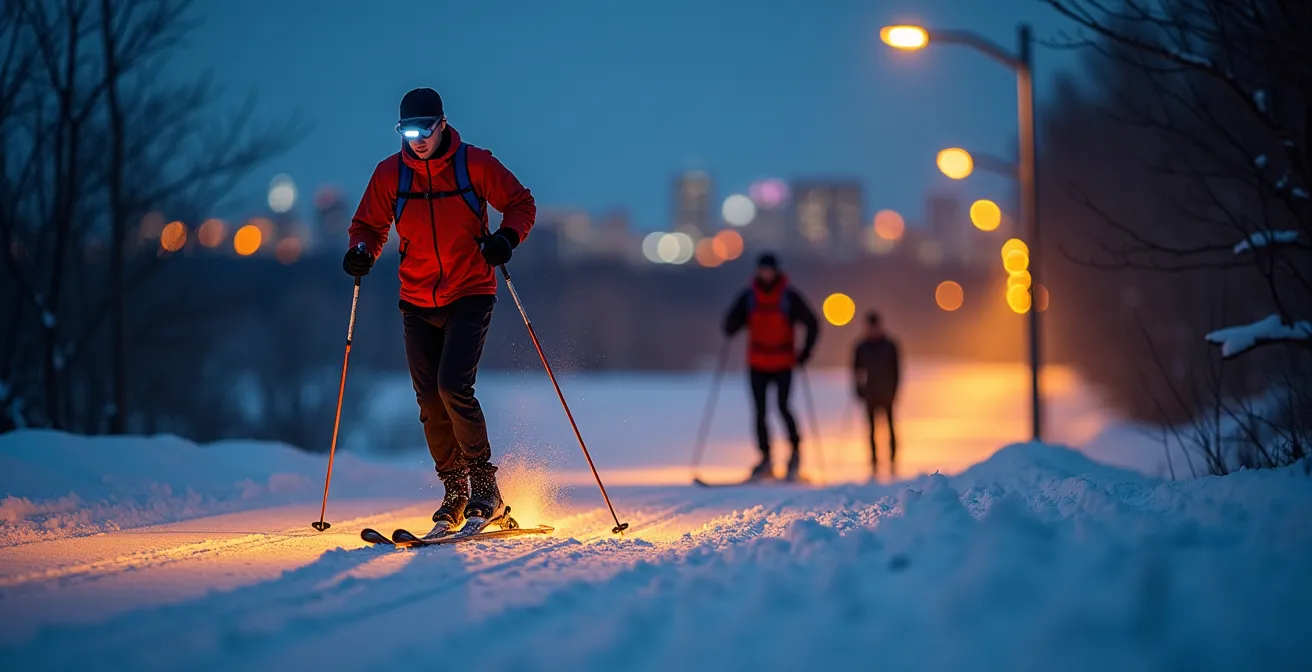
Skiing by headlamp on unlit trails is a more advanced practice that requires confidence and familiarity with the terrain. If you venture out with a headlamp, stick to easy, familiar classic trails. A minimum of 800 lumens is recommended for safe navigation. Always ski with a group, never shine your light in your partners’ eyes, and designate a “sweep” skier to ensure no one gets left behind. For the new skier, however, the magic and safety of a lighted trail network is the clear winner.
Why the “Onion Strategy” Is Crucial for Quebec Weather?
We’ve established that a down jacket is the wrong choice, but what is the right one? The answer is the “onion strategy”—a system of multiple thin layers that you can adjust throughout your ski. The goal is to start your ski feeling slightly cool, knowing you’ll warm up within minutes. A typical system for a cold Quebec day consists of three key layers.
The first is a moisture-wicking base layer made of merino wool or a synthetic fabric. This layer’s only job is to pull sweat away from your skin to keep you dry. Cotton is forbidden; it absorbs moisture and will make you dangerously cold. The second is an insulating mid-layer, typically a lightweight fleece or a thicker merino wool top. This layer traps a small amount of air to provide warmth. The final piece is a protective outer layer or shell, which should be wind-resistant and breathable. This protects you from the elements without trapping all your body heat and moisture.
Overheating is not just uncomfortable; it actively harms your performance. Research shows that running economy was significantly reduced at warmer temperatures when athletes wore standard cross-country ski clothing, proving that being too warm makes you less efficient. The layering system allows you to self-regulate: unzip your jacket on a long climb, or remove the mid-layer entirely if the sun comes out. This adaptability is essential for Quebec’s notoriously variable weather.
As the Outdoor Gear Lab testing team notes when describing an ideal layer:
The Smartwool Classic Thermal Merino 1/4 Zip exemplifies ideal mid-layer design for variable conditions – its 100% Merino construction wicks moisture naturally, stays warm even when wet, and resists odors without feeling bulky. The quarter-zip allows easy heat dumping during high-output skating efforts.
– Outdoor Gear Lab Testing Team, 2025 Base Layer Testing Report
Key Takeaways
- Trail Etiquette is Paramount: Respecting the classic tracks and yielding to other skiers is the most important skill for any cross-country skier in Quebec.
- Gear for the 0°C Problem: Choose your skis (especially skin skis) and clothing based on Quebec’s variable, humid cold, not just the absolute temperature.
- Layering is for Moisture Management: The goal of the “onion strategy” is to stay dry by managing sweat, which is the key to staying warm and performing well.
Why Are Trails Closed During the Thaw Period?
In late winter, you’ll see a frustrating sight: a trail centre with plenty of snow on the ground, but with a “Closed” sign at the entrance. This often happens during the “thaw period,” when daytime temperatures rise above freezing but drop back down at night. Skiing during these soft conditions, even for a few hours, can ruin the trails for the rest of the season. This concept is known as grooming integrity.
A groomed ski trail has a densely compacted base, built up over weeks. When the top layer thaws, it becomes soft like wet sugar. Skiing or walking on it creates deep ruts and postholes. When the temperature drops again, these ruts freeze solid, turning the trail into a lumpy, uneven, and dangerous surface that even the most powerful grooming machines cannot fix. Your single afternoon ski can destroy the hard work of groomers and the enjoyment of hundreds of other skiers.
Case Study: Trail Damage from Thaw-Period Use
Studies and reports from trail managers across Canada confirm the devastating impact of using soft trails. As one Nordic manager explained regarding fat bikes, which have a similar impact to skiers on soft snow, “It is very easy for a fat bike to ruin a ski trail.” The deep ruts they create are a nightmare for classic skiers and a hazard for skate skiers. This disrespect for trail conditions is the fastest way to have access privileges revoked permanently. The same principle applies to skiing; respecting closures is a matter of preserving the resource for everyone.
Trail operators close trails not to be difficult, but to protect the base for when it refreezes, potentially extending the ski season by several weeks. During these periods, skiers have alternatives. You can head to high-altitude areas like Camp Mercier in the Réserve faunique des Laurentides, which often holds its snow until mid-April. You can also use these days for ski maintenance, like cleaning and glide waxing, or for cross-training. Always check an app like Nordic Pulse for real-time trail status before you drive to the trailhead.
How to Prepare for a Hike in the Boreal Forest Without Getting Lost?
While this guide focuses on groomed trails, the skills you develop—reading conditions, managing your energy, and dressing appropriately—are the gateway to a grander adventure: exploring Quebec’s vast boreal forest on skis. The title’s mention of hiking is a misnomer in winter; the real progression is from groomed trails to off-piste or backcountry skiing. This is not something to be undertaken lightly, but it is a rewarding goal for any aspiring skier.
Quebec’s national parks (Sépaq) maintain an impressive network of marked but ungroomed backcountry trails, offering a safe entry point into this world. Locations like Parc national du Mont-Orford have designated sectors for this type of skiing. The first step is adjusting your equipment. Narrow classic or skate skis will sink in deep snow. The ideal tools are “ski-hoks” or “ski-raquettes,” which are short, wide skis with integrated skins that provide excellent flotation and grip for exploring untracked forest terrain.
Navigation becomes paramount once you leave the groomed network. Winter snowpack obscures summer landmarks and even buries trail markers. Carrying a GPS device or having a reliable app on your phone is essential, along with a map, compass, and an emergency whistle. Daylight is also a critical factor; Quebec’s short winter days mean you must start early and always carry a powerful headlamp as a backup, even if you plan to be back before dusk.
For those aspiring to ski in the truly wild mountains of the Gaspésie’s Chic-Chocs, avalanche awareness training (AST 1) is not just recommended; it is mandatory. But for the beginner, the goal is simpler: master the groomed trails, then progress to the marked backcountry sectors, always putting safety and preparation first.
Now that you understand the fundamentals of gear, etiquette, and conditions, the next logical step is to apply this knowledge. Choose a local trail, rent the appropriate skis for the day’s weather, and mindfully practice these principles on the snow.