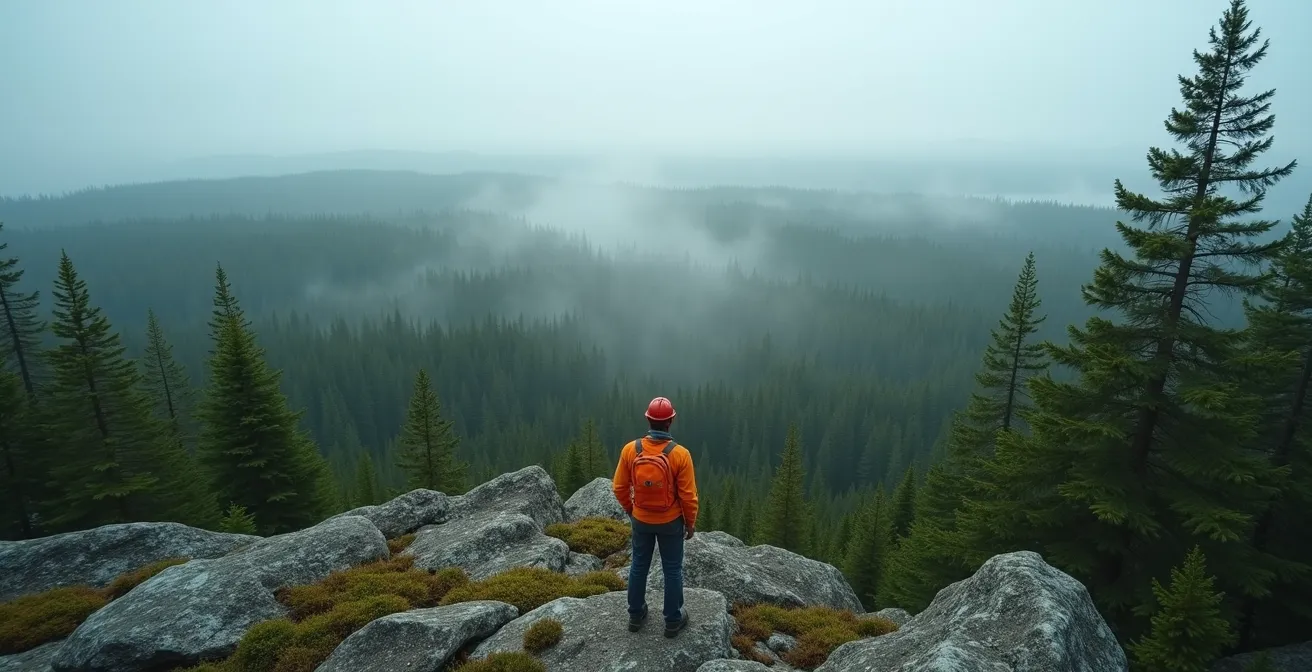
Your experience hiking in city parks is your biggest liability in the Quebec wilderness; it creates a dangerous overconfidence that the boreal forest will punish.
- True safety isn’t about a generic gear checklist, but mastering boreal-specific risks like magnetic deviation, sudden summer hypothermia, and aggressive biting insects.
- Consumer technology like cell phones will fail. Relying on them is a critical error; only dedicated off-grid communication devices and map skills are dependable.
Recommendation: Shift your mindset from a casual hiker to a prepared explorer. Acknowledge the unique dangers of this environment before you even think about packing your bag.
As a search and rescue volunteer with SÉPAQ, I’ve seen the same story play out too many times. An adventurous hiker, fit and experienced from years in urban or provincial parks, ventures into the boreal forest. They have a good pack, some snacks, and a fully charged phone. A few hours later, they are hopelessly lost. The fundamental truth is this: the dense, repetitive landscape of the Quebec boreal forest is unlike any park you’ve hiked before. It doesn’t forgive overconfidence.
Most guides will tell you to “pack the essentials” and “tell someone your plan.” While true, this advice is dangerously incomplete. It fails to address the specific, counter-intuitive threats of this environment. This isn’t about simply having a compass; it’s about knowing how to correct for a 15-degree magnetic declination that makes your compass lie. It’s not just about a rain jacket; it’s about understanding how a 10°C temperature drop in July can lead to life-threatening hypothermia when you’re soaked in sweat and rain. Forget your casual bug spray; it’s useless against the swarms of black flies that can drive a person to panic.
But what if the key wasn’t a longer packing list, but a complete mental reset? The purpose of this guide is to recalibrate your risk assessment. We will move beyond the platitudes and give you the specific knowledge that actually keeps you safe in the Quebec wild. We’ll cover the real reasons hikers get disoriented, the gear that actually works against our unique challenges, and the protocols for dealing with wildlife encounters that tourists often get wrong.
This guide is structured to build your preparedness from the ground up, starting with understanding the environment’s unique challenges and moving towards practical solutions and responsible exploration. Follow these sections to transform your preparation from a checklist to a survival mindset.
Summary: A Hiker’s Survival Guide to the Quebec Boreal Forest
- Why the Boreal Forest Is Disorienting Even for Experienced Hikers?
- What to Pack for the Woods: The Kit That Saves You from Hypothermia in July
- Black Flies or Mosquitoes: Which Repellent Actually Works in June?
- The Error of Relying on Cell Phones in Zones 15 Minutes Outside Towns
- How to React to a Black Bear Encounter to Ensure Your Safety?
- How to Find a Swimming Spot Without Crowds using Topo Maps?
- Soap and Sunscreen: What Products Are Legal in Protected Lakes?
- How to Choose the Right Outfitter in Northern Quebec for Your Needs?
Why the Boreal Forest Is Disorienting Even for Experienced Hikers?
The first mistake you’ll make is trusting your “natural sense of direction.” In the boreal forest, there is no such thing. The landscape is a uniform sea of black spruce, balsam fir, and moss. There are few distinctive peaks or landmarks visible from the forest floor. Every direction looks the same, a phenomenon known as “green-out.” This visual monotony quickly erodes confidence and leads to second-guessing, which is the first step toward getting truly lost.
But the most critical, and often overlooked, factor is magnetic declination. In much of Northern Quebec, the difference between magnetic north (where your compass points) and true north (the geographic North Pole) can be 15 to 20 degrees west. If you follow your compass without correcting for this, for every kilometer you walk, you will be off course by hundreds of meters. Over a few hours, this error compounds, leading you miles away from your intended path. Relying on an uncorrected compass is worse than having no compass at all; it gives you a false sense of security while actively leading you astray.
This environment punishes those who rely on intuition. Navigation here is a science, not an art. It requires deliberate, methodical steps to account for the forest’s inherent challenges. You must proactively manage your position at all times, trusting your instruments (correctly) over your instincts.
What to Pack for the Woods: The Kit That Saves You from Hypothermia in July
Hypothermia is not just a winter threat. One of the most common rescue scenarios in July and August involves hikers suffering from exposure. The temperature in the Quebec boreal forest can plummet by 15°C or more in a matter of minutes during a summer thunderstorm. When you combine that with being drenched in sweat from a strenuous hike and then soaked by rain, your body’s core temperature can drop to dangerous levels with shocking speed.
Your standard rain jacket is not enough. You need a dedicated hypothermia prevention kit, even on the sunniest day. This isn’t about bulky winter gear; it’s about smart, lightweight layers. The core components include a non-cotton base layer (merino wool or synthetic) that wicks moisture away, a mid-layer fleece for insulation, and a high-quality waterproof and windproof outer shell. Most importantly, you must carry an emergency bivvy or space blanket, a large orange contractor bag (which serves as a waterproof shelter and a signaling device), and a reliable fire-starting kit with weatherproof matches and a ferro rod. These items are non-negotiable.
Case Study: The Importance of Emergency Communication
Hikers on Saskatchewan’s Boreal Trail, an environment similar to Quebec’s, report dramatic temperature drops even in summer months. In one documented case, an experienced hiker lost their InReach satellite messenger in the backcountry. They were only able to successfully retrieve it months later by using its GPS ping functionality. This incident highlights two critical points: the unforgiving nature of the boreal conditions and the absolute necessity of carrying a reliable emergency communication device that works when all else fails.
This kit is your life insurance. The reality is that a simple twisted ankle can force you to spend an unplanned night in the woods. Without the ability to stay dry and create warmth, that inconvenience can become a fatal emergency.
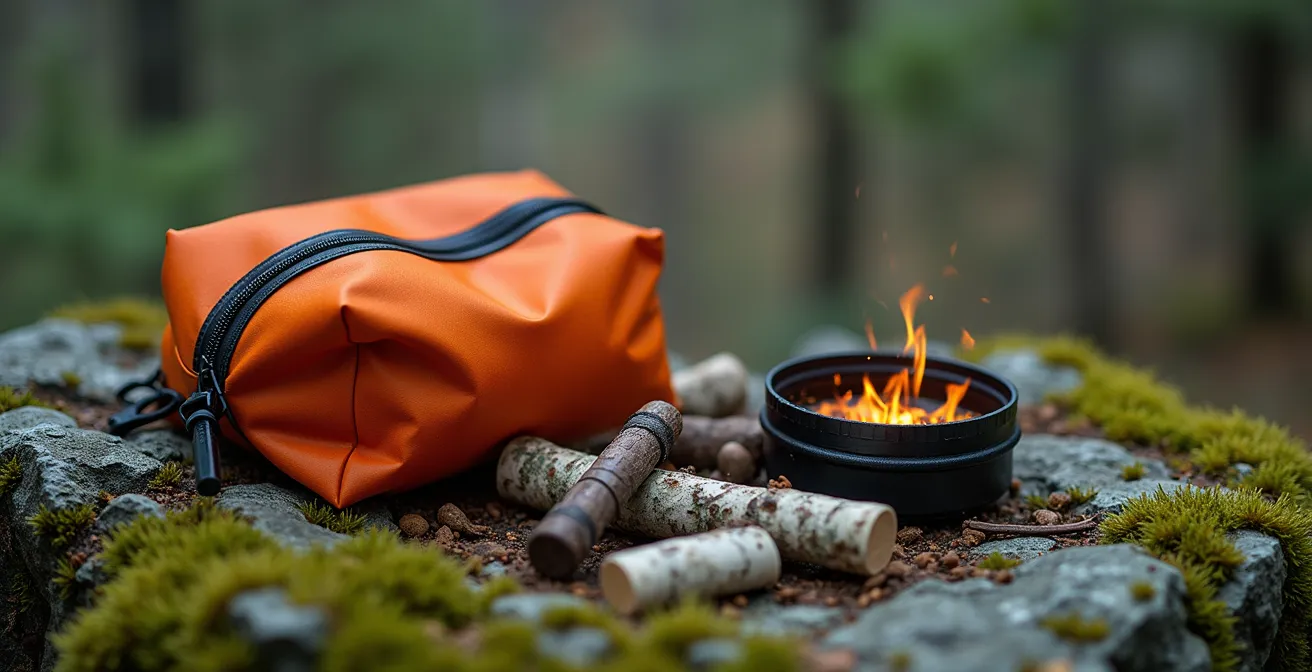
As you can see, the essential items are compact. A ferro rod, weatherproof tinder like birch bark, and a waterproof container for matches are the foundation of your ability to create a life-saving fire when your lighter is wet and useless. Never underestimate the cold, even in the heart of summer.
Black Flies or Mosquitoes: Which Repellent Actually Works in June?
If you hike in Quebec in late May or June, your primary battle will not be with the terrain, but with insects. Specifically, black flies (mouches noires). These are not the same as common house flies; they are tiny, relentless biting insects that swarm in clouds, crawling into your ears, eyes, and nose. Their bites are painful and can cause severe swelling and allergic reactions. Mosquitoes (maringouins) are a nuisance, but black flies can be a genuine threat to your sanity and safety by causing panic and distraction.
Your standard-issue repellent from the pharmacy will likely be ineffective. You need a two-pronged strategy: chemical repellents and physical barriers. For repellents, the two most effective active ingredients are DEET (30% concentration) and Icaridin (20% concentration). While DEET is highly effective against mosquitoes, many seasoned woodsmen find Icaridin superior for black flies. A critical third component is treating your clothing with Permethrin. It’s an insecticide that you apply to your gear (never your skin) before your trip; it kills insects on contact and lasts for several washes.
This table compares the most common and effective repellents against Quebec’s biting insects, based on extensive field use. As the research from Canadian Wildlife Federation suggests, the forest is a complex ecosystem.
| Repellent Type | Black Fly Protection | Mosquito Protection | Duration | Gear Safety |
|---|---|---|---|---|
| DEET 30% | Moderate (6-7/10) | Excellent (9/10) | 6-8 hours | Can damage synthetics |
| Icaridin 20% | Good (8/10) | Good (8/10) | 8-10 hours | Safe for all materials |
| Permethrin (clothing) | Excellent (9/10) | Excellent (9/10) | 6 washes | Clothing treatment only |
Beyond chemicals, physical barriers are essential. A bug head net is the single most important piece of gear for June hiking. It may look silly, but it’s the only thing that will keep you from inhaling flies. Wear light-colored, long-sleeved shirts and pants tucked into your socks. Black flies are attracted to dark colors. Avoiding them behaviourally is also key; they are most active during the day and near running water, and they dislike wind.
The Error of Relying on Cell Phones in Zones 15 Minutes Outside Towns
This is the single most dangerous assumption made by hikers accustomed to urban parks. Your smartphone is not a reliable safety device in the boreal forest. Cellular coverage is notoriously patchy and often disappears completely just a few kilometers from a main road or town. Believing you can call for help is a fantasy that puts you and rescue teams at risk.
Even if you have a signal, the cold can drain your phone’s battery in a fraction of its normal time. Using it for GPS will deplete it even faster. A dead phone is a useless piece of glass. The forest is littered with stories of lost hikers found with dead cell phones in their pockets. It creates a profound and dangerous false sense of security, discouraging hikers from learning and carrying proper navigation tools.
The professional standard for communication in the backcountry is a dedicated satellite messenger. These devices operate independently of cellular networks, using satellite constellations to send and receive messages, track your location, and trigger an SOS alert to a global emergency response center. The two dominant networks are Iridium and GlobalStar. Testing confirms that the Iridium network provides 100% global coverage, making devices that use it, like the Garmin inReach or ZOLEO, the most reliable choice for the vast and remote areas of Quebec.
Investing in one of these devices is not a luxury; it’s a fundamental component of a responsible safety plan. Here is a comparison of popular devices used by hikers in Quebec:
| Device | Network | Two-Way Messaging | Battery Life | Monthly Cost (Basic) | Weight |
|---|---|---|---|---|---|
| Garmin inReach Messenger Plus | Iridium | Yes + Photo/Voice | 25 days | $15 | 4.2 oz |
| ZOLEO | Iridium | Yes (app required) | 200 hours | $20 | 5.3 oz |
| SPOT Gen4 | GlobalStar | One-way only | 15 days | $12 | 5 oz |
How to React to a Black Bear Encounter to Ensure Your Safety?
The best way to handle a black bear encounter is to prevent it from happening in the first place. The vast majority of negative encounters are related to food. Bears have an incredible sense of smell, and they learn to associate humans with easy calories. This is why proper food storage is not a suggestion—it’s a rule. Never keep food, toiletries, or any scented items inside your tent. All food must be stored in a bear-proof canister or, more commonly in Quebec, in a proper “bear hang.” This means your food bag must be at least 12 feet off the ground, 4 feet out from the tree trunk, and 4 feet below the supporting branch.
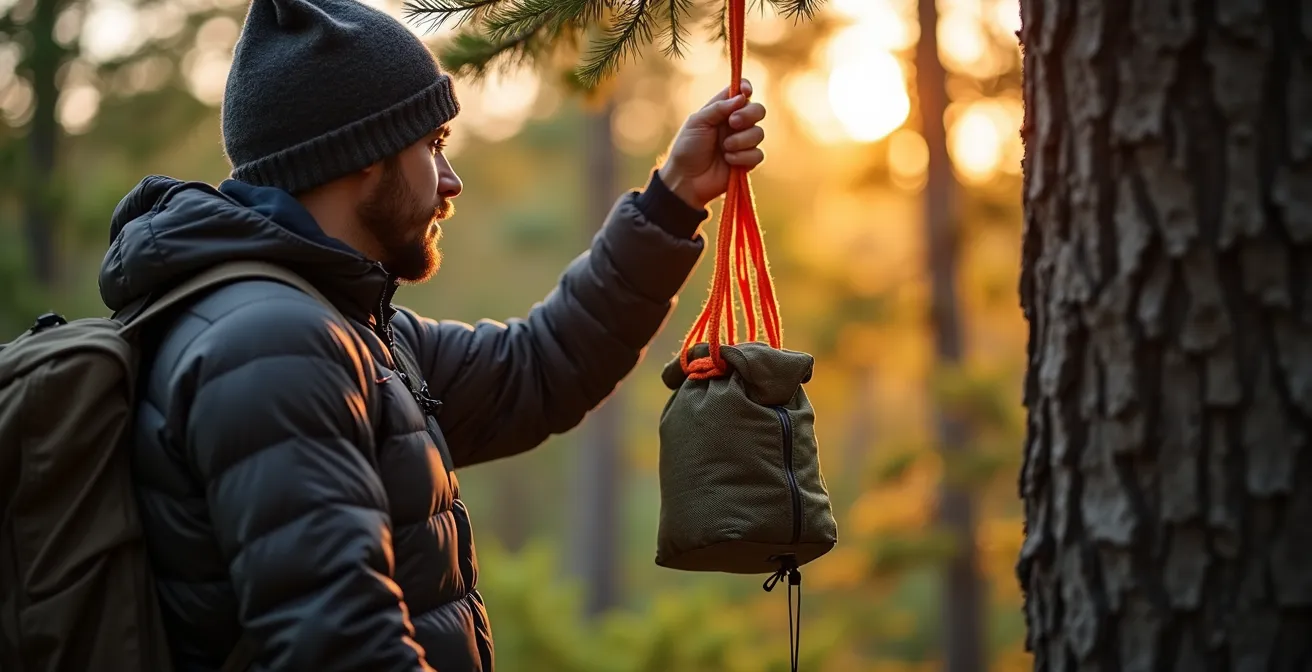
However, encounters can still happen on the trail. If you see a black bear, the first rule is: do not panic and do not run. Running can trigger a bear’s predatory chase instinct. Stay calm. Assess the situation. Is it aware of you? Does it have cubs? A mother bear with cubs is the most dangerous scenario. If it hasn’t seen you, back away slowly and quietly, giving it a wide berth. If it has seen you, you need to identify yourself as a human and not a threat. Speak to it in a calm, firm voice. “Hey bear. Whoa bear.” Make yourself look as large as possible by raising your arms. Do not make direct eye contact, as this can be perceived as a challenge.
Under no circumstances should you drop your pack or offer it food. You want the bear to see you as a dominant, uninteresting figure, not a source of a meal. Slowly back away. Do not turn your back on it. In the extremely rare event of a defensive attack (if you surprised it), play dead. In the even rarer event of a predatory attack (it stalks and follows you), you must fight back with everything you’ve got. Many hikers in bear country carry bear spray, which is a powerful deterrent, but you must know how to use it correctly under pressure. It is not a magic shield.
How to Find a Swimming Spot Without Crowds using Topo Maps?
After days of hiking through dense forest, finding a secluded lake for a swim is one of the great rewards of the boreal. But the most accessible spots are often crowded. The key to finding your own private paradise lies in learning to read a topographic (topo) map. With the boreal forest covering almost one third of Quebec province, there are countless hidden gems waiting to be discovered by those who can interpret the landscape on paper.
A topo map tells you the story of the land through contour lines. Each line represents a specific elevation. The closer the lines are together, the steeper the terrain. For a good swimming spot, you are looking for the opposite. You want to find a lake where the contour lines are spaced far apart as they meet the shoreline. This indicates a gentle, gradual slope, which likely means a sandy or pebbly beach entry, not a sheer cliff or a swamp.
You should also pay attention to other symbols. Avoid areas marked with marsh symbols (tufts of grass in blue), as these will be muddy and full of leeches. Look for south-facing shorelines, as they receive the most sun and will have warmer water. Using Quebec’s own Forêt ouverte online platform, you can cross-reference your topo map findings with recent satellite imagery to confirm the shoreline looks promising before you even leave home. This combination of old-school map reading and modern technology is the secret to successful off-trail exploration.
- Look for contour lines spaced 10+ meters apart meeting the water’s edge (indicates a gradual slope).
- Avoid areas where contour lines bunch together at the shoreline (indicates cliffs or steep drops).
- Check for blue dotted lines indicating intermittent streams that may create cold water inflows.
- Identify south-facing shores on lakes for warmer water temperatures.
- Cross-reference with satellite imagery on the Forêt ouverte platform to confirm current conditions and access.
Soap and Sunscreen: What Products Are Legal in Protected Lakes?
Accessing these beautiful, pristine lakes comes with a profound responsibility to protect them. The water in many boreal lakes is pure enough to drink, and it’s our duty to keep it that way. The “Leave No Trace” principles are not just guidelines here; in SÉPAQ parks and protected areas, they are enforced rules. The most common violations involve washing and the use of improper products.
It is strictly forbidden to use any kind of soap or cleaner directly in a lake or stream, even if it is labeled “biodegradable.” These soaps can cause algal blooms and harm aquatic life. As the official park guidelines state, the rule is absolute. In their official guidelines, Sépaq Quebec makes it clear:
All washing, whether body or dishes, must be done at least 20 metres from any lake or stream
– Sépaq Quebec, Official Sépaq Park Guidelines
You must carry water 20 meters (about 70 feet) away from the shore before washing yourself or your dishes. The gray water should then be scattered broadly over the ground so the soil can filter it, not poured in one spot. The same principle applies to brushing your teeth. Sunscreen is another major contaminant. Chemical sunscreens containing ingredients like oxybenzone and octinoxate are toxic to freshwater ecosystems. You must use a “reef-safe” mineral-based sunscreen, which uses zinc oxide or titanium dioxide as its active ingredient. These are physical blockers that are not harmful to aquatic life.
This commitment to protecting the environment is part of the pact we make when we enter these wild spaces. It ensures that the solitude and purity we enjoy will be there for generations to come.
Key Takeaways
- Your urban hiking skills can create a false sense of security; the boreal forest requires a specific, respectful mindset.
- Mastering navigation beyond your phone, including correcting for magnetic declination, is a life-saving skill.
- Prepare for hypothermia even in summer, and choose insect repellents specifically effective against black flies, not just mosquitoes.
How to Choose the Right Outfitter in Northern Quebec for Your Needs?
For those new to the boreal forest or looking to undertake a more ambitious expedition (like a multi-day canoe trip or a remote fly-in), hiring a professional outfitter (a pourvoirie) is the smartest and safest decision. A good outfitter provides not only gear and logistics but, most importantly, expert local knowledge. They know the land, the weather patterns, and the emergency procedures. However, not all outfitters are created equal.
Your top priority when vetting an outfitter should be their commitment to safety and professionalism. The gold standard in the province is accreditation from Aventure Écotourisme Québec (AEQ). This certification is a guarantee that the outfitter adheres to strict standards. As stated by the organization itself, this provides a critical layer of assurance for any adventurer.
AEQ-certified outfitters meet rigorous standards for guide training, safety protocols, and environmental practices
– Aventure Écotourisme Québec, Quebec Adventure Tourism Accreditation Standards
When you contact a potential outfitter, you need to ask specific, targeted questions that go beyond their advertised packages. This is your due diligence to ensure they are qualified to keep you safe if something goes wrong. A professional outfitter will welcome these questions and have ready, confident answers. A vague or dismissive response is a major red flag.
Action Plan: Vetting a Quebec Wilderness Outfitter
- Ask about the guide-to-client ratio for their expeditions. (A ratio of 1:6 or lower is the standard for safety in remote terrain).
- Confirm their guides are certified in 40-hour Wilderness First Aid (Secourisme en régions éloignées), the industry standard for remote guiding.
- Inquire about the emergency communication systems they carry. (They must have a satellite messenger or phone, plus a backup).
- Request to see their written emergency evacuation plan. (This should include identified helicopter landing zones and contact protocols).
- Ask how they work with and respect the local Indigenous communities whose traditional territory they operate on.
Frequently Asked Questions About Boreal Forest Safety
Can I use biodegradable soap directly in Quebec lakes?
No, even biodegradable soap must never be used directly in water. All washing must occur at least 20 meters (65 feet) from any water source, and greywater must be scattered broadly on land.
What sunscreens are safe for boreal freshwater ecosystems?
Choose ‘reef-safe’ mineral sunscreens using zinc oxide or titanium dioxide. Avoid products containing oxybenzone, octinoxate, or other chemical filters that can harm aquatic life.
How should I dispose of toothpaste in the backcountry?
Spit toothpaste into a cathole dug 15-20cm deep, at least 60 meters from water sources, trails, and campsites. Cover the hole completely when finished.