The secret to an authentic Quebec food tour isn’t following the official map—it’s learning to read the unwritten rules of the terroir itself.
- Authenticity is proven by legal designations like IGP, not just rustic-looking signs.
- Understanding local laws and farm etiquette unlocks genuine experiences that most tourists miss.
Recommendation: Use this guide as a decoder ring to distinguish passionate artisans from the mere “performance of authenticity” and transform your trip into a true culinary exploration.
The promise of Quebec’s Charlevoix Flavour Trail is intoxicating: a scenic drive dotted with artisans offering the pure taste of the land. Foodies arrive with coolers and high hopes, dreaming of sharp, crumbly cheese from a smiling fromager and robust red wine poured by the vintner himself. The reality, however, can be a minefield of carefully curated tourist experiences, where the “performance of authenticity” often outshines the real thing. It’s a landscape where anyone can hang a “produits locaux” sign, but few can back it up with genuine, small-batch savoir-faire.
Most guides will tell you to follow the official map, talk to producers, and look for quaint farm stands. This is well-meaning but fundamentally flawed advice for a discerning palate. It doesn’t teach you how to spot the difference between a farm that’s a working enterprise and one that’s primarily a retail operation. It doesn’t explain the perplexing local laws that dictate why you can buy cider at one farm but not spirits at another. And it certainly doesn’t prepare you for the critical task of preserving your hard-won treasures. After all, Canada produced a total of 528,207 metric tonnes of cheese, but only a fraction of that represents the true artisanal quality you’re seeking.
Forget the generic advice. This guide is your decoder ring. We will move beyond the map to cultivate true “terroir literacy.” Instead of just listing stops, we will explore the unwritten rules of the road: the science of keeping cheese alive in a hot car, the legal quirks of alcohol sales, the non-negotiable etiquette of farm visits, and the ultimate litmus test for verifying products like the famed Charlevoix lamb. This is about transforming you from a passive tourist into an active, informed connoisseur who can confidently navigate the trail and bring home its most authentic flavours.
Contents: Your Guide to Navigating Quebec’s Terroir
- How to Keep Charlevoix Cheese Fresh in a Hot Car All Day?
- Why You Can Buy Wine at the Farm but Not Spirits at the Grocery Store?
- The Mistake of Walking Into Barns Without Permission
- Lunch or Dinner: When Is the Best Time to Taste the Terroir Menus?
- Grand Cru vs. Industrial: How to Spot Real Charlevoix Lamb?
- Eastern Townships or Saguenay: Which Region Has the Best Cheese Density?
- Can Quebec Grow Good Hops Despite the Cold?
- How to Plan a Cheese Tasting Road Trip in Quebec?
How to Keep Charlevoix Cheese Fresh in a Hot Car All Day?
The single greatest tragedy of a food road trip is a perfectly aged wheel of Le 1608 de Charlevoix sweating into an oily, ammoniated mess in the back of your car. Protecting your investment isn’t just about cold; it’s about intelligent temperature and humidity management. Cheese is a living thing, and your goal is to keep it dormant, not kill it with frost or cook it with heat. The cardinal rule is to avoid drastic temperature fluctuations.
Experts agree that proper transport is critical. In fact, cheese preservation guidelines recommend maintaining temperatures below 50°F (10°C) to prevent spoilage and flavour degradation. But simply throwing it in a cooler with ice isn’t enough. The key is creating a stable micro-environment. You must first wrap hard cheeses in parchment or wax paper to allow them to breathe, then place them in your insulated container. Soft, delicate cheeses should be stored separately in their own containers to prevent them from being crushed or absorbing odours.
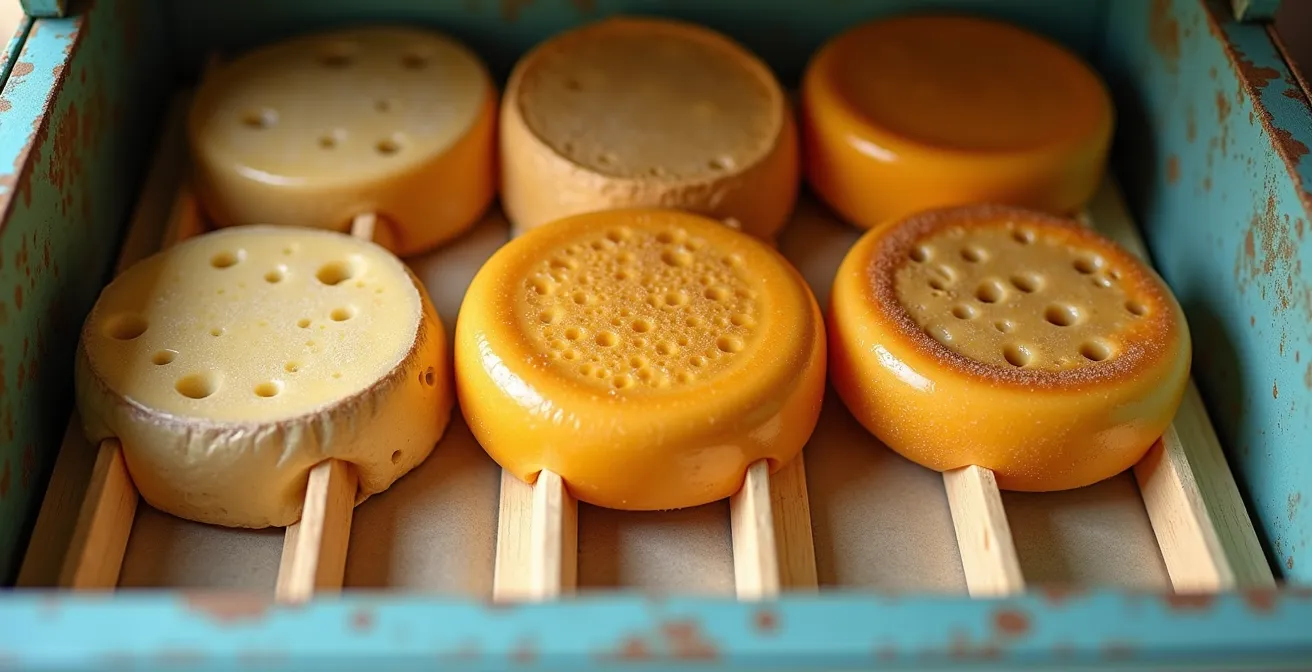
As this setup illustrates, strategic placement is everything. Ice packs should be positioned around the cheese but never in direct contact, which can cause ice crystals to form and ruin the texture. The center of the cooler is the safest zone, buffered from the temperature swings that occur each time you open the lid. Remember that hard cheeses can endure up to 8 hours at room temperature, while soft cheeses have a much shorter window of only 4 hours before their quality is compromised. A little foresight ensures your terroir treasures arrive home in perfect condition.
Why You Can Buy Wine at the Farm but Not Spirits at the Grocery Store?
You’ve just had a fantastic tasting at a Charlevoix cidrerie and bought a bottle of their signature ice cider. At the next stop, a winery, you do the same. But when you visit a micro-distillery, you’re told you can only buy their gin at the government-run SAQ (Société des alcools du Québec). This isn’t an arbitrary rule; it’s a window into the complex world of Quebec’s alcohol laws, a form of “regulatory arbitrage” that artisans must navigate.
The ability to sell directly to consumers is a privilege granted by specific production permits. These permits are designed to support agricultural producers by allowing them to commercialize products derived directly from their own crops—grapes for wine, apples for cider. It’s a system that favours farm-based production. For instance, data from Quebec’s alcohol regulations showed that 145 businesses held small-scale wine production permits, enabling this direct-to-consumer model that is so vital for agrotourism. This creates a powerful incentive for vignerons and cidriculteurs to welcome visitors and build a brand right on their land.
Spirits, however, fall under a different, more restrictive category. Their production often involves sourcing ingredients (like grains or neutral spirits) that aren’t grown on-site, breaking the direct farm-to-bottle chain that the permits are designed to encourage. Therefore, their sale is channeled exclusively through the SAQ monopoly. This state-controlled system ensures tax collection and regulated distribution but creates the paradox you experience on the road. So when a producer can’t sell you a bottle, it’s not because they don’t want to; it’s because they are operating within a century-old legal framework designed long before the craft distilling boom. Understanding this nuance is a key piece of terroir literacy.
The Mistake of Walking Into Barns Without Permission
The romantic image of a food tour often involves wandering through a sun-dappled barn, the scent of hay in the air, while sheep or cows look on curiously. This is a fantasy. The single most common and dangerous mistake a tourist can make is treating a farm like a public park. A farm is a high-risk workplace and a sensitive biological environment. Uninvited entry isn’t just rude; it’s a threat to animal health and human safety.
This is where “biosecurity etiquette” becomes paramount. Farms are fragile ecosystems. You could unknowingly track in diseases on your shoes that could devastate a herd. Furthermore, these are active work zones with heavy machinery, protective animals, and procedures that are invisible to the casual observer. Producers on the Flavour Trail are eager to share their world, but only in a controlled, safe manner. Respecting their space is the first and most important rule of authentic agrotourism.
The producers on the Charlevoix Flavour Trail are professionals who have designed specific ways to welcome visitors safely. The key is to look for the designated channels and never assume access. Adhering to this etiquette not only ensures your safety but also shows respect for the artisan’s livelihood, often leading to a much richer interaction when you connect through the proper channels.
Your Farm Visit Etiquette Checklist
- Identify Points of Contact: Look for official signs marking visitor areas, such as ‘Accueil’ (Welcome), ‘Boutique’ (Shop), or ‘Dégustation’ (Tasting). These are your designated entry points.
- Respect Boundaries: Never enter areas marked ‘Propriété privée’ (Private Property) or with any form of ‘Access Prohibited’ signage. A closed gate is not an invitation.
- Ask for Permission: If in doubt, find a person and ask clearly, “Bonjour, est-ce que vous offrez des visites de la ferme?” (Hello, do you offer farm tours?). Do not wander off to find someone.
- Stay on Designated Paths: If you are on a tour, stick to the paths provided. This is crucial for biosecurity and keeps you clear of machinery and animal handling areas.
- Wait for a Guide: Recognize that farms are workplaces. Always wait for a guided tour or specific instructions before entering any operational area like a barn or pasture.
Lunch or Dinner: When Is the Best Time to Taste the Terroir Menus?
Many farms along the Flavour Trail have evolved into true gastronomic destinations, offering “table champêtre” or “farm-to-table” dining experiences. The choice between booking for lunch (dîner) or dinner (souper) is more than a matter of timing; it’s a strategic decision that defines the entire experience. While dinner often promises a more elaborate, multi-course affair, lunch is frequently the golden hour for authentic interaction.
The heart of a “table champêtre” is the connection to the producer and the land. As a recent analysis of Quebec’s terroir dining highlights, the midday meal often offers a more relaxed and personal atmosphere. During lunch, the farmer-chef may have more time to step out of the kitchen, share the story behind a dish, or explain the unique qualities of their produce. It’s the time for genuine connection, where the meal becomes a conversation with the artisan.
Dinner, on the other hand, is typically a more formal, structured event. It’s a showcase of the chef’s full culinary prowess, often presented as a prix-fixe menu with optional wine pairings. While gastronomically impressive, it can sometimes feel more like a traditional restaurant experience, with less direct access to the producers themselves. The following table breaks down the strategic differences to help you choose the experience that best suits your goals.
| Timing | Advantages | Best For | Price Range |
|---|---|---|---|
| Lunch (Dîner) | More interaction with producers, relaxed atmosphere, daily specials available | Authentic local experience, meeting artisans | Generally 20-30% less expensive |
| Dinner (Souper) | Formal prix-fixe menus, full gastronomic experience, wine pairings | Special occasions, complete tasting menus | Premium pricing for elaborate presentations |
Grand Cru vs. Industrial: How to Spot Real Charlevoix Lamb?
Charlevoix lamb is one of the crown jewels of Quebec gastronomy, but its fame means that the name is often used loosely on menus to attract tourists. Simply seeing “Agneau de Charlevoix” is not enough. The true mark of quality, the “IGP litmus test,” is the legally protected designation: ‘Agneau de Charlevoix IGP’ (Indication Géographique Protégée).
This IGP is not a marketing slogan; it’s a binding set of rules. It guarantees that the lamb was born and raised in the Charlevoix region, fed a specific diet (including at least 70% locally grown cereals and hay), and raised according to strict animal welfare standards. This system ensures a product of exceptional and consistent quality, with a unique flavour profile shaped by the region’s salty air and pastures. Anything less than the full ‘Agneau de Charlevoix IGP’ title might be excellent lamb, but it isn’t the genuine, certified article. It might be lamb *from* Charlevoix, but it’s not *the* Charlevoix lamb.
Distinguishing the real thing from a generic equivalent requires a bit of polite interrogation and keen observation. Authentic producers and restaurateurs who go through the effort and expense of sourcing IGP-certified lamb are immensely proud of it and will be happy to confirm its origin. Being an informed consumer empowers you to support the producers who are committed to this high standard of excellence. Don’t be shy; your questions are a sign of a discerning customer, which true artisans always appreciate.
- Look for the Logo: The official ‘Agneau de Charlevoix IGP’ logo is your first and best clue. Look for it on menus, butcher displays, or product packaging.
- Ask the Right Question: Be direct and precise. Ask your server or butcher: “Est-ce que votre agneau est l’Agneau de Charlevoix avec la certification IGP?” (Is your lamb the IGP-certified Charlevoix lamb?).
- Verify the Farm Name: Restaurants committed to authenticity will often name their suppliers. If they mention a specific farm like Ferme Éboulmontaise, it’s a very strong sign of legitimacy.
- Check the Price: Quality has a cost. The strict standards of the IGP mean the lamb commands a premium of 30-40% over standard lamb. If the price seems too good to be true, it probably is.
- Request Certification: If you are making a significant purchase from a butcher, it is perfectly acceptable to politely ask to see the certification documents for the batch you are buying.
Eastern Townships or Saguenay: Which Region Has the Best Cheese Density?
While Charlevoix is a star, Quebec’s cheese universe is vast. For a road tripper, choosing the next destination often comes down to a strategic question: where can I find the highest concentration of exceptional fromageries? The two main contenders are the Eastern Townships (Estrie) and Saguenay-Lac-Saint-Jean. They offer distinctly different experiences, and the “best” choice depends on your travel style.
The Eastern Townships are, without a doubt, the champions of cheese density. The region boasts a tightly packed network of producers, allowing you to visit multiple fromageries in a single day without spending hours in the car. This concentration has fostered a highly collaborative and competitive environment, leading to incredible diversity. You’ll find world-class cheeses made from cow, goat, and sheep milk, often within a few kilometers of each other. The famous Route des Vins (Wine Route) also runs through the area, making for perfect food and drink pairings. This region was recently in the spotlight when Fromagerie la Station won top honours at the American Cheese Society competition for its Alfred Le Fermier, proving the region’s world-class status.
Saguenay-Lac-Saint-Jean, on the other hand, offers an experience defined by iconic producers and epic landscapes. The fromageries are more spread out, requiring more driving between stops. However, this is the historic heartland of Quebec cheese, home to foundational producers like Fromagerie Perron, which has been making cheddar since 1890. A trip here is less about ticking off a long list and more about making a pilgrimage to the roots of Quebec’s cheese culture, with the added bonus of exploring the breathtaking Saguenay Fjord and vast Lac Saint-Jean.
| Region | Number of Fromageries | Specialty | Pairing Options |
|---|---|---|---|
| Eastern Townships | Higher density, concentrated routes | Variety of cow, goat, and sheep cheeses | Route des Vins for wine pairings |
| Saguenay-Lac-Saint-Jean | More spread out, iconic producers | Foundational cheeses like Perron | Boreal products and microbrews |
Can Quebec Grow Good Hops Despite the Cold?
For decades, the idea that Quebec’s cold climate was unsuitable for growing quality hops was a widely held belief. Local brewers relied heavily on imported pellets from Germany, the Czech Republic, and the Pacific Northwest. However, a quiet revolution has been underway, driven by passionate agronomists and brewers determined to prove that Quebec terroir can extend to beer. The answer to the question is a resounding yes, and the proof is in the pint.
Pioneering breweries like MicroBrasserie Charlevoix have been instrumental in this shift. Since 1998, they have been crafting creative, Belgian-inspired beers like the Dominus Vobiscum series, proving that world-class beer could be made locally. As they and others grew, they created a demand for local ingredients, encouraging a renaissance in Quebec’s hop farming. Today, dedicated hop farms (houblonnières) are successfully cultivating a range of varietals, from classic North American hops to unique local strains that express a distinct Quebec character.
The challenge for a beer lover is identifying these truly local brews. The secret is to look for “wet hop” or “fresh hop” beers, which are only available during the late summer harvest season (August-September). These beers must use hops within 24 hours of being picked, making them an undeniable showcase of local agriculture. Asking a brewer about their hop suppliers or looking for the names of specific Quebec houblonnières on the label are other key strategies for tasting the local terroir.
- Visit During Harvest: Plan your brewery visits for late August or September to find special “récolte” (harvest) beers made with fresh, not dried, local hops.
- Read the Label: Look for breweries that explicitly name their Quebec hop suppliers, such as Houblonnière Lupuline or other local farms. It’s a sign of pride and transparency.
- Ask About Terroir: Engage the brewers. Ask if they notice aromatic differences between hops grown in Montérégie versus the Capitale-Nationale region. Their answers will reveal their commitment to local sourcing.
- Seek Out Seasonal Brews: Many microbreweries release limited-edition beers specifically to showcase the current year’s local hop harvest. These are often the most authentic expression of Quebec’s hop-growing potential.
- Taste the Difference: If possible, compare a brewery’s fresh-hop IPA to their standard version made with pellets. The vibrant, grassy, and floral notes of the local hops will be unmistakable.
Key Takeaways
- True authenticity is verified by official certifications like IGP, not by appearances.
- Respecting farm biosecurity and understanding local alcohol laws are crucial for genuine interactions.
- The best time for producer interaction is often at lunch; the best time for a gastronomic showcase is dinner.
How to Plan a Cheese Tasting Road Trip in Quebec?
Now that you are armed with the principles of terroir literacy, you can move beyond being a tourist and become the architect of your own authentic culinary journey. Planning a successful cheese road trip in Quebec isn’t about following a pre-made itinerary; it’s about building a route that reflects your own tastes and priorities, using the right tools and an insider’s mindset.
Your first step is to use the online directory from Aliments du Québec or the official La Route des Fromages map as a starting point, not a bible. Filter by region and, most importantly, by “Visites à la ferme” (farm visits) to distinguish working farms from simple cheese shops. Once you have a list of potential stops, the real work begins. Group them geographically to create a logical route, and always call ahead. Many of the best small-scale producers require reservations for tastings or tours, especially on weekends. Assuming you can just show up is a rookie mistake.
Finally, embrace a thematic approach. Instead of trying to see everything, create a focused mission. You could plan a “Trappist Cheese Trail” to explore the history of monastic cheesemaking, a “Blue Cheese Tour” of Quebec’s best bleus, or a route dedicated entirely to raw milk cheeses. This not only makes your trip more manageable but also deepens your understanding of a specific style. And don’t forget the practicalities: carry cash, as some of the most remote and authentic producers operate as “argent comptant seulement” (cash only).
By combining strategic planning with a deep respect for the artisans and their craft, your Quebec food journey will yield more than just delicious souvenirs; it will provide a true, lasting connection to the taste of the land.