
In summary:
- Success hinges on logistical mastery: strategic warmth, smart transport, and knowing when to retreat.
- Dress for -20°C with a multi-layer system, and always pack an emergency warm-up kit.
- Choose a sled over a stroller for snow-covered sites and better parade views.
- Staying inside the Old City walls is worth the cost for quick access to your hotel for naps and warm-ups.
- Embrace free activities and strategic splurges to manage your budget and energy.
The thought of taking young children to an outdoor festival in the depths of a Quebec winter can send a shiver down any parent’s spine. You picture the magical ice palace and the festive parades, but your mind quickly flashes to blue-lipped toddlers, mitten-related meltdowns, and the dreaded phrase, “I’m cold.” Most guides will tell you the basics: see Bonhomme’s Ice Palace, watch the parades, and try some maple taffy on snow. They aren’t wrong, but they miss the most critical element.
The real secret to not just surviving, but actually enjoying the Quebec Winter Carnival with kids isn’t about what you see; it’s about how you operate. It’s a game of logistical mastery. The key lies in understanding the unique challenges of navigating extreme cold and big crowds with little legs. Forget just “dressing in layers.” We’re talking about a complete operational strategy: mastering the warmth-to-fun ratio, making brilliant transport choices, and planning for strategic retreats that preserve everyone’s sanity.
This is your veteran-mom-approved playbook. We’ll go beyond the tourist brochures to give you the ground-level intel you need. We will break down the real costs, the best way to keep tiny toes warm during a night parade, where to stay for maximum convenience, and the definitive answer to the great sled-versus-stroller debate. Get ready to conquer the cold and create amazing family memories.
This guide breaks down the essential strategies you need to master. Follow along to discover the secrets to a successful and joyful Carnival experience with your little ones.
Summary: A Mom’s Survival Guide: How to Actually Enjoy the Quebec Winter Carnival with Kids
- Is the Carnival Effigy Pass Worth the Cost for a Day Trip?
- What Is in “Caribou” and Why Does It Hit So Hard?
- How to Dress Kids for the Night Parade at -20°C?
- Staying Inside the Walls vs. Outside: Which Is Better for Carnival?
- Stroller or Sled: Which Is Best for Navigating the Carnival Site?
- The Danger of Walking on the Walls During Icy Conditions
- What to Do at the Resort If You Don’t Ski?
- How to Visit Old Quebec’s Fortifications With Limited Mobility?
Is the Carnival Effigy Pass Worth the Cost for a Day Trip?
Let’s tackle the first big question for any family budget: the Effigy. This pass, featuring the likeness of Bonhomme Carnaval, is your key to the main paid sites, like Bonhomme’s Winterland. For a multi-day trip, it’s a no-brainer. But for a single day, the math gets more interesting. The key is to buy early. For example, presale pricing can be around $29 compared to a regular price of $39, and those savings add up for a family. Children under a certain age are often free, so always check the latest rules.
However, the real “veteran mom” strategy is knowing that much of the Carnival’s magic is free. You don’t need an Effigy to feel the incredible atmosphere. You can build a fantastic, cost-effective day trip by focusing on the public-access festivities. This approach saves money and reduces the pressure to “get your money’s worth” from the paid sites, which can be overwhelming for little ones anyway.
Consider this free-access itinerary:
- Walk the incredible ice sculpture route that winds through the streets of Old Quebec.
- Soak in the festive energy and music on the bustling Grande Allée.
- Go for a skate at the charming Place D’Youville outdoor rink.
- Watch the thrilling Ice Canoe Race from the banks of the St. Lawrence River.
- Visit the enchanting German Christmas Market if your visit overlaps with its schedule.
Ultimately, the decision depends on your family’s priorities. If seeing the Ice Palace up close is a must-do, buy the Effigy in presale. If you’d rather have a more flexible, lower-pressure day, the free activities offer more than enough winter wonder.
What Is in “Caribou” and Why Does It Hit So Hard?
As you wander the Carnival grounds, you’ll see adults sipping a steaming red beverage from hollow plastic canes. This is Caribou, the legendary (and potent) Carnival drink. While the kids are having their hot chocolate, this is a little something to warm the parents from the inside out. But be warned, it’s not your average mulled wine. This drink has a reputation for a reason, and understanding why is key to enjoying it responsibly while on parenting duty.
The traditional Caribou recipe is a powerful cocktail designed for deep winter. It typically contains red wine, brandy, and a mix of spices like cinnamon, cloves, and star anise, often sweetened with maple syrup. It’s the combination of wine and hard liquor (brandy) that gives it such a kick. That potent mix, combined with the dehydrating effect of cold weather and physical activity, means it can go to your head much faster than you expect.

For parents supervising children in a crowded, icy environment, this is crucial information. One small mug is usually plenty to get that pleasant, warm glow without impairing your judgment. It’s a delicious part of the cultural experience and a rite of passage for many visitors. Think of it as a strategic tool for parental morale—just a tool to be used with respect and caution!
How to Dress Kids for the Night Parade at -20°C?
This is the single most important piece of logistical planning you will do. The Night Parades are magical, but they involve long periods of standing still in temperatures that can easily dip to -20°C before you even factor in the wind chill. A cold child is an unhappy child, and an unhappy child can end the night for everyone. Generic advice to “dress in layers” is useless here. You need a system.
The foundation is a three-layer system: a synthetic or merino wool base layer that wicks moisture away, a fleece or down mid-layer for insulation, and a waterproof/windproof outer layer (the snowsuit). Pay special attention to extremities: wool socks, waterproof boots with room for toes to wiggle, a neck warmer or balaclava, a warm hat (a classic tuque), and most importantly, waterproof mittens over liner gloves. The biggest mistake is dressing kids so they are comfortable indoors; they should feel slightly too warm just before you step outside. This is the ‘heat soak’ strategy, and it buys you precious time before the cold starts to seep in.
Beyond the clothing itself, your success depends on your emergency supplies. Having a well-stocked bag is not over-planning; it’s essential. Before you head out for the parade, conduct a quick audit of your gear to ensure you’re prepared for anything.
Your Pre-Parade Warmth Audit
- Assess your heat sources: Have you packed reusable HotPaws hand warmers (easily found at Jean Coutu or Pharmaprix)?
- Check your insulation reserves: Is a cozy fleece blanket included for wrapping around kids while they wait?
- Verify your internal fuel: Is a thermos filled with hot chocolate or warm soup ready to go?
- Plan for the worst-case scenario: Do you have an extra pair of dry wool socks for each child? (A wet foot is a dangerously cold foot).
- Confirm your ‘heat soak’ plan: Are you intentionally getting the kids warm and toasty indoors right before heading out into the cold?
This level of preparation might seem excessive, but it’s the difference between a magical memory and a frantic, frozen retreat back to the hotel. A warm child is a happy child, and that’s the ultimate goal.
Staying Inside the Walls vs. Outside: Which Is Better for Carnival?
Your choice of accommodation is the most strategic decision you’ll make. It’s not just about a place to sleep; it’s your base of operations, your warm-up station, and your emergency retreat. The primary debate for families is whether to stay within the historic walls of Old Quebec or just outside them.
Staying inside the walls offers unparalleled charm and, more importantly, walkability. You are immersed in the atmosphere 24/7 and can easily pop back to your room for a toddler’s nap, a quick change of wet socks, or just a 30-minute break from the cold and crowds. This convenience comes at a premium, especially during Carnival. However, for families with very young children, the ability to make these “strategic retreats” without a major trek can be priceless for parental sanity.
A prime example of this strategy is booking a hotel directly across from the main site. The Hilton Quebec, for instance, offers unbeatable convenience. As one analysis notes, many of its rooms provide direct views of Bonhomme’s Ice Palace. For a family, this means you can return in minutes for a crucial midday rest, a factor that can make or break the day for a toddler. Staying just outside the walls or further in the suburbs offers better value, larger rooms, and amenities like pools, but requires more logistical planning for transportation.
To make an informed decision, it’s helpful to see a direct comparison. The costs and benefits vary significantly depending on location.
This comparative analysis of Quebec City hotel costs highlights the trade-offs you’ll need to consider:
| Location | Price Range (CAD/night) | Distance to Carnival | Key Benefits |
|---|---|---|---|
| Inside Old City Walls | $200-$400+ | 5-10 min walk | Historic charm, walkable to all sites |
| Just Outside Walls | Under $200 | 10-15 min walk | Better value, still walkable |
| Suburbs (Sainte-Foy) | $100-$120 | 15-20 min by bus | Family rooms, free parking, pools |
For families, the verdict is clear: if your budget allows, the premium for staying inside the walls pays for itself in convenience, flexibility, and fewer meltdowns. It transforms your hotel from just a room into a vital part of your Carnival survival strategy.
Stroller or Sled: Which Is Best for Navigating the Carnival Site?
This is the ground-level logistical question that can make or break your mobility. Do you bring your trusty all-terrain stroller or embrace the local method of transport: the sled? As a veteran mom, I can tell you the answer is almost always the sled, and here’s why.
While major city sidewalks are cleared, the Carnival sites themselves are vast, snow-covered plains. Stroller wheels, even large ones, will bog down, turning a simple walk into an exhausting struggle. A sled, on the other hand, glides over the snow with ease. It’s not just about transport; it’s about vantage point. A child in a sled is higher up than one in a stroller, giving them a much better view of parades and activities over the crowds.
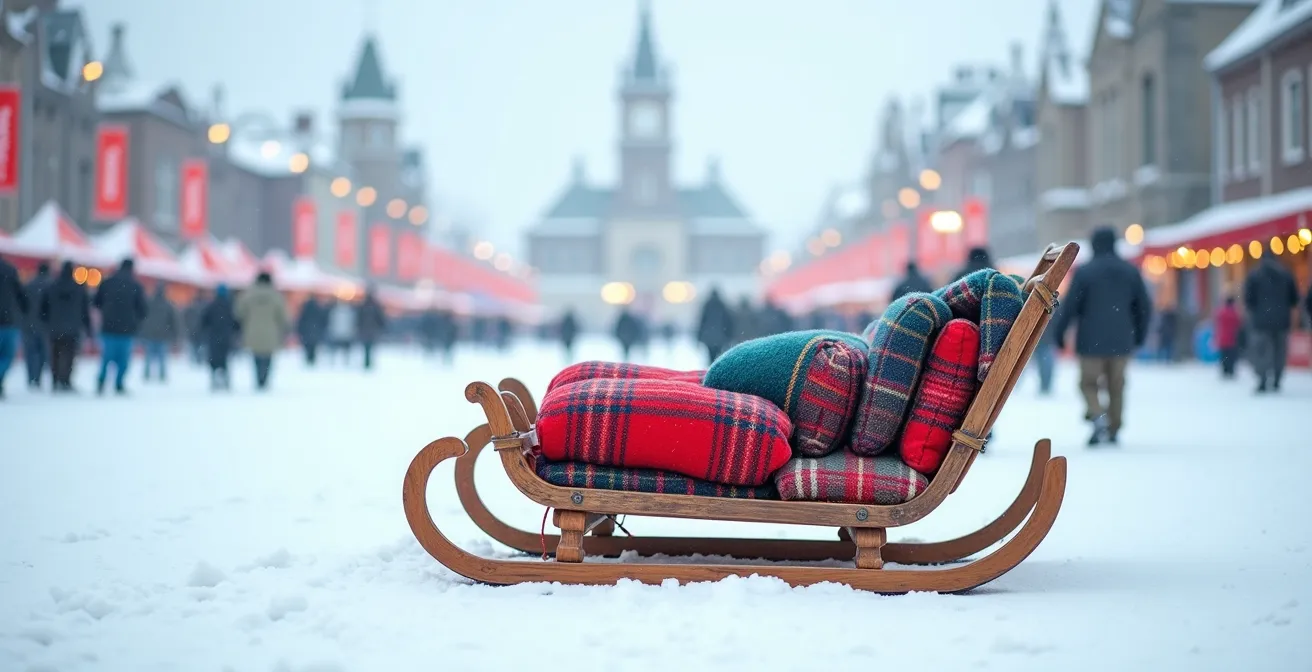
This isn’t just a theory; it’s an observation you’ll make within five minutes of arriving. As one family traveler noted, it’s a common and practical sight:
Throughout the festival, we saw families with babies, toddlers, and young kids — many of which were being pulled through the area on sleds (I guess that’s the Quebec version of a winter stroller)
– Tamara, We3Travel
Making the sled work for you requires a little planning. Here’s a quick guide to making the right choice:
- A sled is superior for parade viewing as it elevates kids for better visibility.
- Choose an all-terrain stroller only if your day involves many indoor stops (like shopping on Rue Saint-Jean), where a sled is cumbersome.
- For parade comfort, equip your sled with a high back and plenty of cushions and blankets.
- When choosing a sled, consider a lightweight model that can be easily carried if you do find yourself on cleared sidewalks for a long stretch.
Embrace the local culture. Rent or buy a simple plastic sled upon arrival. It will be the best ten dollars you spend, saving your back and giving your kids the best seat in the house.
The Danger of Walking on the Walls During Icy Conditions
The fortifications of Old Quebec are a magnificent historical landmark, and walking along the top of them offers breathtaking views of the city. It’s tempting to climb up there for that perfect family photo with the Château Frontenac in the background. However, during Carnival, this can be a genuinely hazardous idea, especially with children.
The tops of the walls are exposed, often windswept, and can be covered in sheer, slippery ice. There are few railings, and a slip could be disastrous. The official guidance for the Carnival itself highlights the challenges of the terrain, stating that “since the site is outside in snow and ice, there is no special wheelchair access”, which underscores the uneven and often treacherous footing throughout the area. The walls are no exception. For a parent holding a child’s hand or trying to keep a toddler from running off, the risk is simply not worth it.
But that doesn’t mean you have to miss out on those iconic views! The key is knowing the safer, ground-level alternatives that offer equally spectacular photo opportunities without the danger. These are the spots the locals use.
Here are some safe and accessible vantage points for those perfect family photos:
- Pierre-Dugua-De-Mons Terrace: Located right next to the Château Frontenac, this wide, ground-level area offers the same stunning river views with no elevation risk.
- The Plains of Abraham: These vast, open fields provide a beautiful city backdrop and plenty of space for kids to run around safely in the snow.
- Dufferin Terrace: The famous boardwalk in front of the Château is wide, well-maintained, and has robust safety railings.
- Place Royale: For historic charm, the heart of the Lower Town provides a fairy-tale setting without any dangerous heights.
If you are determined to walk in potentially icy areas, do yourself a favor: stop at a Canadian Tire or SAIL sports store and buy a cheap pair of ice grippers or crampons for your boots. It’s a small investment for a massive gain in safety and confidence.
Key takeaways
- The key to a successful trip is logistical planning, focusing on warmth, transport, and strategic rest.
- A sled is almost always a better choice than a stroller for navigating snow-covered Carnival sites and parades.
- Staying inside the Old City walls, while more expensive, provides crucial convenience for families with young children needing naps and breaks.
What to Do at the Resort If You Don’t Ski?
Many families combine a trip to the Carnival with a stay at one of the beautiful ski resorts surrounding Quebec City, like Mont-Sainte-Anne or Stoneham. But what if your family members aren’t all skiers? The great news is that these resorts have become winter wonderlands in their own right, offering a perfect complement to the urban festivities of the Carnival.
You can easily create a “best of both worlds” vacation. Spend a day or two immersed in the Carnival crowds, then retreat to your resort for a different kind of winter fun. These resorts are often packed with family-friendly activities that don’t require a pair of skis. Think outdoor skating rinks, snowshoeing trails, and cozy lodges with fireplaces and hot tubs—the perfect way to warm up after a cold day in the city.
For a truly epic non-skiing adventure, consider a day trip to a dedicated winter playground. For instance, the Valcartier Village Vacances is a highlight for many families. Located just 35 minutes from the city, it boasts the largest tubing park many have ever seen, with everything from gentle slopes for toddlers to the “Everest” slide, which reaches speeds of 80 kilometers per hour. Activities like snow rafting allow the whole family to slide down together, making it a fantastic bonding experience.
This resort-based strategy allows you to dip into the Carnival for its most iconic moments (like a parade or a walk through the ice sculptures) without committing to multiple days of intense cold and crowds. It provides a balanced vacation with a mix of high-energy city fun and more relaxed resort-style winter activities.
How to Visit Old Quebec’s Fortifications With Limited Mobility?
While the title mentions “limited mobility,” for a family with young children, this translates to “stroller mobility” or “toddler-leg mobility.” Old Quebec is a UNESCO World Heritage site, which means it’s historic, beautiful, and full of steep hills, narrow sidewalks, and lots of stairs. Navigating it can be a workout. The 10-20 minute walks required from many hotels can feel like an eternity with a tired child. But don’t be intimidated; the city has some fantastic logistical secrets that make it surprisingly manageable.
Your number one enemy will be the steep hill connecting the Upper Town (where the Château Frontenac is) and the Lower Town (Place Royale). Trying to push a stroller up that hill is a Herculean task. The “Escalier Casse-Cou” (Breakneck Stairs) are a picturesque landmark, but completely impossible with a stroller. Your mission is to avoid these obstacles by using the city’s built-in shortcuts.
This is the kind of insider knowledge that transforms your day from a struggle into a delight. Knowing where to find an elevator or a clean, warm changing table is a core part of your logistical mastery. Arm yourself with this knowledge before you go.
Here are the essential accessibility tools for any family navigating Old Quebec:
- Use the Funicular to travel between Upper and Lower Town. It costs a few dollars but saves your legs and sanity.
- Take advantage of the free Ascenseur du Faubourg, an elevator that provides another crucial vertical link.
- Find heated, accessible public washrooms on the ground floor of City Hall (Hôtel de Ville).
- For baby care, there are excellent changing tables at the Fairmont Le Château Frontenac and the Musée de la Civilisation.
- Absolutely avoid the “Escalier Casse-Cou” if you have a stroller or a child you might have to carry.
By using these tools, you can explore the city’s stunning fortifications and historic streets without exhausting your family. It’s about working smarter, not harder, and using the city’s infrastructure to your advantage.
With the right preparation and a strategic mindset, you can do more than just survive the Quebec Winter Carnival—you can conquer it. By focusing on warmth, smart logistics, and strategic retreats, you’ll be free to embrace the magic and create unforgettable memories with your family. Now, go plan your adventure with confidence!
Frequently Asked Questions about the Quebec Winter Carnival
Can we experience Carnival atmosphere without going to Quebec City?
Many Quebec ski resorts offer carnival-themed activities like outdoor skating, tubing, and on-site maple taffy on snow during winter.
How long does it take to drive from Mont-Sainte-Anne to the Carnival?
Mont-Sainte-Anne is approximately 40 kilometers from Quebec City, making it an easy day trip for Carnival highlights.
What resort amenities help families recover from cold Carnival days?
Resort amenities like indoor pools, hot tubs, and fireplace lounges provide the perfect warm-up after cold carnival excursions.